dailynewsnblog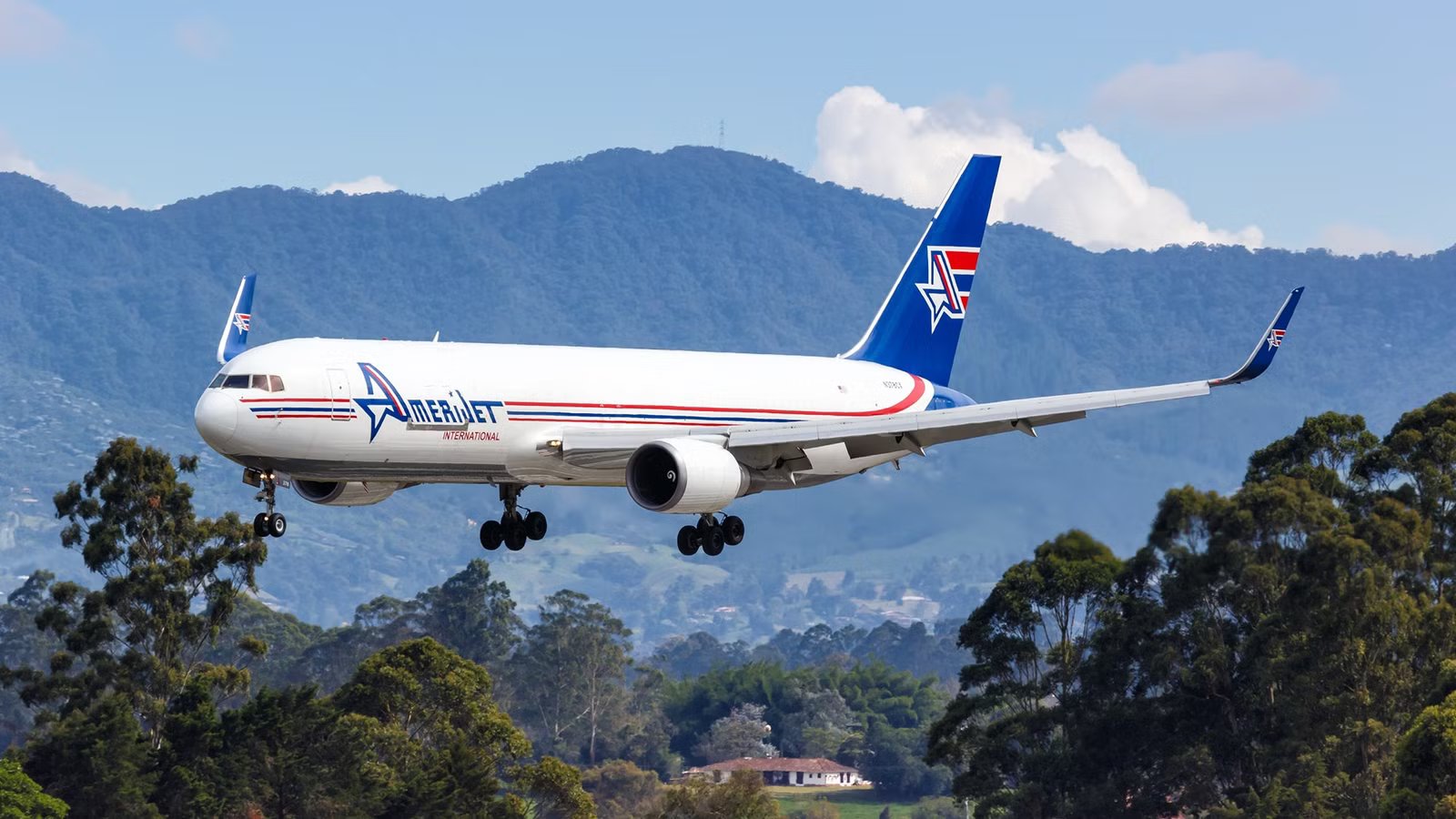
United States cargo carrier Amerijet International has seen one of its Boeing 767-300F aircraft sustain fuselage damage after a hard landing at Guatemala City’s La Aurora International Airport (GUA). The flight, which was operating as M6 8743, arrived in Guatemala after being directed during a flight from  Miami International Airport (MIA) to San Juan (SJU).
The airplane, which carries registration N373CM, landed on Guatemala’s Runway 02/20 when it struck the ground, leading to a visible crease and buckle on the upper forward fuselage. The jet remains grounded in Guatemala while the damage is assessed.
Flight M6 8743 Diverted To Guatemala

According to reports, the Amerijet flight was operating between Miami and San Juan on Sunday, September 6, when the plane was required to divert for an unknown reason to Guatemala City. As the plane came into land, it suffered a hard landing, leading to fuselage damage.
It is believed that the plane landed nosewheel first, and the damage to the fuselage, crimping on the top of the frame, is a common side effect of this type of hard landing. Flight360aero confirms the plane sustained ‘Buckle Damage, Top Fuselage, STA 650 S14L to S14R.’
Simple Flying reached out to Amerijet International for comment; however, an airline spokesperson could not immediately be reached.
Flight Details On September 6

Reviewing flight data shows that the nearly 36-year-old jet had departed from Miami on the evening of September 6 at 11:19 PM, more than two hours behind its initial scheduled departure time of 9:00 PM. The flight was expected to arrive in San Juan that evening at 11:35 PM with a three-hour, ten-minute estimated flight time.
After two hours and 11 minutes, the aircraft diverted to Guatemala City, where it sustained damage during landing. At this time, the aircraft remains grounded, with no scheduled onward flights. Guatemala’s La Aurora Airport is the busiest in the country, and fourth busiest in Central America. It is located just 16 miles (25 km) from downtown Guatemala City. The airport has just one runway, 02/20, with a length of 9,800 feet (2,987 m). In 2024, the airport recorded 4.9 million passengers.
If an aircraft experiences a nose-forward hard landing, this is when the nose wheel strikes the runway before the main landing gear. If this occurs, it can lead to mechanical stress and structural failure to the front of the airframe. The nose gear is not designed to carry the full weight of the aircraft, so it can lead to it buckling, or in some instances snapping. The downward force transmits directly into the forward fuselage of the plane, which results in bending of bulkheads or the aircraft firewall.
Amerijet Boeing 767-300F Aircraft Details: N373CM

The plane at the center of the incident is that of 35.8-year-old N373CM, where data from ch-aviation identifies it as a jet that first took flight in 1990. The plane is a 767-338ERBDSF cargo jet that initially flew as a passenger aircraft for Qantas when delivered to the Australian flag carrier in December 1990. The plane at that time carried the nickname ‘City of Rockhampton’.
Flying for Qantas for nearly 25 years, the aircraft was subsequently sold to Miami-based Amerijet International, where it was converted to a freighter aircraft. The jet was acquired by Amerijet on December 4, 2015, and has since operated exclusively for the cargo carrier to destinations throughout its international and domestic network. Further aircraft details outlined below:
Aircraft Registration | N373CM |
|---|---|
Serial Number (MSN) | 24929 |
Aircraft Type | Boeing 767-338 ERBDSF |
Plane Age | 35.8 years |
First Test Flight Date | November 27, 1990 |
Delivery Date |
|
Hex Code | A43F2E |
Engines | Two General Electric CF6-80C2B6 |
It is one of 11 767-300F freighters for Amerijet, a fleet that is made up solely of this type. Alongside the airline’s operations from Miami, the carrier also maintains a hub at Piarco International Airport (POS) in Trinidad and Tobago. According to the carrier’s website, it operates to more than 48 destinations worldwide.