dailynewsnblog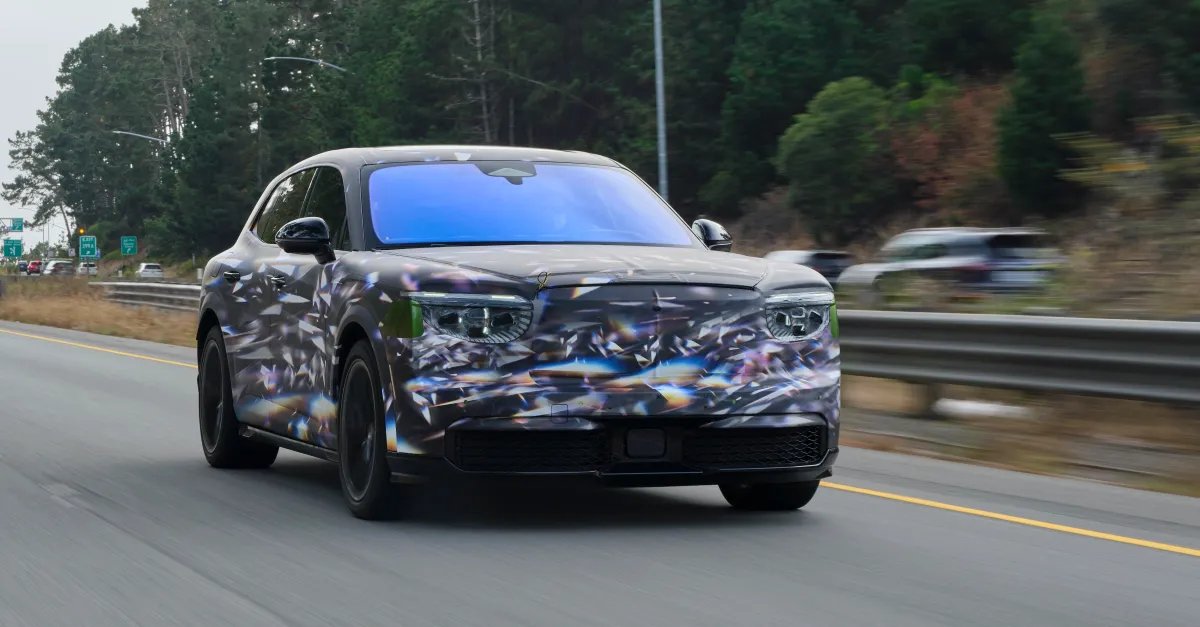
Thanks to their ability to provide a smooth ride and quiet powertrain with ease, electric vehicles are a true shoo-in for the high-end luxury automotive segment. Rolls-Royce has the Spectre, Cadillac’s Celestiq is taking bespoke to a whole new level, and Mercedes has given the EQS the full Maybach treatment. From Volkswagen Auto Group, Bentley is just about to debut its 2027 Torcal, a spacious SUV that shares a platform with the electrified Porsche Cayenne.
I recently got a quick ride in a heavily camouflaged preproduction Torcal as a way to experience it before its official debut toward the end of this month. Between this brute’s spacious interior, supple ride quality, and focus on craftsmanship in the digital age, all signs point to it not just being a viable competitor in the segment, but also characteristically Bentley.
When I say heavily camouflaged, this not only covers (pun intended) the Torcal’s exterior, but the interior as well. Thick black cloth was draped over most of it, to the point of the engineers punching holes in the cloth for proper seatbelt usage. The exterior was rather deceiving, too; apparently they affixed false body paneling under the wrap so as not to fully spoil its overall shape and profile. Upon first glance, it seemed like Bentley took a page from Lucid’s Gravity by making it wider at the front than at the back—in the name of teardrop-resembling aerodynamics—but Martin Page, the Torcal’s product line director-slash-chauffeur for my ride, assured me that what I was seeing (or rather, trying to see) wouldn’t be production.
However, this enabled me to zero in closer on what I could feel and hear. Whether up front or in back, the Torcal is amply spacious, even though it’s noticeably smaller in size and shape than Bentley’s current Bentayga. Page explained the great lengths that engineers reached to ensure it had an isolating and tremendously smooth ride. Running off-the-shelf two-chamber air suspension — common in the rest of the brand’s lineup — would seemingly suffice with an EV’s inherently good chassis balance, but engineers took it a step further by carefully altering the flow of oil through its adaptive dampers. This means that the jump in ride and handling between Comfort and Sport modes is much more discernible. No matter the mode, it rode incredibly smoothly. Heavy focus was paid to the Torcal’s alignment, too, with steering that returns to and maintains center as confidently as possible.
Diving deeper into signature Bentley characteristics, developing the best simulated engine note was high on the list of priorities. Inspiration came from the brand’s V8-powered Turbo R of the 1980s, except the track itself was recorded by a musician’s drum beat and mixed accordingly, rather than simply churned out from a synthesizer.
“What we wanted to do throughout the car is maintain craftsmanship, not only in the materials but also in the way we execute the digital aspects,” Page shared.
“What we wanted to do throughout the car is maintain craftsmanship, not only in the materials but also in the way we execute the digital aspects.”
— Martin Page, Torcal’s product line director
The reasoning behind this lies in hearing subtle imperfections, much like one would from an analogue internal combustion powertrain. Going one step further, the Torcal’s throttle tuning seemed to mimic a torquey V8 with progressive power delivery. In light of this, Page added that with this sound turned on, it gives occupants auditory cues to tie to the vehicle’s torque delivery, which is known to help reduce motion sickness. The sound has not yet been finalized and is still being finely tweaked at the time of this writing.
I got a peek at the digital instrument cluster and center infotainment screen — Page had to observe the speed limit, after all. The image these display in the background is of a fine crystal decanter hand-cut by Cumbria Crystal with light shone through it. In Page’s words, this shows the natural refractions and reflections that you get from every one of the cuts. It’s another indication of the brand’s focus on craftsmanship in the digital age, albeit a subtle one.
It’s also worth pointing out that Bentley takes net environmental impact seriously. “In this car we take sustainability to another level, we have clear targets for circular material and green aluminum,” Page shared. “The door cards are made with a natural fiber — not injection-molded plastic — that’s fully recyclable and fully sustainable.”
Then, Bentley is working with fellow UK company Fox Brothers to offer a Merino wool interior option, not just as a lesser-taken route for comfort (Volvo’s done well with wool, too) but also as a sturdy, renewable material that will hold up to automotive use. Finally, the assembly plant in Crewe, England, has tough requirements for green energy use (namely solar) and other renewable practices.
Output, battery, and charging specs are not carved into stone just yet. Power will be north of 800 hp and 700 lb ft of torque, and curb weight is estimated to be nearly 6,000 lbs. Page was quiet about battery size (though, expect it to mirror the Porsche’s 108 net kWh unit), and the targeted range is over 370 miles. With a peak charging rate of 400 kW, the brand is aiming for a 10–80 percent top-up in under 20 minutes, with 100 miles tacking on in as little as seven.
“We’re trying to be authentic in the whole experience,” Page summed up as we headed back to the parking lot where I met him.
The approach with the Torcal is to make a great Bentley first, and in the process of doing so, a great EV. It combines some already hashed-out tech from Volkswagen, but the brand is hoping its focus on craftsmanship and fine-tuning will attract discerning, well-heeled potential customers who want an electric luxury vehicle. Pricing hasn’t been announced yet, but it will be interesting to see how the Torcal is received after its full official unveiling.