dailynewsnblog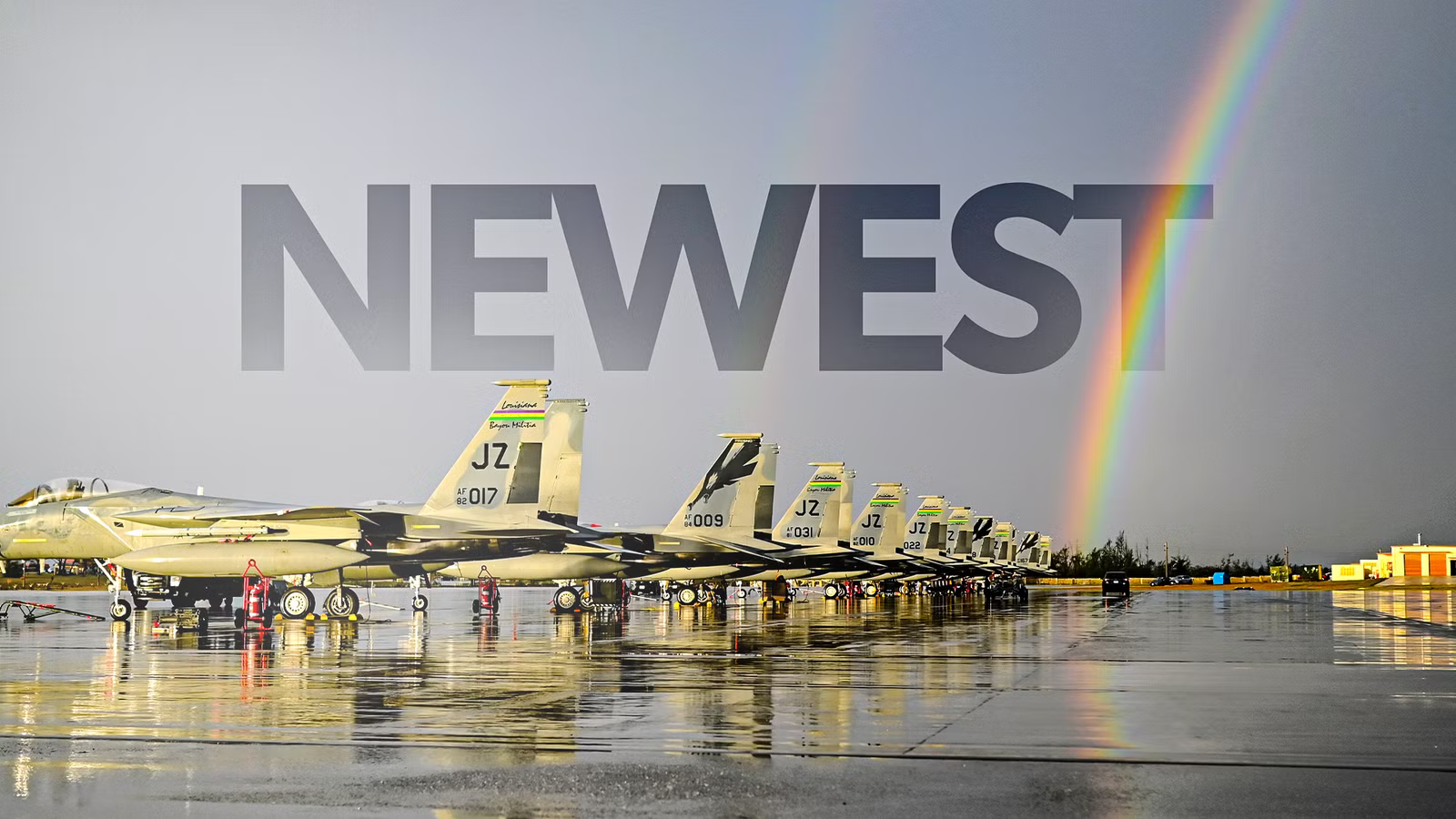
For this article, ‘Pacific air bases’ are bases in the Eastern Pacific, Hawaii, Australia, and Alaska, but not the mainland US West Coast. This is because bases in Alaska and Australia are close enough to be consequential in a future conflict in the region. In fact, some consider Alaska to be one of the most, or the most, important locations for the US Air Force’s Pacific posture. This article will also consider places in the Pacific that host rotational US fighter jet units.
It is important to note that while only seven airbases (two each in Japan, Korea, Alaska, and one in Hawaii) permanently host United States Air Force (USAF) fighter jets, dozens of airbases, airports, and airfields are part of its strategic planning. Many of these host exercises, while others are currently being rehabilitated after being largely abandoned over the years. Some have been abandoned by the US military since the end of WWII.
US Air Force Bases In Japan

Multiple bases in Japan permanently host US fighter jets. The most important of these is Kadena Air Base in the southern Okinawa islands. On its official website, Kadena Air Base describes itself as “the hub of airpower in the Pacific, and home to the 18th Wing and a variety of associate units. Together they form ‘Team Kadena’ — a world-class combat team ready to fight and win from the Keystone of the Pacific.”
Currently, the base’s permanent fighter jet complement is made up of legacy F-15C/Ds. However, these are currently in the process of being replaced by new F-15EX Eagle IIs. In July 2026, the Air Force reported that the F-15EX returned to Kadena, marking the “next phase” of the effort to replace the base’s aging F-15C/D fighters. Another major US Air Force base in Japan is Misawa Air Base, which is in the process of transitioning from legacy F-16C/Ds to F-35A stealth fighters.
Catch what other flight trackers miss
Emergency squawks, holds, NOTAMs — live signals, no signup.
Open tracker
Catch what other flight trackers miss
Emergency squawks, holds, NOTAMs — live signals, no signup.
Open tracker
Meanwhile, the US Marine Corps has F-35Bs stationed at MCAS Iwakuni, while the US Navy has F-35Cs, F/A-18E Super Hornets, and EA-18G Growlers there. It is the only permanently forward-deployed US aircraft carrier air wing in the world. Yokota Air Base is the headquarters of US Forces Japan and Fifth Air Force, but it doesn’t have permanent fighter jet squadrons. Instead, it mostly serves as an airlift, command, and special operations base.
US Air Force Bases In South Korea

South Korea has two bases that are home to permanent US Air Force fighter jet squadrons. These are based at Korea’s Osan Air Base and Kunsan Air Base. Both of these airbases host F-16C/D Fighting Falcons and not the newer and heavier F-35As or F-15EXs. Osan is the US’s principal air base in Korea and is the headquarters of the Seventh Air Force.
Osan’s squadrons are the 25th Fighter Squadron and the 36th Fighter Squadron, of which the 36th has been expanded into a larger ‘super squadron.’ This is part of an Air Force effort to test whether bigger squadrons can generate more sorties with fewer support resources. The two fighter jet squadrons based at Kunsan are the 35th Fighter Squadron and the 80th Fighter Squadron.
Countries/states with permanent USAF fighter jet presence | Airbases (per USAF) | Fighter jet types | Approx. number permanently stationed |
|---|---|---|---|
Japan | Kadena Air Base, Misawa Air Base | F-15C/D, F-15EX, F-35A, F-16C/D | 84 (planned) |
South Korea | Osan Air Base, Kunsan Air Base | F-16C/D | 80 to 90 |
Alaska | Joint Base Elmendorf–Richardson, Eielson Air Force Base | F-22, F-35A | Around 100 |
Hawaii | Joint Base Pearl Harbor–Hickam | F-22 | 40-50 |
Osan Air Base likely hosts between 40 and 50 F-16s, while the two squadrons at Kunsan add around 46 more. In all, South Korea permanently hosts around 80 to 90 US fighter jets (all F-16s). The US Air Force completed this final withdrawal and divestment of its 24 A-10 Thunderbolt II ‘Warthog’ ground attack jets from Osan’s 25th Fighter Squadron in July 2025. This ended the Warthog’s permanent presence on the peninsula.
US Territory Of Guam

Perhaps surprising to many, Guam does not host a permanent fighter base in the traditional sense. Guam’s Andersen Air Force Base is designed as a strategic air hub able to accommodate all US Air Force military aircraft from strategic bombers through to F-22 Raptors. Various units are regularly rotated through Andersen for exercises and other missions, but none are permanently based there.
While there are no permanent fighter squadrons on Guam, it is common to see F-22s, F-35s, F-15s, strategic bombers (e.g., B-2s, B-52s), and other aircraft, including many airlift units, rotating through it. The US Navy often deploys MH-60S helicopters to Andersen, while other units can be found at Naval Base Guam. Marine Corps Base Camp Blaz likewise does not permanently host fighter jets, but there are rotational F-35B deployments.
In the event of a high-end conflict in the Eastern Pacific, Andersen is expected to be a focal point. Its mission is to receive and sustain deployed aircraft from across the Air Force, and it is a base that is close enough to China to be consequential, while also being far enough away to complicate efforts to hit it. Land-launched missiles need to have an intermediate range, about 1,800 to 2,500 miles (3,000 to 4,000 km), placing it out of range of many shorter-range systems.
Other Eastern Pacific Air Bases

Outside of Alaska, Hawaii, South Korea, and Japan, no other places have a permanent US fighter jet presence, although there are many airbases where the US is restoring bases, dual-use international airports, and airstrips for its Agile Combat Employment doctrine. This is the plan to disperse operations and keep those assets constantly moving in the event that Andersen comes under sustained attack.
Perhaps most notable are US efforts to rehabilitate Tinian Island’s abandoned North Field in the Northern Mariana Islands. This was one of the largest and most important US air bases in the Pacific War. It is also upgrading the international airport on the island. Rota Airport and Saipan International Airport also fit into the US Air Force’s planning.
Elsewhere, Palau’s southern WWII-era Peleliu airstrip is closed as it is being upgraded. Palau’s Angaur airstrip and its main international airport are also part of the Air Force’s ACE planning. In the Federated States of Micronesia, the Air Force has plans to significantly upgrade the island state of Yap’s airport, besides other airstrips, like Micronesia’s Ulithi Airport. The Air Force is upgrading Guam as well, with expansions to Andersen, revitalization of North Field, and renewed military interest in Claasson-Apra Regional Airfield and the main Guam International Airport.
The States Of Hawaii & Alaska

The only base in Hawaii to permanently host fighter jets is Joint Base Pearl Harbor–Hickam, which hosts F-22 Raptors. The US Navy deploys fighter jets to Pearl Harbor and the Marine Corps to Marine Corps Base Hawaii, but they don’t have permanent fighter jets or permanent land-based fighter squadrons based there. The Marines do have assets like CV-22 Ospreys permanently based there; the Navy bases its fighter jets at NAS Lemoore in California.
The two fighter squadrons on the island state are the 19th Fighter Squadron (active US Air Force) and the 199th Fighter Squadron (Hawaii Air National Guard). Together they operate around 40–50 F-22s, which is a large share of the operational fleet. Alaska is potentially the most important US fighter-base location in the entire Pacific.
Fighter jets are based at Joint Base Elmendorf–Richardson and Eielson Air Force Base. Elmendorf-Richardson at Anchorage has two F-22 squadrons (the 90th and 525th), while Eielson has two combat-coded F-35A squadrons (the 355th and 356th). Together, these make up around 100 F-22 and F-35A fighter jets. Separately, the US Air Force does not permanently station fighter jets in Taiwan, and any presence there is very limited and deliberately ambiguous, largely centered on training. A US Congress document says, “it is an ‘open secret’ that small numbers of U.S. military personnel conduct work in an advisory capacity on the island.”
The Philippines & Australia

Australia has become important for US Air Force Agile Combat Employment planning, but differently from the small islands around Guam. Australia’s strategic value is more about basing the strategic bomber fleet, rather than fighter jets. Guam is considered uncomfortably close to China to protect the bombers on the ground. Australia is considered far enough away to be easier to protect, while also being close enough to generate a reasonable sortie rate (unlike the mainland United States).
The US and Australia are upgrading RAAF Tindal and RAAF Darwin, while considering upgrading RAAF Amberley. These bases host US fighter jets during exercises, etc., but the main thrust is bombers. Another important country is the Philippines. The Philippine Senate voted to reject a new treaty extending the US military bases on September 16, 1991, with the last permanent US units departing in 1992.
However, the countries signed another important treaty with the US that allows the US to use its bases temporarily. While no US fighter jets are permanently based in the Philippines, the US has nine EDCA-agreed locations (four were added in 2023). This gives the US rotational access to Philippine facilities, but does not transfer ownership or establish permanent US bases. Even without permanent bases, the country is an important part of Air Force strategic planning in the Eastern Pacific.