dailynewsnblog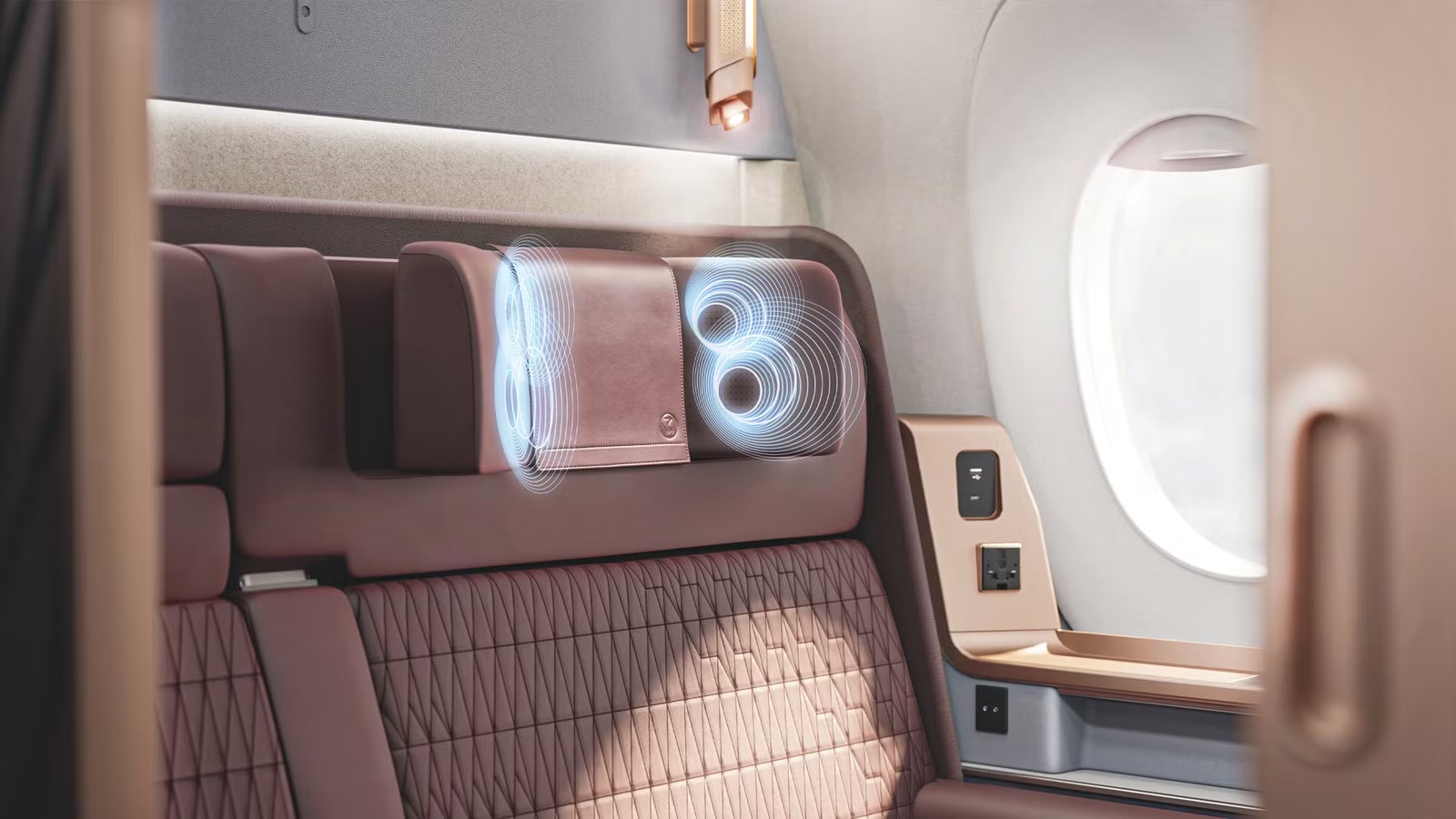
When Japan Airlines unveiled its flagship Airbus A350-1000 cabin featuring headrest-embedded speakers in place of traditional headsets, the marketing promised a silent revolution in passenger comfort. The technology, integrated into six first class suites and 54 business class seats, aims to liberate premium travellers from clamping earcups and tangled cords. Behind the sleek design is a very obvious limitation: an open-air audio system attempting to deliver private concert-hall sound inside an aircraft cabin, with the sound of two massive turbofan engines competing, most definitely struggles to do what it is designed to achieve.
The central question facing both airline executives and frequent flyers is whether an ambient headrest system can ever replace active noise cancellation on commercial flights. Developed through a partnership between seat manufacturer Safran Seats and audio engineering specialist Devialet, the Euphony system relies on digital signal processing rather than isolation. JAL is expanding its A350-1000 fleet across long-haul flagship routes like  Tokyo Haneda Airport (HND) to
  London Heathrow Airport (LHR), and passengers are discovering that acoustic physics places severe limits on what marketing claims can deliver.
A Speaker Against An Engine

Headrest speakers are undoubtedly a unique and forward-thinking piece of technological innovation, but until exterior engine sound can be reduced significantly, the engines will always win. Devialet embedded two specialized micro-drivers into the headrest structure, using algorithms designed to adjust volume and frequency based on ambient background sound. However, unlike traditional headphones that create an airtight seal around the ear canal, open-air speakers cannot generate phase-inverted anti-noise signals directly at the eardrum to cancel low-frequency jet engine drone.
In a commercial cabin cruising with background noise levels near 75 dB to 85 dB, an open-air speaker placed 3 inches (8 cm) from a passenger’s ear does not have the best clarity. To cut through the persistent ambient rumble of airflow and turbofans, the system must boost midrange frequencies, which often leaves music and cinematic audio sounding thin or tinny. Increasing the volume further causes directional sound waves to spill across the aisle, compromising the very privacy that premium suite doors were installed to provide.
This compromise leaves JAL with a headrest audio system as an optional secondary amenity rather than a true replacement for premium noise-canceling hardware. Leaving traditional wired headphones in every suite alongside Bluetooth connectivity, the airline implicitly acknowledges that headrest speakers serve best during casual meal services or light viewing.
An Interesting Reason For This Technology

The decision to invest in headrest audio comes less from acoustic perfection and more from long-haul ergonomic friction. On flights lasting over 14 hours, wearing traditional active noise-canceling headsets produces noticeable ear pressure, thermal discomfort, and physical fatigue. Passenger reviews and JAL specifications emphasize that headrest speakers eliminate hardware clamping entirely, allowing travellers to lie on their side in bed mode while listening to audio without an earcup pressing uncomfortably into their skull.
Beyond sleeping comfort, headrest audio resolves a key friction point during inflight hospitality. Wearing heavy noise-canceling headphones isolates passengers from cabin crew, where travelers repeatedly remove and adjust hardware whenever flight attendants present dishes, drinks, or hot towels. The system enables effortless communication between crew and passengers, aligning with traditional Japanese service philosophy. Flight testing reports from Aviation Wire confirm that when seated inside the private suite, near-field audio containment keeps sound bleed into adjacent aisles negligible at normal listening levels.
Headrest speakers excel during meal service and quiet rest, but their performance relies heavily on the enclosure of the cabin to contain sound and maintain privacy. This acoustic dependency turns attention directly to the structural design and spatial dimensions of the underlying seat platform.
Setting The Bar High

Japan Airlines addresses the limitations of headrest audio by surrounding the speaker array with an expansive private suite structure. Deploying its flagship A350-1000 double-daily on the Tokyo Haneda (HND) to London Heathrow (LHR) corridor starting October 1, 2026, the carrier is replacing the Boeing 777-300ER and the widely praised Boeing 787-8 on flights JL41/JL42 alongside JL43/JL44. Combining high suite walls with acoustic absorption materials, the aim is to reduce sound spilling into adjacent aisles as much as possible.
The first class cabin scales down capacity to just six suites arranged in a 1-1-1 configuration, prioritizing personal space over seat density. Each suite features 62 in (157 cm) high walls with closing doors, a maximum seat width of 48 in (123 cm), and a fully flat bed extending to 80 in (203 cm). Passengers can adjust the living space across three distinct seating modes: sofa, single bed with seat, or double bed, while viewing a 43 in 4K monitor. Behind first class, the 54 business class suites utilize 52 in (132 cm) walls, sliding privacy doors, and 24 in 4K screens, ensuring that near-field audio containment remains effective throughout the forward cabins.
Cabin Class | Suite Capacity and Layout | Wall Height | Bed Length and Seat Width | Screen Size |
First Class | 6 suites (1-1-1) | 62 inches (157 cm) | 80 in (203 cm) length; 48 inches (123 cm) width | 43 inches 4K |
Business Class | 54 suites (1-2-1) | 52 inches (132 cm) | 78 in (198 cm) length; 22 inches (56 cm) width | 24 inches 4K |
While these physical dimensions provide the structural isolation necessary for headrest speakers to function, they also place JAL in direct competition with the most prestigious commercial cabins in aviation. Matching enclosed suite geometry against global rivals raises the question of whether a six-seat residential layout can establish a new benchmark for ultra-luxury travel.
Differing Ideologies For A Modern First Class

Benchmarking JAL’s flagship first class against premier international competitors shows just how acoustic engineering and spatial geometry shape hard product design.  Singapore Airlines utilizes the upper deck of the Airbus A380 to offer 50 sq feet (4.6 sq meters) per suite, separating a swivel armchair from a 27 inches (69 cm) wide standalone bed, but pairs the space with a smaller 32 in screen and traditional active noise-canceling headphones, as per Travel Weekly.
  Emirates takes privacy to its limit on select 777-300ER aircraft with floor-to-ceiling doors rising 81 in (205 cm), NASA-inspired zero-gravity seating, and active noise-canceling Bowers & Wilkins headsets, reported by New Atlas.
This contrast reflects differing priorities regarding passenger interaction and entertainment integration. Where Emirates relies on total enclosure, requiring virtual windows for middle suites, and Singapore splits its footprint between two separate furniture pieces, JAL maximizes usable lounging area on a single surface. Choosing partial-height suite doors preserves natural cabin airflow and line-of-sight visibility for cabin crew, maintaining attentive service while giving Safran-Devialet headrest speakers enough acoustic breathing room to operate without feeling claustrophobic.
The spatial balance proves that modern twin-engine aircraft can challenge quad-jet superjumbos in cabin efficiency without sacrificing comfort. With the integration of high-definition displays and near-field audio into a single flexible living space, JAL delivers an alternative to traditional enclosed suites. Airlines are, however, re-evaluating multi-class economics on longer long-haul routes, and so the success of this flagship suite strategy depends heavily on how premium hospitality touches are expanded beyond the elite first class cabin.
The Rest Of The Cabin Is Getting Premium Attention

Extending premium soft product amenities beyond the elite forward suites is what transforms the A350-1000 from a niche flagship showcase into an end-to-end brand ambassador on competitive long-haul corridors. While major European and North American carriers increasingly unbundle economy fares and charge for basic perks, Japan Airlines is firmly set on retaining the all-inclusive model that was once commonplace across the world.
Helping to cement this strategy is introducing Hakurakusei Junmai Ginjo sake, crafted by Niizawa Sake Brewery in Miyagi Prefecture, into premium economy and economy cabins on the London route starting October 1, 2026. Renowned in Japan as the pioneer of shokuchūshu, sake specifically brewed to complement food rather than dominate the palate, its service brings high-end Japanese dining culture to the rear of the cabin. Offering an award-winning craft beverage usually restricted to premium lounges across all four service tiers establishes a distinct hospitality halo that hardware seat metrics alone cannot replicate.
With long-haul carriers balancing rising fuel costs against passenger retention, JAL’s decision to pair elite hardware in the front with improved service in the back tests whether full-service hospitality can survive modern margin pressures. As a result, will competitor airlines now have to rethink their economy service cuts or remain reliant solely on high-margin forward suites?
Current Problems But Future Promise

The integration of headrest-embedded near-field speakers is a subtle yet significant change in how airlines approach acoustic cabin design. It is now possible to move personal audio away from clamping noise-cancelling headphones and directly into the seat structure, removing friction points on ultra-long-haul flights. This transition changes the cabin audio dynamic, offering passengers greater freedom of movement while preserving acoustic privacy inside individual suites.
Japan Airlines is signaling that the A350-1000 is ready to take over its network on a larger scale, especially with the adjustment of aircraft on some of its most valuable routes. Over the coming years, airline product planners across the globe will evaluate whether the Safran Devialet Euphony system justifies its seat integration weight and maintenance overhead through elevated passenger satisfaction scores. It most definitely has its downsides, but as Japan Airlines has shown, the cabin environment it is placed in can make the technology far more usable if built correctly.
As onboard inflight entertainment hardware continues to integrate higher resolution wireless connectivity, near-field audio stands at a pivotal junction. If component costs decline and seat manufacturers streamline electrical harness design, headrest speakers could gradually migrate from exclusive first and business class suites into premium economy cabins. Aviation industry observers will be watching closely to see whether cabin noise isolation gives way to individual acoustic zones across commercial flight decks and passenger cabins alike.