dailynewsnblog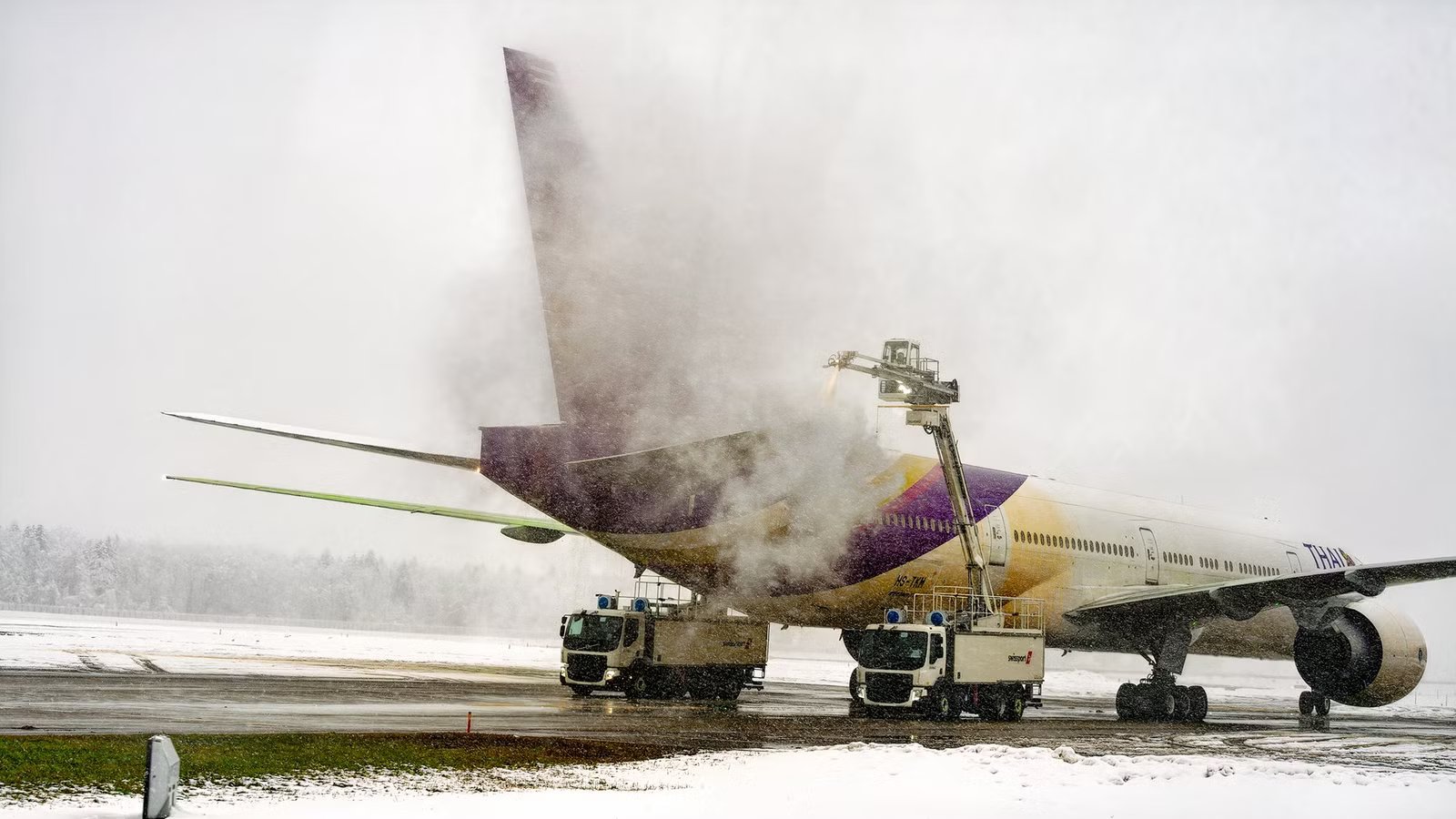
When temperatures drop below freezing at airports across the northern United States, Canada, and Europe, commercial aircraft cannot depart until every trace of ice, snow, and frost has been removed from their wings, tail surfaces, and control surfaces. The FAA’s clean aircraft concept makes this an absolute requirement. Specialized trucks spray heated glycol-based fluids onto the aircraft at high pressure, followed by a thicker anti-icing coating that protects the surfaces while the aircraft taxis to the runway. For a widebody like the Boeing 777-300ER, with a wingspan of 212 feet, 7 inches (64.8 meters) and over 4,600 square feet (427.8 sq meters) of wing area, the process consumes hundreds of gallons of fluid and costs thousands of dollars per application.
Airlines operating hubs at  Chicago O’Hare International Airport(ORD), Minneapolis-St. Paul (MSP), Denver (DEN), and Toronto Pearson (YYZ) de-ice hundreds of aircraft per day during winter storms, consuming millions of gallons of fluid per season at costs that can reach $30-50 million per carrier per winter. Here is why ice on an aircraft is dangerous, how the four types of de-icing and anti-icing fluid work, what a single de-icing event on a 777 actually costs, and how those costs add up across a full winter season.
Why Ice On An Aircraft Is A Safety Problem

Ice accumulation on an aircraft’s wing changes the shape of the airfoil. A wing generates lift because of its curved upper surface and the angle at which it meets the oncoming air. Even a thin layer of frost or ice on the leading edge or upper surface disrupts the smooth airflow that produces lift, creating turbulent separation earlier along the chord than the wing was designed to tolerate. The result is reduced lift at any given airspeed and an increase in the speed at which the wing stalls. NASA research has shown that ice contamination as thin as a piece of coarse sandpaper on the leading edge of a wing can reduce lift by up to 30% and increase drag by up to 40%.
The effect extends beyond the wings. Ice on the horizontal stabilizer changes its aerodynamic characteristics in the same way, potentially reducing the tail’s ability to provide pitch control during critical phases of flight. Ice on control surfaces, including ailerons, elevators, and rudders, can restrict their movement or alter the forces required to deflect them. Ice-blocked pitot tubes or static ports feed incorrect airspeed, altitude, and vertical speed data to the flight instruments, which can lead to crew decisions based on information that does not reflect the aircraft’s actual state. The crash of Air France Flight 447 in 2009 demonstrated how ice crystal contamination of pitot tubes can produce cascading failures in flight instrument data and crew decision-making.
The FAA’s clean aircraft concept, codified in 14 CFR 121.629 for Part 121 operators, prohibits takeoff when ice, snow, or frost is adhering to the wings, control surfaces, propellers, engine inlets, or any other critical surface of the aircraft. Any contamination on a critical surface must be removed before the aircraft is cleared for departure. The rule exists because the accidents that led to its adoption, including the 1982 crash of Air Florida Flight 90 into the Potomac River after takeoff from Washington National Airport (DCA) with ice-contaminated wings, demonstrated that even experienced crews underestimated the effect of contamination on takeoff performance until it was too late to recover.
The Four Types Of De-Icing And Anti-Icing Fluid

The aviation industry uses four types of fluid for ground de-icing and anti-icing, designated Type I through Type IV. Each has a different viscosity, application method, and purpose. Airlines typically use two of the four in a two-step process: one fluid to remove existing contamination and a second to prevent its reaccumulation before takeoff.
Type I is the de-icing fluid. It is a mixture of propylene or ethylene glycol and water, heated to between 140°F and 180°F (60°C to 82°C), and sprayed under pressure onto the aircraft to melt and wash away ice, snow, and frost. Type I fluid is orange or orange-red in color, has low viscosity, and flows off the aircraft quickly after application. Its holdover time, the period during which it continues to prevent ice from reforming, is short, typically between 3 and 15 minutes, depending on the type and intensity of precipitation falling at the time. Type I is effective at removing contamination but does not provide lasting protection if precipitation continues.
Type IV is the anti-icing fluid used most commonly on commercial aircraft. It is green, substantially thicker than Type I, and applied cold or at ambient temperature after the Type I de-icing step is complete. Type IV fluid coats the aircraft’s surfaces with a viscous layer that absorbs falling snow, freezing rain, or frost, preventing them from bonding to the skin. Its holdover time varies significantly depending on the specific fluid brand, the ambient temperature, and the type and intensity of precipitation, ranging from under 30 minutes in heavy freezing rain to well over an hour in light dry snow. FAA and Transport Canada publish holdover timetables that crews reference for each combination of fluid, temperature, and precipitation type. At rotation speed during the takeoff roll, the aerodynamic forces shear the Type IV fluid off the wing and tail surfaces, leaving a clean airfoil for flight. If the holdover time expires before takeoff, the aircraft must return for reapplication.
Type II fluid serves a similar anti-icing function to Type IV but with slightly lower viscosity and shorter holdover times. It is yellow and was the primary anti-icing fluid before Type IV superseded it. Type II is being phased out of commercial use as Type IV has become the industry standard. Type III is a lower-viscosity anti-icing fluid designed for aircraft with rotation speeds below 100 knots, primarily turboprops and smaller regional aircraft. It is rarely used on mainline commercial jets because their higher rotation speeds are designed to interact with the thicker Type IV coating.
How A Boeing 777 Gets De-Iced

The  Boeing 777-300ER has a wingspan of 212 feet, 7 inches (64.8 meters), a fuselage length of 242 feet, 4 inches (73.9 meters), and a tail height of 60 feet, 9 inches (18.5 meters). Every square foot of critical surface area on the aircraft must be treated. Specialized de-icing trucks carry between 1,500 and 2,500 gallons of fluid in heated tanks and are equipped with hydraulic boom lifts that extend high enough to reach the top of the vertical stabilizer. Operators at the end of the boom control high-pressure nozzles that spray heated Type I fluid across the aircraft from the nose to the tail, working systematically from the top surfaces downward so that melted contamination flows off the aircraft rather than refreezing on lower panels.
Industry data indicate that narrowbody aircraft like the 737 typically require 400-500 gallons per de-icing application, while the largest widebodies, like the A380, require 800-1,000 gallons. The 777 falls between the two, with the exact volume depending on the severity of the contamination, the ambient temperature, and whether a one-step or two-step process is used. A light frost on a cold dry morning requires less fluid than a heavy accumulation of wet snow or freezing rain with active precipitation. The two-step process, Type I to remove existing contamination followed by Type IV to protect against reaccumulation, uses more total fluid than a single-step Type I application because two separate passes are made across the entire aircraft. In extreme cases where the aircraft has been sitting overnight in a winter storm, total fluid consumption increases further.
The holdover time clock starts the moment the first Type IV fluid contacts the aircraft. From that point, the crew has a defined window, published in holdover timetables issued by the FAA and Transport Canada, to complete taxi and begin the takeoff roll. If the holdover time expires before the aircraft reaches the runway, the crew must return to the de-icing pad for reapplication. At busy hub airports during winter storms, taxi times of 30-45 minutes can consume most or all of the holdover time, which is why many airports have relocated de-icing operations to pads positioned near the departure end of the active runway rather than at the gate. De-icing at a remote pad near the runway minimizes taxi time between fluid application and takeoff, preserving holdover time and reducing the likelihood of a return for retreatment.
What A Single De-Icing Event Costs

The cost of a single de-icing event on a Boeing 777 is driven primarily by the volume of fluid consumed and the per-gallon price of the fluid at the airport where the service is performed. De-icing fluid prices typically range from $20 to $75 per gallon, depending on the fluid type, supplier, airport, and whether the application occurs during peak demand. Type I fluid generally costs less per gallon than Type IV because it is a simpler formulation diluted with heated water. Type IV anti-icing fluid, which is applied as a concentrate, sits at the higher end of the per-gallon range.
The total cost per application depends on how much fluid the aircraft requires, which varies by the severity of the contamination and whether a one-step or two-step process is used. At the lower end, a light single-step de-icing using a few hundred gallons of Type I produces a fluid cost under $10,000. A two-step application under heavier conditions, using both Type I and Type IV, pushes the cost well above $10,000 and can reach $15,000-$20,000 or more. In severe contamination requiring high fluid volumes, the cost can exceed $25,000 for a single widebody application. Service fees for the de-icing truck and crew are charged on top of the fluid cost and vary by airport and provider.
During major winter storms, costs can spike well above normal rates. One documented case in Washington, DC involved de-icing charges reaching $75 per gallon during peak demand, nearly triple the typical rate. When a hub airport is de-icing 200-300 departures in a single day during a nor’easter or a lake-effect snow event, the fixed supply of trucks, crews, and fluid storage cannot keep pace with demand, and premium pricing applies to the airlines that need the service most urgently. An airline operating multiple widebody departures per day from a single hub during a multi-day winter storm can accumulate de-icing costs exceeding six figures per day at that station. The cost is absorbed as a variable winter operating expense that airlines budget for annually but cannot predict precisely until the season’s weather reveals how many de-icing events each hub requires.
What Airlines Spend On De-Icing Across A Full Winter Season

Major hub airports in the northern United States and Canada consume between 8 and 12 million gallons of de-icing fluid annually during the winter months. Chicago O’Hare (ORD), Minneapolis-St. Paul (MSP), Detroit Metropolitan Wayne County (DTW), Denver International (DEN), and Toronto Pearson (YYZ) are among the highest-volume de-icing airports in North America. Frankfurt Airport (FRA), one of the busiest hubs in Europe, spends up to €300,000 per day on de-icing operations during severe winter weather. On a single peak day at a major hub, daily fluid consumption can reach 50,000-80,000 gallons when every departure requires treatment.
Airlines do not typically disclose de-icing costs as a separate line item in their financial reporting. The expense is rolled into ground handling or airport operating costs. A large US carrier operating hubs at two or three northern airports faces a de-icing bill that scales with the number of departures, the severity of each winter event, and the per-gallon fluid pricing at each station. A mild winter with few major storms reduces the total. A winter with repeated nor’easters, ice storms, and prolonged sub-freezing temperatures at multiple hubs simultaneously pushes it significantly higher. The cost is entirely variable and unpredictable until the weather happens, which makes it one of the more difficult operating expenses for airlines to forecast accurately during annual budget planning.