dailynewsnblog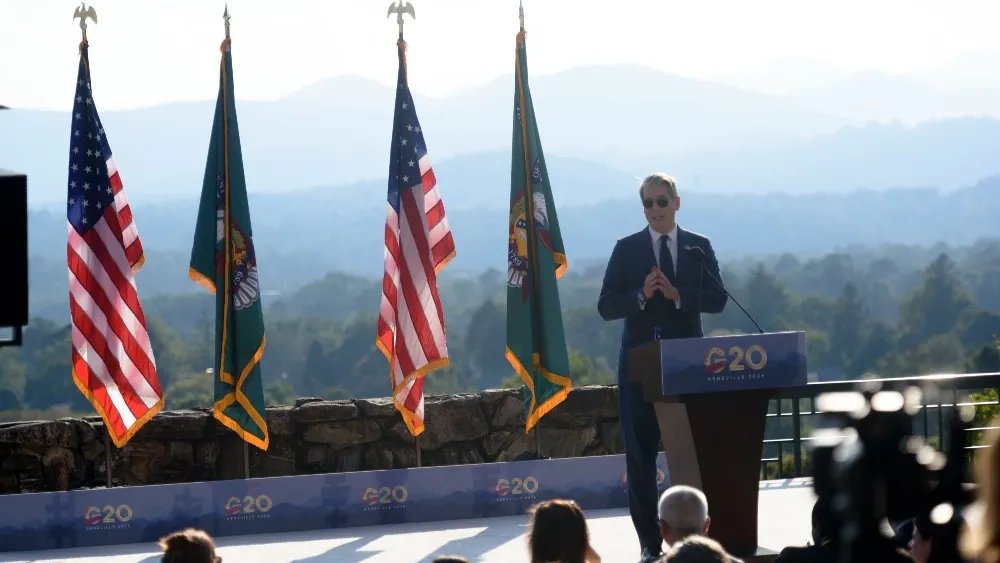
The four-day summit of the G20 finance ministers in Asheville, N.C. closed on a tense note—and without a joint consensus statement—due to China’s repudiation of assertions that its export strategy deluges other markets in low-value goods.
Economic officials from across the globe could not come to an agreement about the message they wanted to deploy because China opposed language criticizing its excess industrial capacity, which is responsible for creating persistent imbalances with trading partners, according to the United States Treasury Department.
In the absence of a collective communiqué, the Treasury released a chair statement that outlined the group’s high-level shared goals and values. Bessent’s office said China specifically refuted elements of the missive that spoke to taking steps to eliminate non-market practices and policies that drive up imbalances, specifically for countries that have “persistent external surpluses” that “result in an overreliance on exports for growth.”
The Treasury said China also rejected a paragraph that outlined continued concerns from the other 19 members about shipping constraints in the Strait of Hormuz.
“We believe that nonmarket-based economies pushing out a never-ending stream of cheap exports is not sustainable,” U.S. Treasury Secretary Scott Bessent said during a press conference following the meetings.
“It is clear that the country with the world’s largest and unsustainable current account surplus, People’s Republic of China, was the dissenter,” he added. “The fact that 19 countries did want to address this shows the sheer enormity of the problem.”
While U.S.-China trade has plummeted due to the trade war that has raged since Trump resumed office, China’s global export volume surged to record highs last year, reaching $1.2 trillion—a 20 percent jump from 2024.
Asked during a Wednesday press conference about the G20’s failure to issue a joint communiqué after four days of meetings, China Foreign Ministry spokesperson Guo Jiakun said the nation has participated in discussions about world finance in an “active and constructive manner” since the U.S. assumed the 2026 G20 presidency. “We have noted that parties hold diverging views on certain issues” at the meeting, he said.
Guo went on to say that he hopes the U.S. and other members will “give full respect to all parties’ legitimate concerns” in pursuit of a “fruitful” Miami Summit on Dec. 15.
On Monday, as the discussions surrounding trade imbalances were heading up, Guo told reporters, “China never deliberately pursues a trade surplus and opposes unilateral tariff measures in all forms” as a means of regulating commerce.
This week’s frictions could set the stage for a tenser meeting than the administration had hoped for between President Donald Trump and Chinese President Xi Jinping, who is scheduled to visit Washington the week of Sept. 24. Trade and tariffs will surely be a central focus of discussions, which both sides have hoped will usher in a reset of the bilateral relationship between world superpowers.
There’s another prospective wrinkle that could throw a damper on that meeting, and it could come about quickly.
The Office of the U.S. Trade Representative is imminently expected to release the results of its investigation into 16 world economies including China, the European Union, Singapore, Switzerland, Norway, Indonesia, Malaysia, Cambodia, Thailand, South Korea, Vietnam, Taiwan, Bangladesh, Mexico and Japan on charges of maintaining excess industrial capacity in certain manufacturing sectors.
In other words: China and its close supply chain allies are in the crosshairs of another tariff action due to charges of overproduction and over-exporting. Following a public comment period and hearings on the investigations, the USTR could choose to levy new duties on the targeted markets.
During a White House press conference Wednesday, Trump seemed unfazed by the week’s developments. He said the prospect of Xi’s visit this month was “very exciting,” and added that the two had “very productive things to discuss” with regard to the future of the U.S.-China relationship.