dailynewsnblog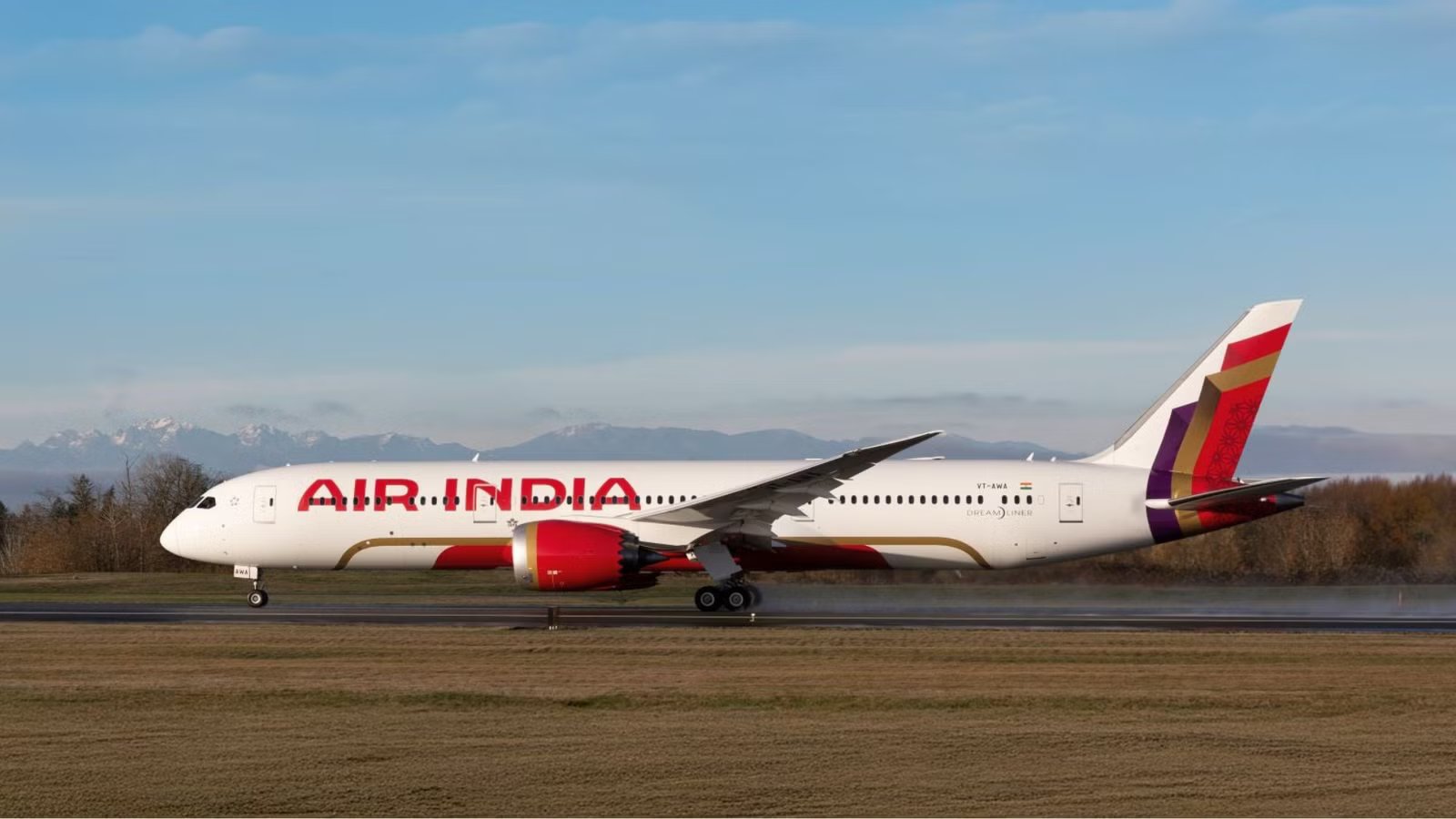
 Air India made a major change to its
  Delhi Indira Gandhi International Airport (DEL) –
  Toronto Pearson International Airport (YYZ) service on August 1, 2026, promising passengers something that had been missing: a genuine nonstop westbound journey. The airline’s new Boeing 787-9 was supposed to eliminate the technical fuel stop in Vienna International Airport (VIE), cutting the journey from roughly 20 hours to around 17 hours. Yet just 10 days after the change was introduced, one AI187 flight landed once again in Vienna, which can be tracked with our Simple Flying flight tracker.
That apparent contradiction raises an important question: how can a route officially advertised as nonstop still require a fuel stop? The answer lies not simply in the Boeing 787-9’s range, but in the specific aircraft assigned to the flight, its certified maximum takeoff weight, available payload, and Air India’s ability to rotate a small fleet of new Dreamliners between demanding long-haul routes. Let’s take a look at what happened.
Air India’s ‘Nonstop’ Toronto Flight Has A Catch

Air India’s official announcement on the Delhi-Toronto upgrade was straightforward. From August 1, Air India deployed its new Boeing 787-9 on AI187 between Delhi and Toronto, allowing the carrier to remove the Vienna fuel stop required on the westbound sector. Air India said the change would reduce the journey from about 20 hours, including the stop, to approximately 17 hours, while the Toronto-Delhi return would continue to operate nonstop for up to 16 hours.
The change also saved passengers several hours. The new Dreamliner introduced Air India’s latest long-haul cabin to Canada, including 30 Business Class suites, 28 Premium Economy seats and 238 Economy seats. Business class passengers receive direct aisle access, fully flat 79-inch beds, and 17-inch 4K QLED HDR screens, while premium economy is arranged in a 2-3-2 layout with 38-inch pitch.
But the aircraft itself is central to the story. Air India currently has three factory-new 787-9s with the registrations VT-AWA, VT-AWB, and VT-AWC, delivered in January, May, and July 2026, respectively. They may all carry the same 787-9 designation, but they are not necessarily interchangeable when the airline needs to operate an ultra-long sector with a demanding payload. That distinction became visible on August 11, when AI187 operated differently from what passengers had come to expect.
Why Did AI187 Stop In Vienna Again?

The immediate reason was aircraft availability. On August 11, Air India operated AI187 using Boeing 787-9 VT-AWA, rather than one of the two higher-weight aircraft normally intended for the nonstop Toronto operation. According to Air India, VT-AWB and VT-AWC were unavailable due to planned maintenance and other operational requirements, so the airline scheduled VT-AWA with a technical stop in Vienna rather than canceling the flight or leaving many passengers and cargo behind, as reported by AviationA2Z.
This distinction is important because the original reporting described the aircraft as the “wrong” 787-9, while Air India explicitly rejected that characterization. The airline said VT-AWA was fully certified and that the Vienna stop was planned in advance, allowing the flight to operate safely and in compliance. It also said that avoiding the stop with the aircraft available would have required offloading roughly 70–80 passengers because of payload limitations.
The flight’s actual operation illustrated the consequence. According to FlightRadar24 data, AI187 departed Delhi at 2:22 AM, reached Vienna at 7:24 AM, remained there for roughly two hours, and then continued to Toronto, arriving at 11:40 AM local time.
Air India AI187 | Planned nonstop operation | August 11, 2026 operation |
Aircraft | New Boeing 787-9 with iMTOW | VT-AWA |
Route | Delhi–Toronto nonstop | Delhi–Vienna–Toronto |
Fuel stop | None, subject to airspace | Vienna |
Approx. journey time | About 17 hours | About 20+ hours |
Reason | Higher-weight aircraft capability | Aircraft availability and payload constraints |
The surprise was not that a 787-9 could suddenly no longer fly the route. Air India’s small pool of suitably certified aircraft left little room for substitution. The key question becomes what makes VT-AWB and VT-AWC different enough from VT-AWA to matter on this particular route.
The Hidden Difference: Boeing’s Increased MTOW

The critical piece of the puzzle is the  Boeing 787’s increased Maximum Takeoff Weight, or iMTOW. Boeing obtained FAA certification for higher maximum takeoff weights for the 787-9 and 787-10, allowing airlines to carry additional payloads or extend the aircraft’s practical range, depending on how the extra weight is used.
For the 787-9, the increase is approximately 10,000 pounds (4,540 kg). Boeing’s figures indicate that this can translate into roughly three metric tons of additional payload or more than 300 nautical miles (560 kilometers) of additional range. That flexibility is especially valuable on long sectors where an airline is trying to carry a full passenger load while also carrying enough fuel to account for routing restrictions, reserves, and operational contingencies.
The certification is not simply a label applied to every aircraft in an operator’s fleet. Boeing has said that 787-9s assembled since December 2025 are structurally capable of operating at the higher certified weight, but airlines can choose whether to activate the capability during delivery or later. This gives carriers flexibility because the maximum certified takeoff weight can also influence airport charges and other operating considerations.
For Air India, that distinction matters enormously. According to Aviation A2Z, the two newer aircraft, VT-AWB and VT-AWC, were delivered with the iMTOW capability, while VT-AWA arrived in January 2026 before the higher-weight certification was available to Air India’s aircraft.
That means the apparent mystery surrounding AI187 ultimately comes down to certified performance. But why should a difference of several thousand pounds determine whether a passenger can fly nonstop across the Atlantic?
Catch what other trackers miss
Emergency squawks, holds, NOTAMs — live signals, no signup.
Open tracker
Catch what other trackers miss
Emergency squawks, holds, NOTAMs — live signals, no signup.
Open tracker
Why A Few Thousand Pounds Can Decide A 17-Hour Flight

For an ultra-long-haul flight, the aircraft has to balance several competing requirements before departure. Fuel is by far the largest weight, while passengers, baggage, and cargo make up the payload. If the aircraft must fly a longer route because of airspace restrictions, fuel requirements increase, potentially pushing the operation beyond what the aircraft’s certified takeoff weight and available payload combination can comfortably support.
That is particularly relevant to Air India’s India-Canada network. The Delhi-Toronto route has faced challenging operating conditions because of geopolitical developments and airspace restrictions, with the westbound service previously requiring a technical stop in Vienna. Longer routings due to airspace restrictions increased the sector’s fuel requirements.
Loading map…
Drag to explore
The iMTOW aircraft gives Air India a few more tons of flexibility. The airline can use that additional certified takeoff weight to carry more fuel, more payload, or a combination of both. On a route where the objective is to transport a full passenger cabin nonstop for roughly 17 hours, that additional margin can be the difference between a commercially viable nonstop flight and one requiring a fuel stop.
Instead of canceling AI187 or leaving approximately 70-80 passengers behind on August 11, the airline used VT-AWA and planned the Vienna stop around the aircraft’s operational limitations, as it had with the Boeing 777-300ER previously operating on the same route. The result was slower, but it preserved the flight for the booked passengers.
The complication is that this exposes a temporary weakness in Air India’s nonstop strategy: the route’s promised performance depends not merely on assigning “a 787-9,” but on assigning the rightly configured 787-9.
Air India’s New Dreamliners Are Still A Very Small Pool

Air India’s solution is ultimately a fleet-management problem. Apart from 26 Boeing 787-8s, the airline has nine 787-9s overall, but six are aircraft previously operated by Vistara, while the three aircraft central to the new Toronto product are the factory-new VT-AWA, VT-AWB and VT-AWC.
That creates a particularly narrow pool for a route that Air India has now restored to daily operation. From August 1, the airline increased the Delhi-Toronto frequency from five weekly flights to seven, after temporarily reducing service in June and July due to elevated fuel prices and broader operational challenges.
The new aircraft are also being used to introduce Air India’s redesigned premium product across its international network. Toronto is one of the latest destinations to receive the factory-new 787-9, following deployments elsewhere in Europe, making this service not only faster but materially different from the older Dreamliner product.
That creates an operational balancing act. Air India needs enough of these aircraft to guarantee nonstop service, while also using them elsewhere in the network and taking them through planned maintenance. The stopover episode, therefore, reveals something bigger than a single irregular operation: until Air India has more suitably configured 787-9s, the “nonstop” promise on Delhi-Toronto remains dependent on fleet availability.
Air India’s Toronto Nonstop Promise Will Depend On Fleet Depth

The long-term significance of the August 11 stopover is that Air India has already solved the technical problem in principle. The carrier has aircraft capable of flying Delhi-Toronto nonstop under the required operating conditions, and its August 1 schedule demonstrated that the Vienna stop can be removed. The remaining challenge is making that capability consistently available whenever one of those aircraft is required.
That should become easier as Air India receives additional factory-new 787-9s. The first three aircraft, VT-AWA, VT-AWB and VT-AWC, were delivered in January, May and July 2026, while another 787-9, VT-AWD, is listed as forthcoming. A deeper pool of new aircraft should give Air India more flexibility to absorb maintenance events without immediately sacrificing the nonstop capability on one of its longest routes.
For passengers, the situation is more nuanced than simply checking whether AI187 is advertised as nonstop. The scheduled service is nonstop, but the aircraft assignment can still determine whether that promise is achievable on a given day. Air India made clear that the August 11 Vienna stop was a planned operational decision rather than an emergency, and that it was made to keep customers traveling rather than cancel or offload a large number of passengers.
The bigger test will come as Air India expands its new 787-9 fleet and decides how much redundancy it wants on ultra-long-haul routes. If enough iMTOW-equipped aircraft are available, Vienna should become an exception. Until then, Air India’s “nonstop” Boeing 787 service has one important qualification: the route may be nonstop on the timetable, but the aircraft flying it still has the final say. To find out information about the aircraft used on the route, you can check out our Flight Tracker.