dailynewsnblog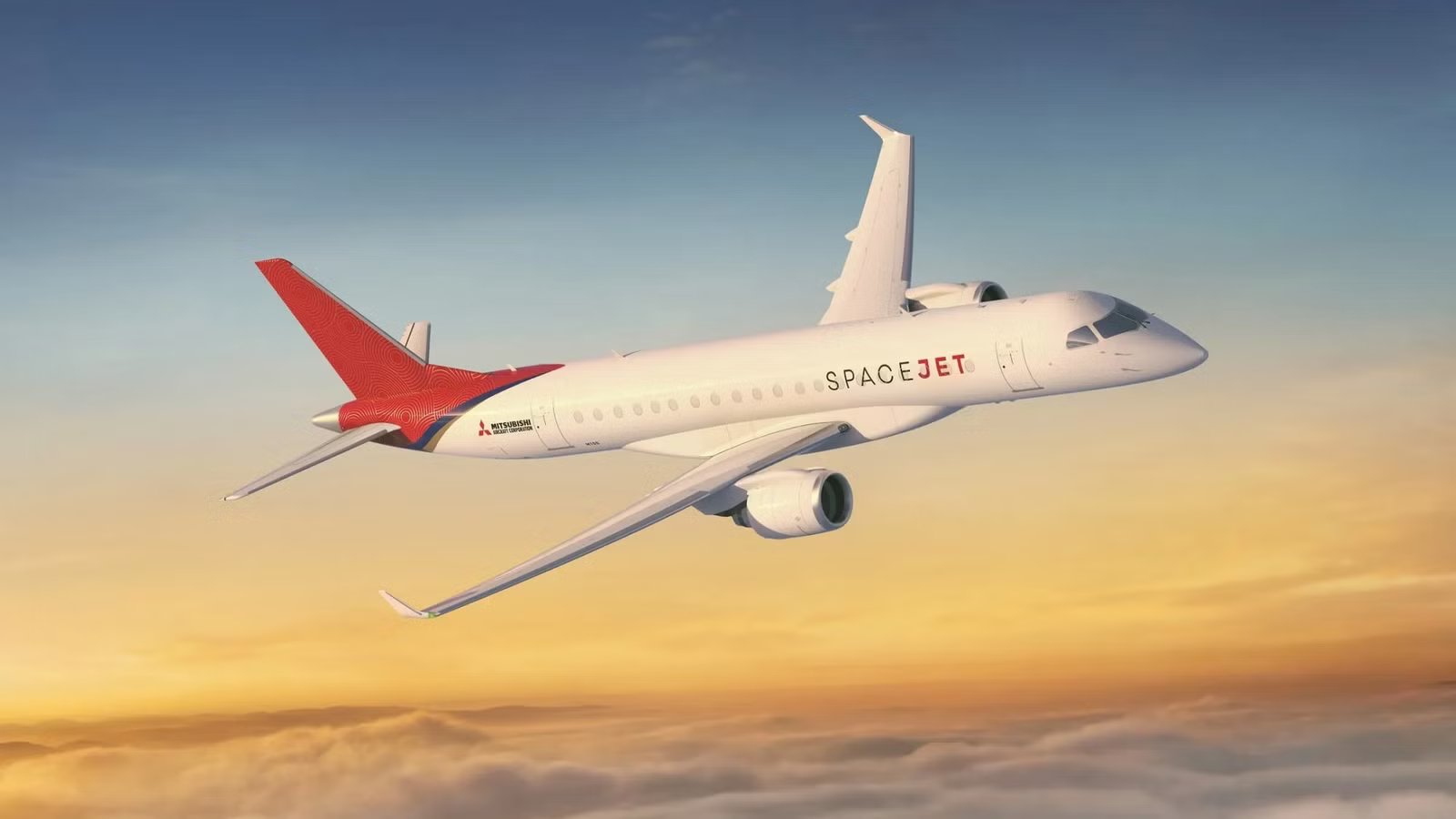
Many aircraft concepts that manufacturers such as Airbus and  Boeing develop never end up carrying any passengers. Some remain little more than drawings, while others might progress to mock-ups, prototypes, or even actual testing before manufacturers decide that there is simply not enough demand to justify further development.
However, a few aircraft programs got very close to commercial service before ultimately being canceled. In several cases, prototypes were already flying, certification was well underway, and airlines had placed firm orders. One aircraft even accumulated thousands of flight-test hours, while another received a type certificate without ever carrying a single passenger in scheduled service.
Mitsubishi SpaceJet
Over 3,900 flight-test hours were still not enough

Perhaps no aircraft on this list came closer to commercial service while still failing to get there than the Mitsubishi SpaceJet. Originally known as the Mitsubishi Regional Jet (MRJ), the program was formally launched in 2008 after All Nippon Airways (ANA) placed an order for 15 aircraft with another ten options. At the time, Mitsubishi Heavy Industries (MHI) planned for the aircraft to enter commercial service by 2013.
However, things did not go according to plan, and development delays pushed the aircraft’s first flight back to November 11, 2015. The maiden flight lasted approximately 90 minutes, and Mitsubishi was now targeting an entry into service in 2017. Further certification-related changes would result in several more delays. However, the launch customer, ANA, is expected to receive its first aircraft around 2020.
Despite thousands of hours in the air, Mitsubishi finally canceled the SpaceJet in February 2023, after pausing development in 2020. The company concluded that substantial additional funding would still be required to complete type certification. At the same time, the 88-seat M90 had become increasingly difficult to sell in the North American market because it did not comply with US airline scope-clause restrictions. MHI also cited the need for further design revisions, difficulties obtaining cooperation from suppliers, and uncertainty about the regional jet market.
For a brand-new aircraft manufacturer, Mitsubishi got remarkably far in its efforts to develop a new commercial aircraft. According to MHI itself, the SpaceJet accumulated more than 3,900 flight-test hours without safety issues. The manufacturer also developed the organizational structure required to design, manufacture, and certify commercial aircraft, established extensive test facilities, and worked through Japan’s commercial-aircraft type-certification framework. Flight testing even took place from a dedicated US base at Moses Lake in Washington State.
Tupolev Tu-334
The regional jet that received a type certificate but never carried passengers

Development of the Tupolev Tu-334 began during the Soviet era as a replacement for the popular Tu-134, with the original plan being for the jet to join Aeroflot’s fleet during the early 1990s. However, the collapse of the Soviet Union and the economic crisis that followed caused development to slow considerably, and the first functional Tu-334 did not fly until February 8, 1999.
Despite the delays, the program continued to move toward production, and a second flying prototype completed its maiden flight in November 2003, while manufacturing arrangements were established with several different production facilities. In December of that year, one of these factories in Kyiv, Ukraine, even received an order to produce five aircraft for two Russian carriers, but none were built in the end.
Most interestingly, the Tu-334 received a Russian type certificate on December 30, 2003, with one important catch. However, this certificate was only temporary, and the aircraft was not yet fully approved for passenger operations. Tupolev still needed to complete another aircraft and conduct a further series of certification tests before full certification could be obtained.
Production was subsequently moved between factories, with plans at one point calling for series production to begin in Kazan in 2007. However, funding remained limited, and Russia’s aviation industry was changing rapidly. The Tu-334 competed for resources with newer aircraft, particularly the Sukhoi Superjet 100, while the Antonov An-148 also occupied a similar market segment. As the Russian industry increasingly focused on these newer programs instead, the Tu-334 was effectively abandoned in 2009 after only two flying prototypes had been built and two decades of development.
Fairchild Dornier 728
The regional jet that went bankrupt before its first flight

Few aircraft that never left the ground came as physically close to doing so as the German-American Fairchild Dornier 728. The new aircraft was supposed to be the centerpiece of a new family of regional jets that Fairchild Dornier hoped would compete directly with Bombardier and Embraer in the rapidly growing regional aircraft market.
By March 2002, eight customers had reportedly placed 125 firm orders and another 164 options for the aircraft.  Lufthansa’s CityLine was intended to become the launch customer, while leasing giant GECAS was another major buyer. The order book therefore looked far more convincing than that of some aircraft that actually made it into production, such as the Airbus A319neo.
The first prototype was officially rolled out at Fairchild Dornier’s production facility in Germany on March 21, 2002. Its maiden flight was scheduled for that summer, with deliveries to Lufthansa CityLine expected to begin during 2003. At this point, the aircraft itself was already largely complete, while other airframes were being prepared for structural and certification testing.
Unfortunately, Fairchild Dornier had accumulated substantial debt while developing the 728 and was struggling to secure enough new financing to continue. Less than two weeks after the aircraft’s rollout, the manufacturer filed for insolvency on April 2, 2002. Lufthansa, GECAS, and other customers quickly withdrew their orders. Since the aircraft itself was not the problem, several attempts were later made to revive the program under new ownership, but none of these succeeded.
IPTN N250
Indonesia’s homegrown airliner stopped by a financial crisis

Indonesia also came close to establishing itself as a manufacturer of commercial passenger aircraft during the 1990s. The country’s state-owned IPTN, today known as Indonesian Aerospace, developed the N250 as a regional turboprop intended to compete in the same general market as aircraft from  ATR, de Havilland Canada and Fokker.
The first 50-seat N250 prototype was rolled out in 1994 and completed its maiden flight on August 10, 1995. This event became so important to Indonesia that August 10 was later designated as National Technology Awakening Day. A second, stretched prototype capable of carrying around 64 to 68 passengers followed, completing its first flight in December 1996. The aircraft was later also demonstrated internationally, including at the Paris Air Show in 1997.
IPTN had much larger ambitions than simply building a few prototypes, as the company was pursuing Western certification. At one point, a second N250 assembly line in the United States was also planned. By the time the program was halted, the manufacturer was reportedly around halfway through a planned 1,400-hour flight-test program. Certification had originally been targeted for March 1999, but was pushed back to the fourth quarter of 2000.
What finally killed the aircraft was largely outside the N250 itself, as the Asian financial crisis hit Indonesia particularly hard in 1997 and 1998. This forced the country to seek an international financial rescue package, and government support for expensive projects such as the N250 was subsequently withdrawn, leaving IPTN without the money needed to finish certification and establish production. Additional prototypes were abandoned, and the manufacturer attempted to find outside investors, but the program never recovered.
British Aerospace Jetstream 61
The certified successor to the BAe ATP that never entered service

The British Aerospace Jetstream 61 was not a completely new aircraft and instead a redeveloped British Aerospace ATP, a 64-seat regional turboprop that entered commercial service in 1988. British Aerospace had hoped the ATP would compete with aircraft such as the ATR 42 and Dash 8, but sales remained relatively limited, with only 63 aircraft produced. Therefore, the manufacturer developed a larger and improved version, initially known as the ATP Mk 2 and later renamed the Jetstream 61.
The Jetstream 61 increased capacity to around 70 passengers and featured more powerful Pratt & Whitney PW127D engines, together with increased operating weights, additional range, and an updated cabin. The first aircraft completed its maiden flight from Glasgow Prestwick International Airport (PIK) on May 10, 1994. In total, British Aerospace built four examples of the jet, two of which reportedly took to the skies.
On June 16, 1995, the Jetstream 61 received its UK type certificate, meaning one of the most important hurdles holding an aircraft from commercial service had already been overcome. However, British Aerospace had agreed earlier that year to combine its regional aircraft marketing activities with the Franco-Italian ATR consortium, placing the Jetstream 61 alongside the already successful ATR 72 in roughly the same market.
Continuing to manufacture and sell two competing turboprops of similar capacity therefore made little commercial sense. British Aerospace abandoned the Jetstream 61 in favor of the ATR family, despite having already built, flown, and certified the aircraft. Unlike the original ATP, which entered airline service and remained in operation for decades, its improved successor never carried a single scheduled passenger, and all four Jetstream 61s were eventually scrapped.