dailynewsnblog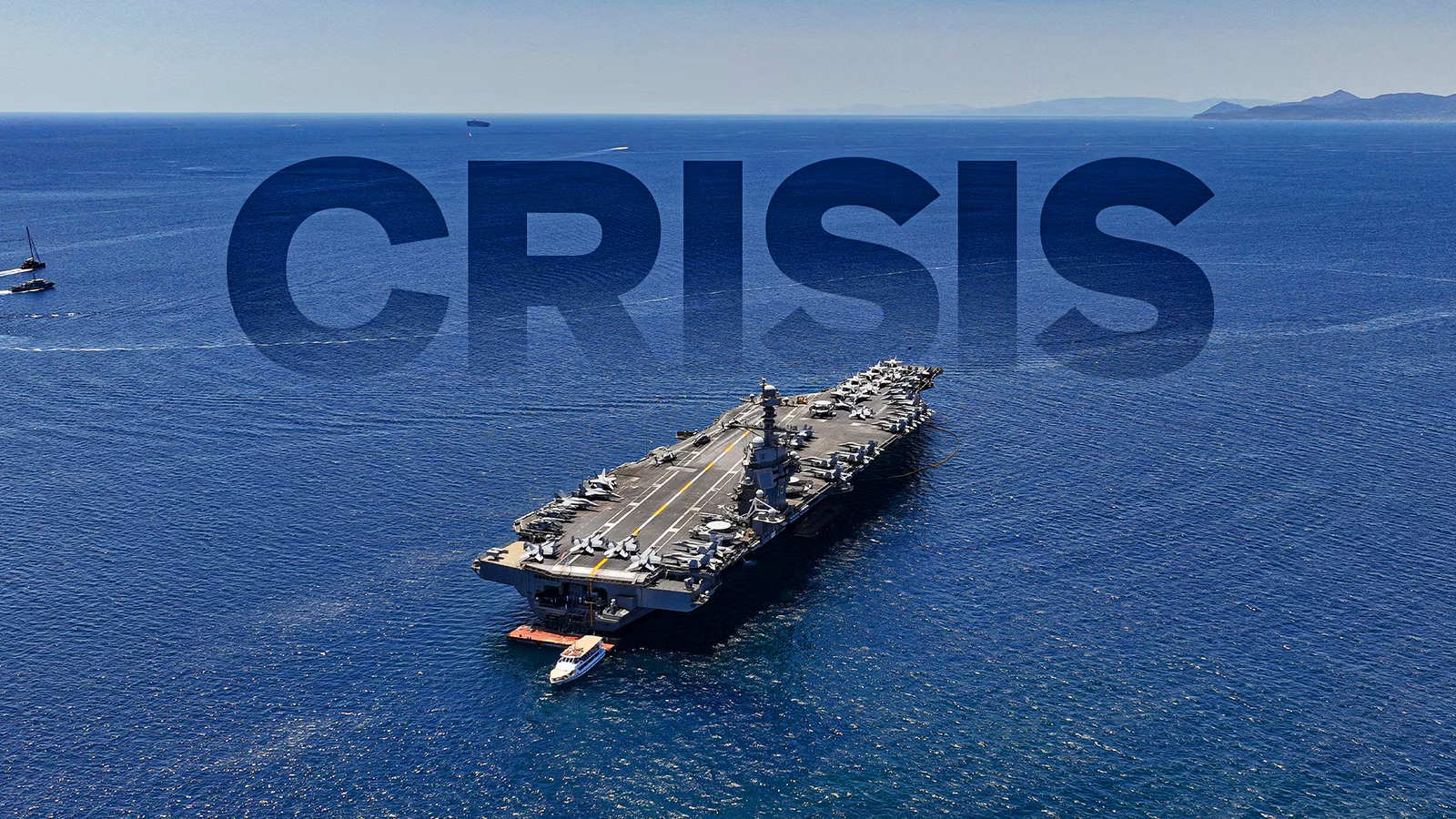
The US Navy’s aircraft carrier fleet may be on track to a readiness crisis, deeply compounded by a series of top-down political directives, shipyard delays, and strained deployment schedules. Analyzing the Navy’s strategic challenges requires evaluating how President Donald Trump’s mandates, including swapping electromagnetic catapults for legacy steam power, costly redesigns for aesthetic preferences, and renaming ships, coincide with the abandonment of the Asia-Pacific region.
As of August, USS George HW Bush (CVN 77) and the newly arrived USS George Washington (CVN 73) are on station in the Middle East enforcing a blockade against Iran. USS Abraham Lincoln’s (CVN-72) relief left the Navy with no aircraft carrier presence in the Indo-Pacific for a stretch, as the Washington USS Theodore Roosevelt (CVN-71) was pierside in San Diego awaiting its next deployment order. USS Carl Vinson (CVN-70) and USS Dwight D. Eisenhower (CVN-69) are in workups off the coasts.
Meanwhile, the other ‘boats’ remain in various stages of maintenance: USS John C. Stennis (CVN-74), USS Harry S. Truman (CVN-75), USS Ronald Reagan (CVN-76), and USS Gerald R. Ford (CVN-78). USS John F. Kennedy (CVN-79), the second Ford-class carrier, completed acceptance sea trials on August 15 and is slated to begin active service early next year. If Kennedy’s delivery slips again, as Ford-class construction has slipped before, the fleet may drop to ten carriers as Nimitz hits the hard limit on its hull’s serviceable lifetime.
The Unreplenished, Unrelieved USS Abraham Lincoln
Crisis in the Middle East diverts America’s only carrier in the Pacific

USS Abraham Lincoln left San Diego on November 21, 2025, on what was briefed as a routine seven-month Indo-Pacific deployment. It was redirected to the Middle East as the war with Iran began and was extended twice, eventually surpassing 270 days at sea and nine months deployed. The Lincoln was left stranded without port calls because the destruction of the Bahrain naval base forced a fragile 2,200 miles (3,540 km) supply line from Diego Garcia. To relieve the Lincoln’s weary crew, the Navy was forced to emergency-route the George Washington from Japan.
The extension was not mismanagement in the ordinary sense. it was forced by the fact that Iranian missile and drone strikes in February destroyed the command headquarters and more than a dozen other buildings at Naval Support Activity Bahrain, the Fifth Fleet’s main logistics hub, and forced most personnel to evacuate. With Bahrain gone and the Strait of Hormuz too dangerous to transit, the Navy rerouted Lincoln’s resupply through Diego Garcia, roughly 2,200 miles away in the Indian Ocean.
The detour, combined with a modern-era record for consecutive days without a port call, left nearly 5,000 sailors and Marines running short of food, toothpaste, deodorant and soap for weeks at a stretch. Sailors’ families and independent reporting have described it instead as a ship pushed to its limit by a logistics failure the Pentagon was slow to acknowledge.
Both descriptions can be true at once, and the pattern wasn’t unique to Lincoln. Its relief, the George Washington, must now assume an open-ended combat posture in the Middle East instead of returning to the US for scheduled maintenance.
America’s Flat Ops At One-Third Strength
Just four of US Navy’s 11 supercarraiers are combat-ready

The federal requirement for 11 operational carriers is shattered because political mandates have weaponized the Optimized Fleet Response Plan. The legal requirement exists to handle simultaneous global threats. The cycle is a roughly 36-month loop with four phases: maintenance; basic training to requalify a crew that has turned over by a third since the last cruise; integrated workups with the destroyers, submarine, and roughly a 60-to-70-aircraft air wing that will deploy alongside the carrier; and finally about eight months of deployment.
By ordering the USS George Washington out of Yokosuka, Japan, to suppress the ongoing crisis in the Middle East, the administration has left the Pacific without an active US carrier. This creates an unprecedented security vacuum around Taiwan and China. This risk is worsened by the administration’s strategic shift to pull back from the Asia-Pacific to prioritize home-water security. When combined with bureaucratic delays, the Navy cannot field enough hulls to plug the geographic gaps created by these rapid, politically driven reassignments.
This shifts extreme logistical wear and tear from one hull directly to another. The strain shows up in the maintenance segment of the cycle, which for a nuclear carrier includes the Refueling and Complex Overhaul, a mid-life rebuild conducted once in a carrier’s roughly fifty-year service life that defuels and refuels two reactors, rebuilds the propulsion plant, and touches hundreds of tanks and thousands of valves and pumps.
Only one shipyard in the country, Huntington Ingalls’ Newport News Shipbuilding in Virginia, is certified to do it, so a delay on one carrier’s RCOH cascades directly onto the next one in the queue. A maintenance period that runs years past its own schedule does not just idle one hull; it delays the ship behind it in the queue and shrinks the pool the Navy can draw on for the next deployment rotation.
The Three Boats Stuck In The Yards
One-third of the carrier fleet is out of action for years for overhaul and refit

Beyond Ford’s unplanned yard period, two Nimitz-class carriers are now tied up in the Navy’s longest and most disruptive maintenance evolution simultaneously. Stennis’s Refueling and Complex Overhaul is not projected to redeliver before October 2026, with sea trials and full deployment readiness pushed into 2027. That is six years in the yard, up from the original four-year plan. USS Harry S. Truman entered its own RCOH in June 2026, a process expected to keep it out of the fleet until at least January 2031.
Huntington Ingalls was already behind on preparatory work before the ship even arrived. Having three or four of eleven carriers in maintenance at once is not, by itself, outside the OFRP. What the plan does not anticipate is those maintenance periods running years past their scheduled length simultaneously. Despite this, the White House has ordered an internal review to relocate the multi-story command tower, or the ‘island,’ toward the middle of Ford-class carriers to mimic World War II-era aesthetics.
Imposing complex structural and architectural changes on future ships forces a strained industrial base to spend precious engineering hours on cosmetic redesigns rather than expediting the deep overhauls of the Stennis and Truman. This design churn locks hulls in the yards and ensures fewer ships are ready to replace deployed forces.
To make the situation even more complex, on August 13, President Trump signed a national-security memorandum directing the Navy to abandon the Electromagnetic Aircraft Launch System and Advanced Arresting Gear on CVN-81 and revert to the steam catapults. Electromagnetic launch and recovery systems that are already close to half complete under a roughly $1.2 billion contract with General Atomics.
The Troubled Next-Gen Ford-class
From fires at sea to dramatic executive orders undoing years of R&D

USS Gerald R. Ford, the lead ship of the Navy’s newest carrier class, left Naval Station Norfolk in June 2025 for what was meant to be a standard deployment to Europe. Instead, it was redirected to the Caribbean to support operations tied to Venezuela, back to the Mediterranean and Red Sea, and finally into direct combat operations against Iran under Operation Epic Fury, not returning to Norfolk until May. The Ford clocked 326 days at sea, the longest carrier deployment since the Vietnam War.
Along the way, a non-combat fire in March damaged seven berthing compartments and the ship’s main laundry facility, forcing repair stops in Souda Bay, Greece, and Split, Croatia, and the crew also dealt with a plumbing and sewage crisis. The 30-hour fire and automated systems failure aboard the Ford highlighted the dangers of uncertified aerospace technology under stress. The Navy has not separated the cost of fire repair from the rest of Ford’s now-open-ended shipyard period at Norfolk Naval Shipyard, where it is the first Ford-class carrier ever serviced.
At the same time, independent estimates put the redesign cost of the EMALS-equipped Ford-class ships in the hundreds of millions of dollars, on top of adding years to the delivery dates. Layered onto that engineering dispute is a naming one. CVN-81 was designated in 2020 to become the future USS Doris Miller (CVN-81), honoring the enlisted Black sailor who manned an anti-aircraft gun without training during the attack on Pearl Harbor. In August, CNN reported that the Navy has been quietly working since earlier in the year to rename the ship after President Trump instead.
The Long-lead Training & Troubleshooting
New Ford-class and refreshed Nimitz-class ships alike still need time to debug after leaving drydock

USS Ronald Reagan entered a 17-month Docking Planned Incremental Availability at Puget Sound Naval Shipyard in Bremerton, Washington, in March 2025, with the dry dock drained, so crews could access the hull, propellers and shafts normally underwater. As of mid-August 2026, the shipyard’s public affairs office confirmed the overhaul remained on track for completion at the end of August, covering structural repairs, nuclear-propulsion system checks and flight-deck and combat-system modernization.
Completion of the yard period is only the first milestone, not the last. The reality that carriers like the USS Ronald Reagan require months of post-dry dock sea trials and air wing integration is directly undermined by reckless strategic planning. With the George Washington diverted to the Middle East, the Pacific has no carrier coverage. This places intense political pressure on the Ronald Reagan to rush through its critical safety checks, carrier qualifications, and training blocks.
The Navy has declined to say when Reagan might actually deploy. Bypassing standard integration timelines to rush a carrier back out to sea invites catastrophe. Hurrying a freshly repaired hull into a theater of war compromises flight deck safety and leaves the crew unprepared for high-end combat, transforming nominal “readiness” into a dangerous strategic illusion.
That gap between ‘out of dry dock’ and ‘ready for combat’ is the same gap that will apply to Stennis when it redelivers in October 2026 and to every carrier that follows it through a major overhaul, which is why counting hulls in commission tells a very different story from counting hulls the Navy could actually surge tomorrow.