dailynewsnblog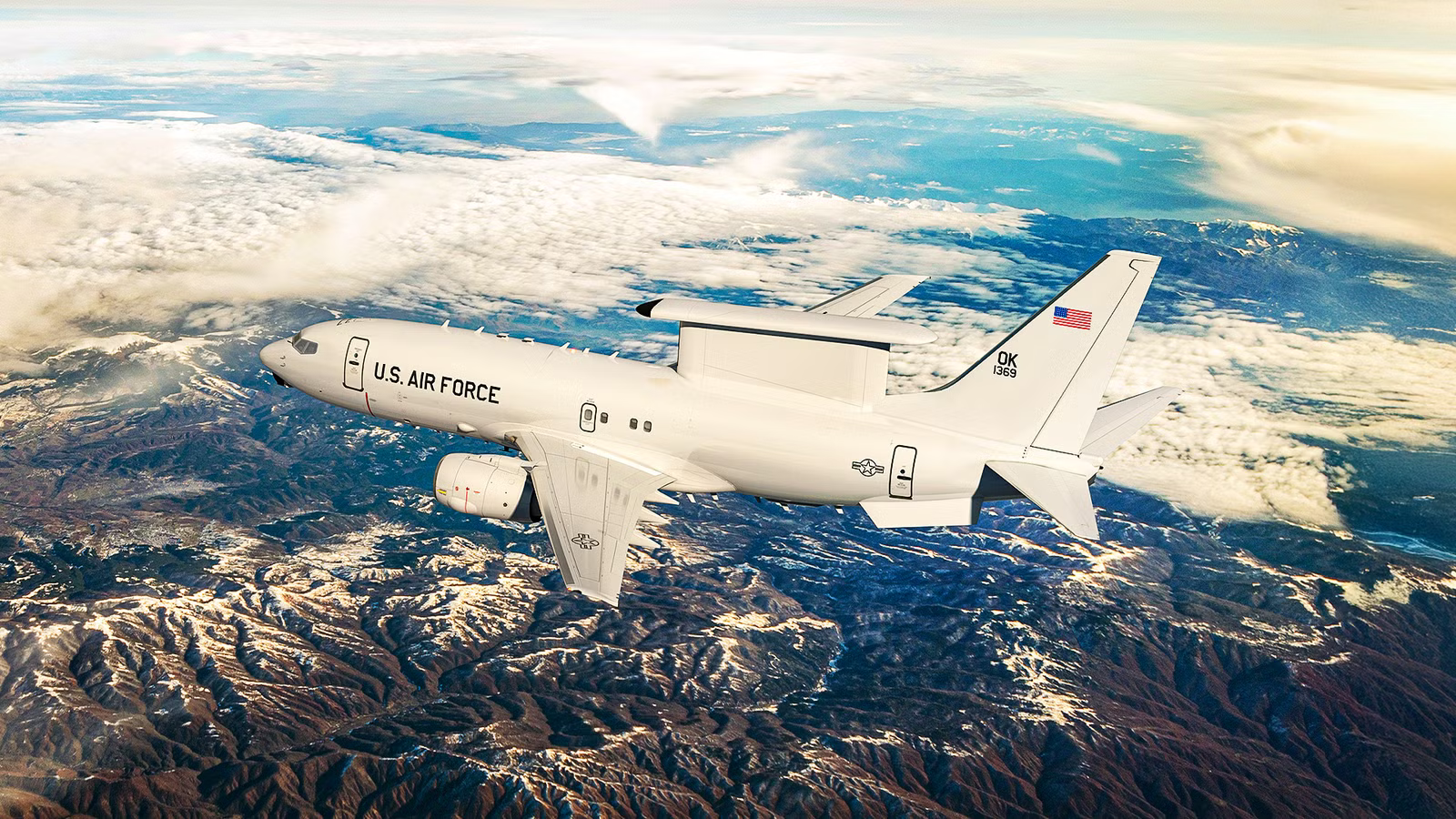
The dramatically escalating price of the  Boeing E-7 Wedgetail airborne early warning and command aircraft forced the United States Air Force (USAF) to essentially give up on modernizing its aging E-3 Sentry jets. The USAF had considered purchasing Northrop Grumman E-2D Hawkeye AWCAS as used by US Navy Carrier Air Wings or repurposing funding for other programs, but lawmakers have decided to force a $650 million budget to keep the Wedgetail program alive.
Boeing has had a very poor track record in recent years delivering defense projects, as seen with the KC-46 Pegasus, F-15EX Eagle II, and next-gen Air Force One, which was a concern before costs began to rise astronomically. Since originally proposing the replacement ‘ Eye in the Sky’ for the Air Force, Boeing has increased the price of its E7 by 33%, with the cost per airframe at over $700 million each.
The wedge tail’s technical capabilities are not the issue; the prohibitive procurement and sustainment costs are. This is already a major problem with the Legacy platform that they will replace, the E-3, which has suffered degrading combat capability since Boeing essentially abandoned it. That has left the Air Force with outdated equipment that costs a painfully high amount to operate, despite its critical contribution to combat operations.
Hawkeye: The Turboprop Backup Plan

The E-3 Sentry has continued to serve despite its obsolescence and very low rate of readiness for some time now because the only proposed replacement programs are nearly as prohibitively expensive as the cost to upgrade the Sentries. The US Air Force has repeatedly stated that space-based sensors are not sufficient to replace an airborne Battlefield AWACS, even as lawmakers have proposed eliminating the fleet entirely. At the same time, the extreme cost of the Boeing E-7 Wedgetail has made it difficult for the US Air Force to balance a budget that can accommodate procurement.
Last year, the Department of Defense opted to shelve the E-7 procurement program in favor of acquiring Northrop Grumman E-2D Hawkeye airborne early warning aircraft proven in service with the US Navy. The turboprop E-2D is significantly cheaper at $200 to $400 million, but offers less endurance and range than the E-7, which is based on a 737-700.
Despite the enormous cost of either option, they are still preferable investments to the E-3, which is essentially a ‘money pit’ that consumes funding without meaningful returns or capability. Specifically, the most wasteful part of sustaining an E-3 is the massive turntable bearings and high-pressure rotary joints. The Air Force is spending millions of dollars to harvest parts from decommissioned aircraft through cannibalization to sustain the remaining jets in service.
The Orphaned E-3 Sentry

Since the E-3 airframe is so old, any major work on the dome mounts involves invasive structural repairs. The liability risk of the airframe cracking or failing while under the stress of a dome removal is so high that contractors demand astronomical insurance and labor premiums. Add to that the fact that aviation technicians do not want to train for skills that are a ‘dead end’ to sustain the tiny fleet of E-3s. Most, if not all, subcomponent manufacturers have long since gone out of business since the last E-3 rolled off the production line 45 years ago. Asking Boeing or NG to set up a workshop to reproduce them is financially unviable.
Since the US is divesting the E-3 to invest in the E-7, there is active discussion about offloading the remaining E-3 support equipment and spare parts to the few remaining international operators, including Saudi Arabia and Japan. Because both air forces lack the budget to acquire the Wedgetail, the RSAF will need to keep flying E-3s, and the JASDF will retain its E-767s. Although the gantries and equipment are also astronomical in price, talks have not progressed to a point where any deal appears imminent.
Setting aside the logistical and financial reasons it is no longer sensible to keep spending money to sustain the E-3 Sentry fleet, the aircraft is now so obsolete against modern threats that it would be irresponsible not to replace it. The aircraft’s mechanically turned radar takes 10 seconds to scan 360 degrees. Meanwhile, the E-7 Wedgetail’s fixed MESA radar steers its radar beams electronically at the speed of light.
The Extreme Engineering Of America’s Eye In The Sky

Northrop Grumman supplies the E-3’s enormous radar array, fitted inside the rotating dome that towers above the fuselage. While the Boeing 707 it is based on is already nearly impossible to sustain, the rotodome is even more insurmountable. NG has essentially said that replacing one in the case of catastrophic damage is impossible ‘at any price on any timeline’ because all the manufacturing equipment and specialized skills to work on them have been retired for decades.
The Block 30/35 program ran from 1987 to 2001 and included upgrades to the aircraft’s computer processing power, datalinks, and GPS navigation. The Block 40/45 program started in 2003 and included upgrades to the aircraft’s electronic support measures, radio spectrum management, and battle management computer systems. Still, the E-3 has reached the end of its operational life and struggles with technological gaps that make it ineffective in 21st-century combat.
Catch what other flight trackers miss
Emergency squawks, holds, NOTAMs — live signals, no signup.
Open tracker
Catch what other flight trackers miss
Emergency squawks, holds, NOTAMs — live signals, no signup.
Open tracker
The technical gap between the E-3’s APY-1/2 and the E-7’s MESA is the difference between a mechanical film camera and a high-speed digital sensor. It can perform layered tasking simultaneously. It can dedicate 10% of its energy to ‘staring’ at a specific high-threat sector like a missile battery while using the other 90% to scan the rest of the 360-degree horizon. This is called dwell capability, and the E-3’s APY-1/2 physically cannot do it. The E-7 is also more resilient against electronic warfare and better at finding stealth jets.
The Potential High-Low Fleet Solution

One of the most likely outcomes of modernizing the US Air Force AWACS fleet, as it inevitably reaches the end of its service life, is a new force built on a hybrid structure. This would incorporate different airborne platforms like the E-7 and E-2D in a ‘high-low’ fleet composition complemented by space-based sensors.
If adopted, the lower-cost Hawkeye will serve as a bridge to a more capable airborne platform, whether that is eventually the Wedge Tail or not. This would buy the USAF time by providing essential radar coverage while the E-3 fleet is retired and more advanced systems mature. A small fleet of E-7s could serve as niche support platforms for the most demanding missions.
The E-2D looks like the E-3 because it has a rotating dome, but inside, it is a completely different beast with some of the same capabilities as the E-7. The Hawkeye’s ADS-18 radar spins, but it also uses electronic scanning within the beam itself. This allows it to dwell on a target even as the dome continues to rotate. The radar also operates on the UHF band, which also makes it better at detecting stealth aircraft than the E-3.
Looking Ahead To The Air Force Of The Future

The Pentagon has attempted to cancel the E-7 program in favor of space-based surveillance like the Golden Dome. Space sensors are seen as more resilient and decentralized, though experts argue they currently lack the resolution and real-time battle management of an aircraft. The issue is that using a radar array on an aircraft with a crew onboard, high-powered sensors, and low-latency ‘human in the loop’ command is crucial in a real-world scenario.
When it comes to air warfare, just one second can be the difference between life and death. Radar effectiveness decreases significantly with distance. Placing a radar in space adds at least 100km of range compared to an aircraft, requiring massive amounts of power to maintain the same detection sensitivity.
Moving the flying command post to outer space introduces extra steps that delay the time from detection to when an air controller can actually communicate with troops on the ground or crewed aircraft in the battlespace. Then there’s the cost, and in this case, space systems once again show little promise. Estimates for a comprehensive space shield like the Golden Dome range from $185 billion to $3.6 trillion, according to the Joint Air Power Competence Center.
Leveraging the advanced AESA radars on the Lockheed Martin F-35 Lightning II and Northrop Grumman B-21 Raider, as well as other advanced aircraft, to network sensor data together. Combining their high-quality sensors with data networking reduces the need for a single large picture of the battlespace for all US and partner forces.
The long-term goal would be to shift the airborne moving target indication mission to space. While the US Space Force is aggressively funding this, the technology is still years from fully replacing manned battle management. Meanwhile, the Pentagon is exploring stealth drones and crewed stealth aircraft equipped with powerful radar that can operate within integrated air defense networks.

![Air Canada Cancels This 9-Hour Transatlantic Long-Haul Route [Map]](https://dailynewsnblog.com/wp-content/uploads/2026/08/332-air-canada-airbus-a330-ross-howey-photo-cangavi-_-shutterstock.jpg)