dailynewsnblog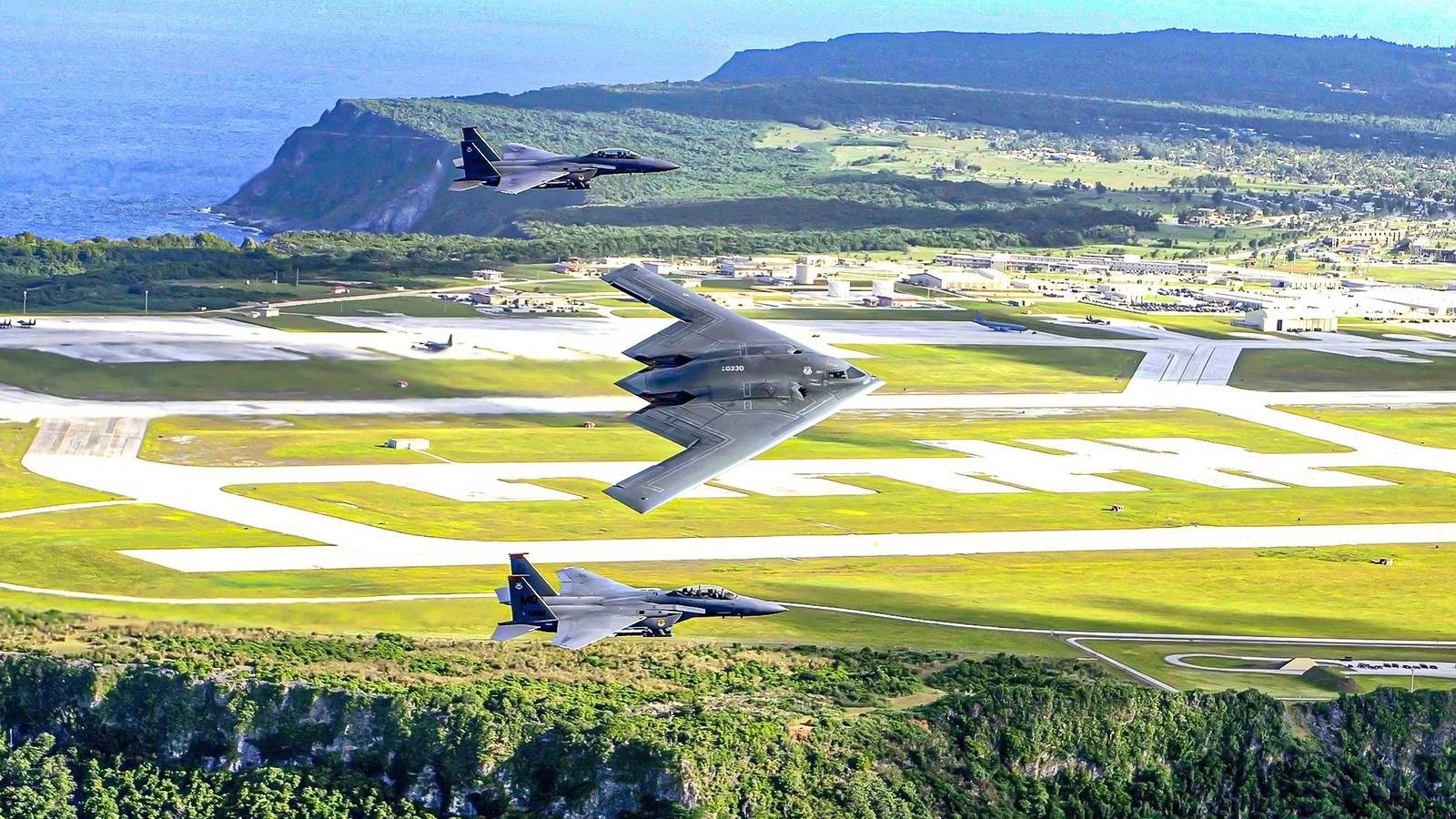
There’s a massive multi-billion dollar upgrade to infrastructure happening at Andersen Air Force Base in the US territory of Guam. The key improvement is the addition of 20 acres of concrete ramp space for open parking of US Air Force strategic platforms like the Northrop Grumman B-21 Raider. On the surface, this goes against the conventional wisdom of putting high-value military platforms out in the open where they could be targeted. However, lessons learned from the first and second Gulf Wars informed this intentional choice by the Pentagon.
When the American military launched its sweeping air campaign against the regime of Saddam Hussein in the early 1990s, the warplanes of the US Air Force, Navy, and Marines quickly and easily dispatched virtually every bunker in Iraq. That included many hardened aircraft shelters which were built to protect planes like the Soviet-built MiG-25 Foxbat supersonic interceptors. According to the Hudson Institute, the Department of Defense concluded that relying on bunkers to protect its fleet was no longer a valid strategy, and that has led to a weakened posture in the Pacific today.
This is one of the fundamental concepts that has informed the Agile Combat Employment (ACE) doctrine now being implemented by the US Air Force and other service branches of the DOD in their own form. The best security against losing valuable planes like the Boeing B-52 Stratofortress or Northrop B-2 Spirit on the ground is to make them hard to find or hard to hit. That means having many airbases that are flexible and ready to accept landings from every plane in the inventory, as well as counter-missile batteries to defend those airfields.
The Specter That Looms Over The South China Sea

The counterargument to the lack of fortifications at the US military’s most important stronghold of air power in the second island chain is the extensive network of hardened structures built by the People’s Republic of China. The PRC has constructed more than 3,000 HAS across 134 air bases within a 1,000-nautical-mile (1,800 km) radius of the Taiwan Strait. Compounding this vast array of reinforcements is a missile network that also dwarfs the one installed at Andersen.
The People’s Liberation Army Rocket Force has hundreds of intermediate-range ballistic missiles that can cross the vast expanse of the Pacific Ocean from the shores of China and strike Guam. The principal munitions of choice are the DF-26, which has been informally nicknamed the Guam Killer, and the even longer-range DF-27. It is estimated there are between 250 and 350 launchers of the DF-26 type alone.
All these missile systems are mobile, as is the recently upgraded DF-17 medium-range ballistic missile, as they are mounted on huge multi-wheel truck chassis capable of traversing harsh terrain. The large number and unpredictable deployment locations make them an incredibly dangerous threat to the military installations of the US and its allies in both the first and second island chains in the opening salvos of an armed conflict. In response, the US is drastically enhancing the anti-ballistic missile defense systems in Guam.
Guam’s Iron Dome: Enhanced Integrated Air Missile Defense

The Pentagon is working towards building 16 new missile batteries with overlapping fields of fire that extend from the surface to the edges of the atmosphere to give Guam a 360° bubble of missile defense. The system will be akin to the “Iron Dome” that famously protects Israeli airspace from missile attacks from adversaries like Iran. The missile launchers themselves are complemented by hardened standoff weapons storage and a new Island Defense Command Center.
The EIAMD network is designed to protect the island, and thereby Andersen, from ballistic, cruise, and hypersonic missile threats. The longest-range interceptors are the Arrow Three with ground-based midcourse defense that can intercept long-range threats like the DF-27 in space, performing exoatmospheric shoot-downs. The next layer of anti-ballistic launchers is the Terminal High Altitude Air Defense missile, or THAAD. Patriot systems provide the final ring of counter-missile fire support.
This system is an active defense that has been proven to be far more effective than HAS bunkers for jets on the ground. The DOD considers it a far better use of funding to expand the anti-ballistic missile defenses, or ABMD, than to build fortified hangars. Additionally, simply pouring huge areas of aircraft parking is a key enabler of the ACE strategy because it allows for highly flexible aircraft deployments which keep planes moving from airfield to airfield and make them a harder target to pin down.
Task Force Talon: Evolving Andersen’s Air Interceptors

Guam is a compact forward hub measuring roughly 30 miles (48 km) long and 4 to 12 miles (6 to 19 km) wide. Because it is well within the range of IRBMs like the DF-26, pouring fixed hangars on a compressed, completely easily mapped island turns those coordinates into little more than targets. Thus, new defensive battery locations were chosen in coordination with the Missile Defense Agency. The sites include six on the grounds of Andersen itself, with two more at Marine Corps Base Camp Blaz and eight at US Naval Base Guam.
The existing THAAD battery was managed by Task Force Talon of the US Army, which has been stationed on Guam since 2013. As the arsenal at Andersen expands, so too is the troop presence that supports it. Talon is being restructured under the Third Battalion, 43rd Air Defense Artillery Regiment to absorb hundreds of incoming personnel for the expanded layout of 36 missile launchers and 14 radar arrays spread across the 16 sites.
The batteries will be anchored by new 360-degree capable radars like the Army’s Lower Tier Air and Missile Defense Sensor and Long-Range Discrimination Radar. The defense ashore will also be supplemented by integration with the Navy’s Aegis-equipped destroyers at sea with Mark 41 vertical launch systems, which fire the RIM-161 Standard Missile Three.
Avoiding The Errors Of A Vanquished Adversary

During the Gulf War, the US Air Force and coalition assets proved that the Iraqi Air Force HAS could not protect aircraft on the ground. Laser-guided precision munitions punched through meter-thick reinforced concrete, effectively making the bunkers into tombs. As the evolution of smart bombs has advanced exponentially since that time, almost three decades ago, the argument has only grown stronger against HAS.
Coalition forces in the Gulf War routinely shattered HAS by dropping two bombs in quick succession, which was already effective enough to make the bunkers irrelevant. Modern ballistic and hypersonic maneuvering re-entry vehicles slam into targets at extreme terminal velocities, creating shockwaves that easily exceed the resistance of Cold War-era concrete structures.
If an open ramp takes a ballistic hit, the crater can be repaired with rapid-curing concrete compounds within hours. If a multi-million-dollar HAS collapses, the airframe inside is destroyed, and the bunker becomes an unusable pile of rubble for months. Under the ACE doctrine, Andersen’s 20-acre apron acts as a dynamic staging node rather than a fortress. It facilitates quick landings for rapid rearm and refuel stops. This allows the fleet to disperse across a resilient web of regional airfields including Kadena, Saipan, or Tinian.
21st Century Strategy For Tomorrow’s Battlefield

The US Air Force is shifting away from Cold War air and megabases in general despite its heavy concentration of assets at Andersen. That includes billions of dollars to invest in civilian dual-use airfields across the Western Pacific, like Yap in Micronesia as well as Saipan, Rota, and Tinian in the Northern Marianas. The Pentagon is even going as far as rebuilding WWII-era airstrips such as the one at Peleliu in Palau.
Instead of attempting to erect a wall against enemy threats, the Air Force and the other branches of the US military are dispersing assets across dozens of isolated airfields and even austere airstrips on remote islands. This goes hand in hand with the evolution of newer aircraft like the Northrop B-21 Raider, which is a sixth-generation bomber but actually has a lower payload and smaller footprint than the B-2 Spirit before it in order to use smaller bases.
Along that same theme, the Raider was designed to be much lower maintenance and even has just two engines instead of four. Its radar-absorbent material is also far more resilient, which makes it possible for the plane to deploy to almost any air base where a fighter jet can land without special accommodations.
Meanwhile, stealth jump jets like the Lockheed Martin F-35B Lightning II flown by the US Marines, Royal Navy, and Japanese Self-Defense Forces can deploy to tiny forward rearming and refueling points. Thanks to their short takeoff or vertical landing capabilities, aircraft can operate from places like Peleliu where larger Air Force aircraft cannot and join the fight in the air rapidly, scrambling to execute point defense missions.
One Team One Fight: Peace Through Deterrence

Another vital tenet of the ACE strategy is interoperability with regional allies. This goes hand in hand with the F-35 Joint Strike Fighter program, which has proliferated the fifth-generation stealth jet to numerous American allies around the globe. The second-largest operator of this plane aside from the US is Japan, while Australia is also home to one of the largest fleets, and the Royal Navy routinely deploys its carriers with F-35Bs to the region.
It is valuable to be able to operate and service the same airframe at allied airfields, but what is even more valuable is the joint data link picture that all of these stealth planes can build together. Every US service branch and US allies in the region are working towards ‘combat cloud’ interconnectivity that will elevate the ‘kill chain’ to a ‘kill web.’ What that effectively means is that all the military aircraft in the region operated by every allied operator share sensor data at all times.
Dispersing airframes across the entire theater and connecting them all together in one unified real-time picture of the battlespace effectively allows every ally to see everything that’s happening in the Western Pacific at any given time. This is one of the most powerful forces of ACE, and it is directly made possible by the network of airfields across the region that allow warplanes to constantly change positions and maintain continuous presence where threats may arise.