dailynewsnblog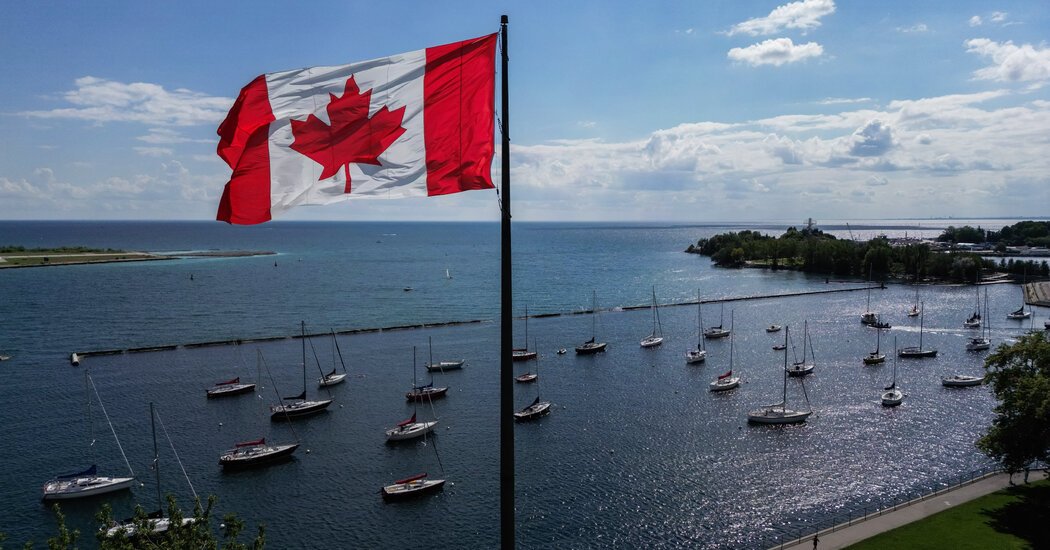
Americans hadn’t seen President Trump in a few days, not since he diverted from an education policy event on Monday to give reporters a tour of the new helipad he is building on the South Lawn of the White House.
A curious citizen may wonder: What has Mr. Trump been up to in the days since we last saw our wartime president? What are his priorities?
We all got an answer on Thursday, when Mr. Trump decided to take a private event, previously billed as a “Signing Time” session on his daily schedule, and make it public. He beckoned reporters into the Oval Office, where he sat next to a large poster of the Great Lakes, which were displayed alongside the words “Making The Great Lakes Even Greater.”
This is not really possible, as the Great Lakes are perfect as they are. But Mr. Trump decided to bump renaming Lake Ontario to the top of his priority list anyway. With a flourish of his executive-order Sharpie, Mr. Trump rechristened the body of water Lake America, sticking it to the Canadians as trade negotiations continued to devolve.
This was only Mr. Trump’s latest maximally patriotic (and some may say, diplomatically petty) branding exercise meant to slight an old ally. On the first day of his second term, Mr. Trump pulled out that Sharpie and — Presto! — turned the Gulf of Mexico into the Gulf of America, as part of a broader effort to “honor American greatness.” On Thursday, Mr. Trump also mused that he would rename an ocean and complete the set.
As one of the five Great Lakes of North America, Lake Ontario didn’t ask for this. The lake existed peacefully long before humans arrived and started divvying up their shares. Now, there is a dividing line between the United States and Canada, drawn right through the pancreas-shaped body of water. Mr. Trump’s executive order asserts that the deepest waters of the lake are located in the United States, along with most of the lake’s volume.
Inside the Oval Office, a reporter asked Mr. Trump a question relevant to his priorities: Why target allies over adversaries?
“Well, they haven’t treated us well,” Mr. Trump said. “The Canadian officials have treated us very badly; they’re nasty people. They charge our farmers 400 percent tariffs. They’ve been doing it for a long time. And I had them figured out in my first term, and I did some pretty strong things and had it getting pretty good. And then the election was rigged and now I’m coming back and doing it the way it — and finishing the job.”
(Mr. Trump has repeatedly claimed that the Canadians bring exorbitant tariffs against American farmers, and those past assertions, just like this one, were misleading.)
Mr. Trump’s rebranding-focused executive orders can direct federal agencies to adopt the new names, but other countries do not have to acknowledge the change, and the Canadians definitely do not seem interested in doing so.
“The name Lake Ontario comes from the Wendat word Ontari’io, which, appropriately, means “the lake is beautiful, the lake is big”. The name is more than 400 years old, predating both the Confederation of Canada and the Declaration of Independence of the United States of America,” Prime Minister Mark Carney of Canada wrote on X — in English, and in French — in a rebuttal to Mr. Trump’s decision. “We know that America is changing. Their trading relationships, their foreign policies, their national monuments, their hydronyms. Canadians also know that naming reality means calling it Lake Ontario — then, now and always.”
Doug Ford, the premier of Ontario, has grown frustrated with souring trade talks and escalating lake threats in recent days, and has said the president could kiss a certain body part — the French call it a derrière. On Thursday, though, Mr. Ford issued a succinct response: “It’s Lake Ontario to Canadians and the rest of the world. Now and forever.”
And so goes another Thursday in the doldrums of Mr. Trump’s August, when he has poked his head up long enough to cause a diplomatic disturbance before retreating out of the public eye to turn to other pressing matters. (Some supporters suggested that this was all a highly strategic way to whip the news media up: “Trump Controls the News Cycle Volume 87187585124782,” Tricia McLaughlin, a former Department of Homeland Security spokeswoman, wrote on X in support of Mr. Trump’s work today.)
On his Air Force One flight to a (private) Republican National Committee event in Houston, Mr. Trump kept the public updated on staffing — Ben Moss is the new White House staff secretary — and his thoughts on presidential performance, posting a graphic of past presidents next to rankings ranging from “THE GREATEST” (take a wild guess) to “FAILURES” (now take another one). He posted an image declaring that the war in Iran was “MISSION ACCOMPLISHED” — not quite true — and he congratulated Nvidia on a record sales year.
He eventually circled back to the matter of renaming the lake, posting a letter from Dr. Ned Mamula, the director of the U.S. Geological Survey, who told him that his wish had been granted.
“The change will begin occurring in printed documents over the next several days,” Dr. Mamula wrote.
Mr. Trump’s job approval rating has reached record lows. The war he began against Iran turns six months old on Friday, which is about five months longer than he had originally promised. And old allies — the Canadians, of all people — are growing comfortable showing greater degrees of defiance in the face of Mr. Trump’s threat.
But at least this mission, this matter of renaming a lake, was accomplished.