dailynewsnblog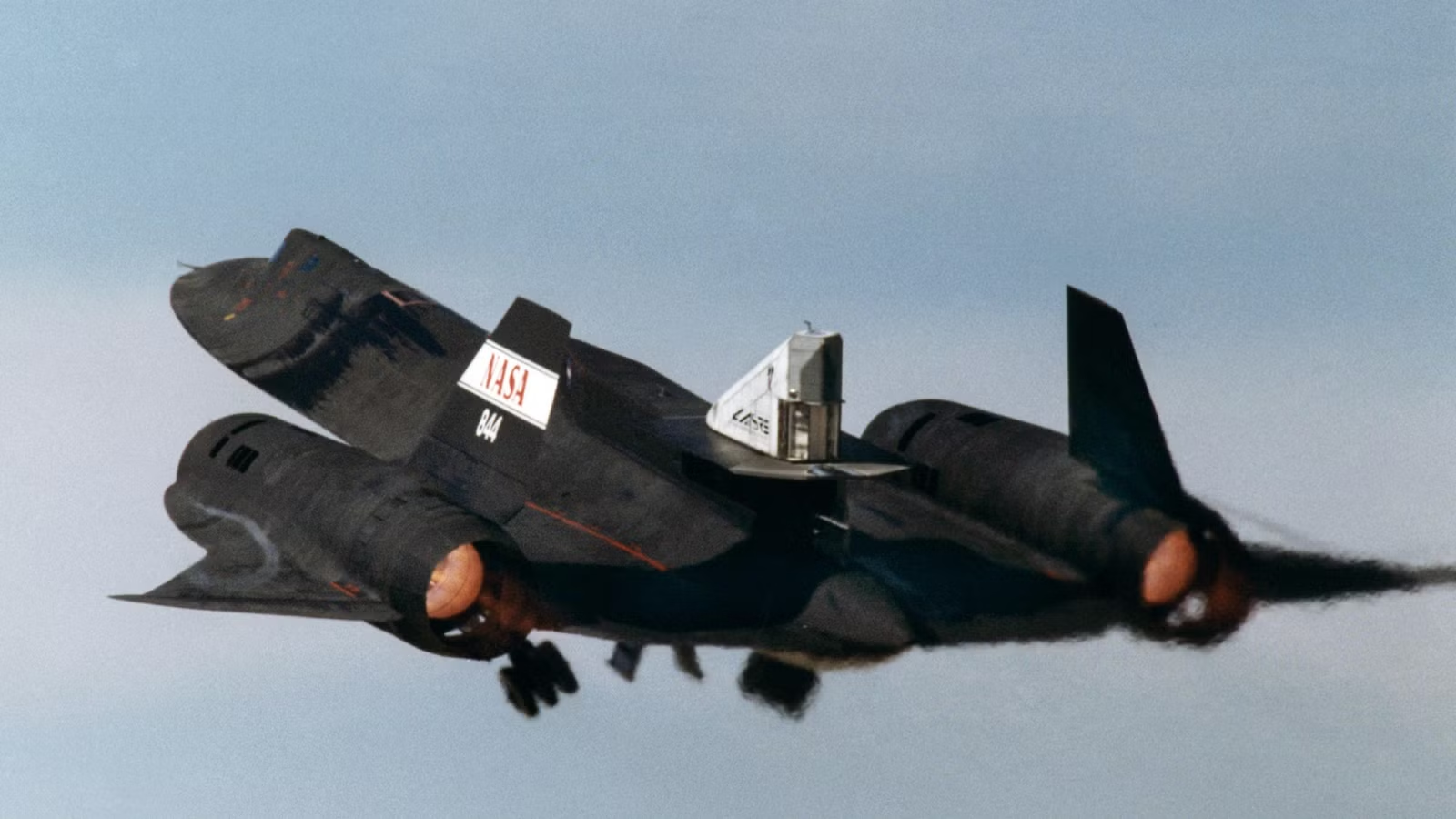
Some observers draw parallels between the next-generation adaptive propulsion system that will power the upcoming  Boeing F-47 sixth-generation fighter jet and the turboramjet engines of the Lockheed SR-71 Blackbird. It can be seen how the mission of the F-47’s next-generation air dominance appears to succeed that of the iconic Mach 3 SR-71 spyplane. Yet, the two power plants differ drastically in design and purpose.
Unlike the Lockheed Martin F-22 Raptor that came before the F-47, the NGAD will be designed for an extremely long range, with engines that can switch between endurance and supersonic performance on the fly. This also departs greatly from the high-speed reconnaissance performed by the Blackbird for which it was famously built to fly so fast.
The F-47 will not be a brutally agile dogfighter or an extremely fast eye in the sky, but rather a super high-tech battlefield commander. One of the reasons the immensely powerful engines will not make the NGAD more performing than its Cold War predecessors is that they will generate massive amounts of electrical power. This is also why it will not be more maneuverable than the Raptor, because its mission is not to go head-to-head with enemy fighters either.
NASA’s LADS & LASRE: The SR-71 Connection

The Pratt & Whitney J-58 used by the SR-71 was built for pure power, which varies significantly from the engines in development by P&W and General Electric NGAP prototypes. The engines in the F-47 will actually be lower-performance than those of the SR-71 and possibly the F-22 before it. Although the details remain shrouded in secrecy, the Air Force has made it clear that the performance profile of the NGAD will emphasize endurance and rapid transit over battlespace.
It is possible that technology pioneered by NASA during the Linear Arrow Spike SR-71 Experiment in 1997 may be connected to the latest NGAP developments. NASA’s Laser Air Data Sensor (LADS) project, which preceded LASRE, pioneered the use of a laser to replace the pitot tube for aircraft data. This is valuable for a stealth aircraft that cannot have external projections on the fuselage. Additionally, LASRE provided valuable research in high-fidelity computational fluid dynamics, which has helped make advanced aerodynamic shapes possible and directly contributed to the engineering of the F-47.
So there is a connection between the Blackbird and the F-47 program from a design and research standpoint. However, there is little to no similarity in the actual machines themselves. Especially when considering the fact that the 1960s-vintage SR-71 only had very minimal low-observability properties, as it was one of the first aircraft to incorporate any radar-defeating design at all. On the other hand, the F-47 will have the most advanced multi-spectral stealth profile of any aircraft ever built, which necessitates a radically different power plant.
NGAP: The Sixth Generation Evolution

The unique turboramjet engines of the SR-71 were extremely impressive in their time, but the needs of the Air Force and the demands of 21st-century Air Warfare have changed engineering priorities. The next evolution of fighter jet propulsion will not be purely about speed and maneuverability, but rather about maximum efficiency. This calls for a third stream of air in the new turbofan engines that are estimated to be in the 40,000-pound thrust class.
The current rejection puts the thrust output of the F-47 power plants at roughly the same level as those of both the F-22 and the SR-71. The exact specifications of the GE XA102 or the P&W XA103 Prototype NGAPs are expected to remain classified for some time as development is still ongoing. The engineering heritage of these power plants currently traces back to the Adaptive Engine Transition Program, which was targeted at enhancing the Lockheed Martin F-35 Lightning II.
Under the AETP, the GE XA100 and P&W XA101 were shelved in favor of incremental upgrades to P&W’s F135 engine, which is currently the most powerful engine in a combat jet and already powers the F-35 Joint Strike Fighter fleet. The NGAP will feature a third airstream that can be routed either to the bypass duct for fuel-efficient cruise and as a heat sink for cooling avionics and sensors, or to the core for maximum thrust. That will allow the same engine to swap between fuel-sipping and high-thrust at the flip of a switch.
The Paradigm Shift In 21st Century Air Warfare

The reason the NGAP departs so significantly from the fighter jet engines that preceded it is a major doctrinal shift in the US Air Force and the fact that every other major air power around the globe is following suit. As illustrated in the conflicts in Ukraine and Iran over the past few years, the dogfights of previous air battles are a thing of the past. They have been replaced by asymmetric warfare, which relies on superior sensors and uncrewed platforms.
To this end, the F-47 will trade super maneuverability and dogfighting dominance, as seen in the F-22, to gain technological superiority in the battlespace. It will act as a kind of quarterback, directing swarms of drones and feeding data to every joint platform in the interconnected combat cloud over an encrypted data link. The NGAD is expected to have supercruise capability like the Raptor, but that is essentially where the similarities of performance end.
Functioning as a mothership over contested skies that cannot be detected by any known sensor, the F-47 can push targeting data out to either standoff platforms like the Boeing F-15EX Eagle II and B-52J Stratofortress or direct support by collaborative combat aircraft. The F-47 will fundamentally change how air superiority is achieved on the battlefield tomorrow by using its ‘off-board arsenal’ rather than directly shooting down adversary aircraft or striking surface-to-air missile batteries.
Long Legs: Supporting The Pivot To The Pacific

The People’s Republic of China has established itself as the only nation besides the United States to simultaneously produce and field two distinct fifth-generation stealth fighter families: the Chengdu J-20 air-superiority platform and the Shenyang J-35. This expanding tactical aviation inventory is backed by major propulsion breakthroughs and an extensive A2/AD missile matrix designed to hold the entire Western Pacific at risk.
The People’s Liberation Army Air Force’s evolving fighter fleet acts as the forward sensory layer for China’s missile matrix. This combined arms force is a system engineered to isolate the first and second island chains. The cornerstone of this land-based containment strategy is the DF-26 intermediate-range ballistic missile, frequently referred to as the ‘Guam Killer.’
Featuring an operational range of 4,000 to 5,000 kilometers, the road-mobile, solid-fueled DF-26 can carry conventional or nuclear payloads. This reach places the massive US hub at Andersen Air Force Base on Guam, along with the first island chain, facing across Okinawa, the Philippines, and other islands of Japan, under constant threat of saturation strikes.
Unlike the European theater, combat operations in the Pacific to counter these threats would require traversing thousands of nautical miles across the open ocean. Relying heavily on non-stealthy aerial refueling tankers is a severe vulnerability in contested airspace. A longer organic range allows the F-47 to operate deep inside anti-access/area-denial bubbles without exposing vulnerable support aircraft. Thus, the F-47 must carry a massive internal fuel payload and use it to its fullest extent.
NGAD: Built For Tomorrow’s Battle

Operating as the master command node, the F-47 leverages its NGAP-enabled power allocation to stitch together separate military components into a unified, resilient kill web. The F-47 acts as a localized controller for forward-deployed CCA drones. Pushing the automated ‘loyal wingman’ drones into high-risk zones allows the F-47 to gather tracking data on Chinese next-gen jets without revealing its own location. It fuses this data with long-range bombers like the B-21 Raider to eliminate land-based mobile missile launchers before they can fire.
If China launches complex ballistic salvos toward Okinawa or Guam, the F-47’s high-altitude radar can identify the missiles’ signatures early. It calculates the trajectory vectors and transmits the tracking directly to Patriot and THAAD batteries. Operating above the naval radar horizon, the F-47 also beams high-fidelity tracking data directly to Navy Aegis destroyers and submarines via secure, directional data links. By supplying precise coordinates to ships operating with dark radars, the F-47 allows the surface fleet to launch long-range anti-air and anti-ship missiles.
The Air Force has publicly disclosed only broad performance targets for the finished aircraft: a top speed above Mach 2, sustained supercruise, all-aspect broadband low observability, and a combat radius exceeding 1,000 nautical miles (1,850 kilometers). That is roughly double the F-22’s estimated 590-nautical-mile (950 km) radius and about 30% beyond the F-35A’s 670 nautical miles (1,100 kilometers), a figure explicitly aimed at reaching contested airspace around Taiwan or the South China Sea from bases in Guam or Japan without tanker support.
The Air Force’s Compromise To Achieve Aerial Dominance

The F-22 was built for within-visual-range dogfighting, relying on thrust-vectoring engines, physical agility, and a high power-to-weight ratio to win close-in aerial duels. The F-47 sheds this high-G maneuverability. Meanwhile, the SR-71 relied on pure speed (Mach 3+) and extreme altitude to outrun threats, operating as a passive reconnaissance platform with no offensive weapons.
The F-47 sheds this high-G maneuverability, and even with these stealthiest engines, high speed generates thermal signatures that defeat stealth. Because tight turns consume energy and require large, radar-reflecting vertical tail fins, the F-47 employs a tailless blended-wing-body design. The F-47 relies on deep infrared and low radar observability to remain undetected while managing a battle space. It focuses entirely on beyond-visual-range missile exchanges and digital dominance rather than turning circles.