dailynewsnblog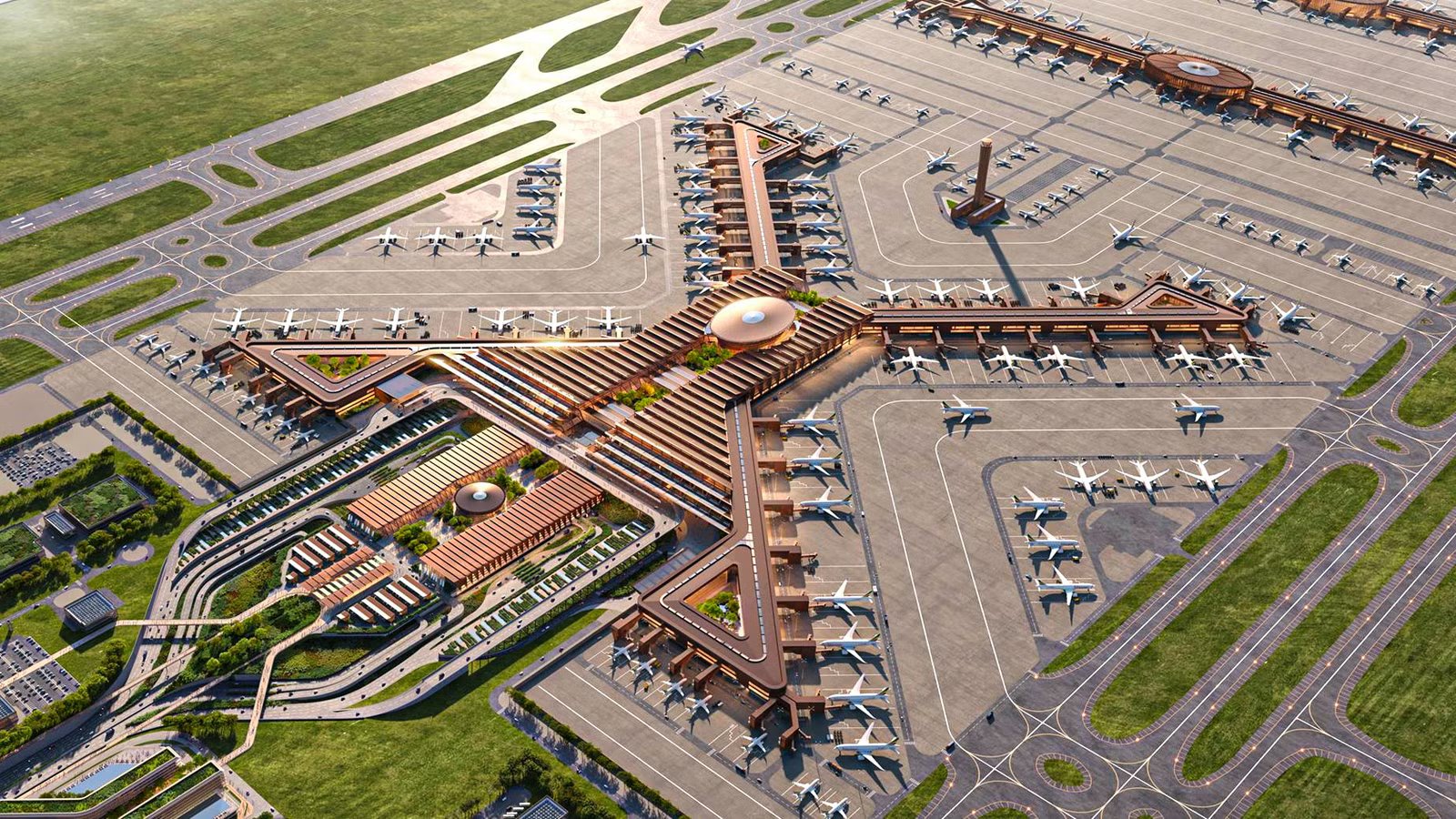
Africa remains one of the most challenging aviation markets in the world. While the continent is the second largest in the world in both overall size and population, Africa accounts for only around 2% of commercial air traffic, per Business Insider. According to IATA, Africa’s aviation market is forecast to grow 4.1% annually to 411 million passengers a year over the next two decades.
This growth potential is reinforced by Africa’s rapidly expanding population, which is expected to reach 3.8 billion people by 2100. To accommodate this growth, the region’s often underdeveloped air travel infrastructure will therefore need significant investment over the coming years. Many African countries continue to announce ambitious and prestigious infrastructure projects, but few of these actually come to fruition.
One such project that is now actually taking shape is Ethiopia’s Bishoftu International Airport (BIA), partly funded by the continent’s largest and most successful carrier, Ethiopian Airlines. This new airport will act as the next global hub for the  Star Alliance member and compete with the likes of
  Istanbul Airport (IST) and
  Dubai International Airport (DXB).
It will also complement nearby Addis Ababa Bole International Airport (ADD). The airport’s planned scale allows Ethiopian to build a much larger connecting hub between Africa, Europe, Asia, the Middle East and the Americas, helping reduce the continent’s passenger leakage to hubs in the Middle East and Europe.
Bishoftu International Airport Can Reshape African Aviation

The construction of Bishoftu International Airport commenced in January 2026, with phase one of the project expected to be complete by 2030. Ethiopian Airlines is funding 30% of the $12.5 billion needed to complete this first phase. By 2030, the airport is planned to have an initial annual capacity of 60 million passengers and 110 million passengers when fully completed.
This would make the airport one of the largest in the world with a total capacity exceeding  Hartsfield-Jackson Atlanta International Airport (ATL) 2025 passenger volumes. Mesfin Tasew, the Group CEO of Ethiopian Airlines, said:
“Bishoftu International Airport marks a historic leap in Africa’s aviation journey, significantly enhancing trade, tourism, and business across the continent and beyond.”
The reason for Ethiopia to construct an airport from scratch is that Bole International Airport, the country’s current largest hub located in the middle of the country’s capital, Addis Ababa, is operating near maximum capacity with limited space for further expansion. While this airport will remain operational for domestic and regional point-to-point flights serving local demand, the new mega airport 25 miles (40 kilometers) to the south-east in Bishoftu will replace Bole’s hub function.
According to the project’s architects, up to 80% of passengers using the new facility in Bishoftu will be transfer traffic and never actually enter Ethiopia. While a large proportion of these passengers will transfer on flights between Africa and other regions of the world and vice versa using Ethiopian Airlines’ vast network, the new facility could also provide a significant boost to fragmented intra-African connectivity.
Today, only 19% of intra-African routes have direct flights. OAG data also suggests that more than 70% of scheduled seats operated by African carriers in August 2026 were on routes to Europe or the Middle East, while intra-African routes accounted for just 21.1% of total capacity across the region. In some cases, passengers even leave the continent before returning to another African destination via a hub in Europe or the Middle East. Bishoftu could therefore function as an intermediary hub.
Bishoftu Fits Africa’s Wider Aviation Ambitions

The development of a new airport in Bishoftu also largely aligns with Agenda 2063, the African Union’s long-term strategy to improve connectivity, trade and economic integration across the continent. In particular, the airport supports the ambitions of the Single African Air Transport Market (SAATM), one of Agenda 2063’s flagship projects, by providing the infrastructure needed to connect more African cities through a major continental hub.
The implementation of SAATM could increase traffic between African countries by up to 141% and reduce fares by as much as 35%, according to research by Georgetown University. Greater liberalization would allow airlines to open more routes and frequencies between African countries, while Bishoftu could aggregate demand from smaller markets that are unable to support direct services on their own.
Combined, these developments could make traveling between African countries significantly easier while allowing Ethiopian Airlines to retain more connecting traffic within the continent. However, constructing one of the world’s largest airports will not solve Africa’s aviation challenges on its own.
IATA continues to highlight high taxes and charges, elevated operating costs, limited affordability, and slow progress toward market liberalization as structural barriers to the industry’s growth. Bishoftu can therefore provide much of the physical infrastructure needed to support Africa’s aviation ambitions, but realizing its full potential will also depend on governments creating the regulatory and economic conditions needed for airlines to actually expand across the continent.
Bishoftu International Airport Is Going To Be Massive

The planned airport in Bishoftu will cover roughly 13.5 square miles (35 square kilometers) of land. For comparison,  New York JFK Airport (JFK) is only 8.1 square miles (21 square kilometers) while
  London Heathrow Airport (LHR) is even smaller at 4.74 square miles (12.3 square kilometers). Despite the airport’s construction site being chosen for the amount of space available, it is not all positive, as thousands of people have been displaced due to the project.
In the first phase of the project, two parallel runways are planned that operate independently of each other, with a terminal of around 163 acres (660,000 square meters). Two more runways are planned to be added in subsequent phases alongside 270 aircraft parking positions, enabling the facility to reach its targeted passenger capacity. BIA’s runways will also be longer compared to the current runways at Bole International Airport.
Combined with the 400-meter lower elevation at approximately 6,300 feet (1,920 meters) above sea level, this will improve aircraft performance and operational efficiency. According to Zaha Hadid Architects, the firm that also co-designed the  Beijing Daxing Airport (PKX), the new terminal’s design is deeply rooted in its local geography. They say that
“Each of the terminal’s piers incorporates a unique interior materiality and color palette to reflect the diverse regions of Ethiopia. Inspired by the Great Rift Valley that passes near Bishoftu as it crosses through the country, a single central spine connects the terminal’s facilities and aircraft piers, minimizing transfer distances and ensuring connecting passengers can easily navigate to their next departure gate.”
Although the exact timeline is unknown, the project also includes a high-speed railway line from the new airport to Addis Ababa and the current Bole International Airport. However, Bishoftu International Airport is planned to become much more than a passenger hub, with the wider development also including major cargo facilities and commercial real estate.
More Than Just Passenger Flights

The new airport is also planned to handle over four million tons of cargo annually, placing the facility comfortably among today’s busiest airports by cargo volume. For Ethiopia, cargo is strategically important since the country is completely landlocked, making it dependent on other neighboring countries for access to ocean shipping. The airport is thus also expected to strengthen Ethiopia’s position as a logistics gateway between Africa and international markets.
Beyond the infrastructure needed to process these large freight volumes, the project also aims to create a true airport city, or ‘aerotropolis,’ surrounding the terminal. This includes hotels, retail, and offices, intended to capture the wider economic activity generated by the hub rather than treating the airport purely as transport infrastructure.
If successful, Bishoftu could therefore generate economic activity well beyond Ethiopian Airlines’ passenger operations. Combining one of Africa’s largest passenger hubs with major cargo, logistics and commercial facilities could turn the area surrounding the airport into an important employment and investment center. It will also strengthen Ethiopia’s position as one of the continent’s main aviation gateways.
Can Bishoftu Live Up To Its Ambitions?

Bishoftu International Airport is also closely tied to Ethiopian Airlines’ wider Vision 2035 strategy, under which the group aims to become one of the world’s 20 most competitive and leading aviation groups and grow its fleet to over 270 aircraft. Ethiopian has already expanded far beyond the traditional role of a national flag carrier and now operates a multi-hub strategy across Africa. The company holds partial ownership in airlines such as ASKY Airlines, Air Congo, Malawi Airways, and Zambia Airways.
Bishoftu therefore represents the infrastructure needed to support the airline’s next stage of growth, giving Ethiopian significantly more room to expand its fleet, network, and connecting operations than Bole International Airport can currently provide. However, the scale of the project also creates significant execution risks.
Ethiopian Airlines plans to provide around 30% of the required funding itself, leaving the majority to be financed externally, with the African Development Bank appointed to help mobilize billions of dollars in debt financing. Completing the first phase by 2030 is therefore an ambitious target for a project of this size, particularly as construction, financing and the airline’s own expansion will all need to progress largely in parallel.
Africa’s Busiest Airports By Passenger Traffic In 2025 | |||
|---|---|---|---|
Airport | Country | 2025 Passengers | Annual Change |
Cairo International Airport (CAI) | Egypt | 31.14 million | +7.5% |
OR Tambo International Airport (JNB) | South Africa | 19.74 million | +7.4% |
Addis Ababa Bole International Airport (ADD) | Ethiopia | 13.13 million | +8.6% |
Mohammed V International Airport (CMN) | Morocco | 11.46 million | +9.3% |
Hurghada International Airport (HRG) | Egypt | 11.43 million | +18.5% |
Bishoftu may already be taking shape, but securing sufficient capital and delivering the airport on schedule will be just as important as the strength of the underlying demand. Competition is another challenge, and Ethiopian is not only trying to retain passengers who currently connect through established hubs in Europe or the Middle East. The carrier will also face growing competition within Africa itself as, for example, Rwanda continues to develop the new Bugesera International Airport.
Cairo International Airport (CAI) is also moving ahead with a new Terminal 4 that is expected to increase its annual capacity to around 70 million passengers. Bishoftu arguably has the strongest advantage in Ethiopian Airlines’ already extensive African network, but whether that will be enough to fill an airport designed for 110 million passengers will ultimately determine whether the project becomes the continental aviation hub its planners envision.