dailynewsnblog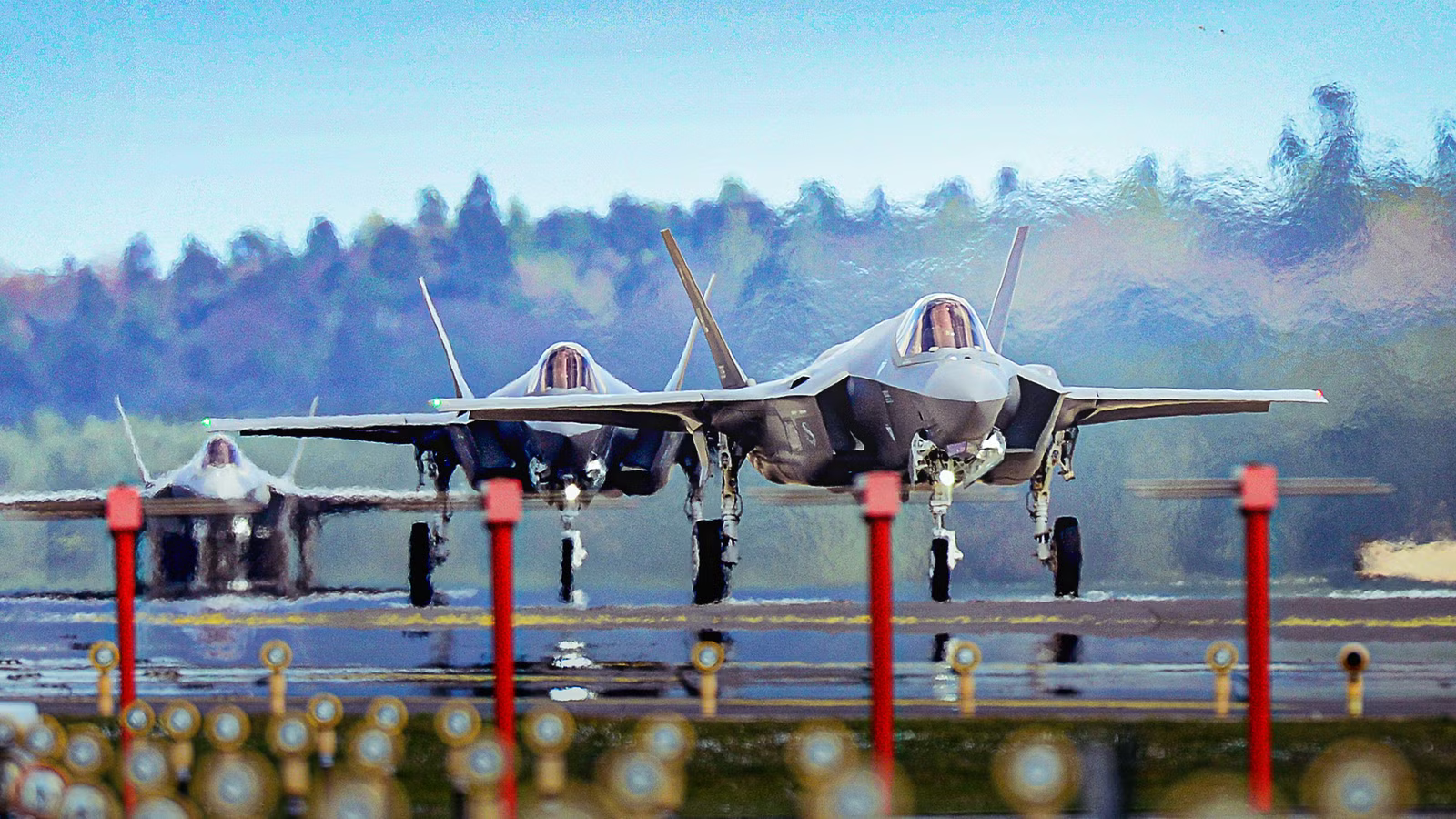
Since the North Atlantic Treaty Organization was established, joint air operations have been a crucial element of the Coalition forces. The United States played a central role in the alliance, with President Harry Truman leading the assembly of 12 founding members to sign the Washington Treaty in 1949.
The US remains, to this day, the most powerful military among the 32 member nations, which means American military aircraft make a vital contribution to many NATO missions. While American aircraft are a small portion of the permanent NATO fleet, the US assets are considered ‘critical enablers’ thanks to their advanced capabilities.
At any given moment, there were between 300 and 400 aircraft in Europe that belonged to the US Air Force, Navy, Marines, and Army. That represents roughly 10% of the total air warfare capability of the NATO alliance, and about half of those airframes are concentrated at 5 bases. Some of these air bases pre-date the founding of NATO but have continuously evolved over the decades to defend Europe’s skies.
Aviano Air Base, Italy
Home to the 31st Fighter Wing

The USAF began a long-term presence at Aviano in 1954, and it became an official joint base under the NATO umbrella after the US and Italy formally announced the decision in 1955. Today the 31st Fighter Wing maintains a standing force of Lockheed Martin F-16 Fighting Falcons to support missions in Southern and Eastern Europe. The base is home to one of just six bases that house nuclear weapons as a part of the shared NATO deterrence mission.
Since the introduction of the Lockheed Martin F-35A Lightning II by the US Air Force, the nuclear deterrence mission has been modernized for deployment on the new stealth fighters. Italy is also one of the NATO members that has ordered a dual-capable aircraft, specifically the nuclear-armed F-35A variant. Germany, Belgium, the Netherlands, and the United Kingdom will also receive DCA still fighters.
There are approximately 20 of the B61-12 guided nuclear gravity bombs in the arsenal at Aviano. Notably, the US Air Force has not yet announced a timeline to replace the F-16s at Aviano with F-35s because the Falcons are already certified as DCA-capable. The current strategy has USAF F-35 Joint Strike Fighters rotating in and out of deployment, with the NATO JSFs providing permanent stealth DCA platforms.
RAF Mildenhall, United Kingdom
Host of the USAF’s 100th Air Wing

Mildenhall was founded as an RAF bomber base in 1934 and temporarily shuttered in the post-war years until it was reopened as a joint US-UK Air Base in 1950. It was once again slated to be shut down in 2020, but those plans were reversed because its mission remains crucial to the alliance. Mildenhall is the largest hub of aerial refueling aircraft and special operations air assets in the NATO fleet.
The USAF’s 100th Air Refueling Wing provides the bulk of that AR capability with its Boeing KC-135 Stratotankers. From Mildenhall, the tankers can support operations across the Atlantic, Arctic, and even Black Sea airspace. The AR mission is a vital strategic capability that makes it possible for fighters and bombers to conduct operations across Europe, Africa, and the Middle East.
Also stationed at Mildenhall is the 352nd Special Operations Wing, which flies Lockheed Martin MC-130J Commando II and Bell CV-22B Ospreys. These forces train for low-level infiltration and tactical assault missions behind enemy lines as well as combat search and rescue. These elite aviators and special warfare operators are some of the most highly trained soldiers in the world. They prepare 24/7 to face extreme conditions to perform daring missions like the rescue of the USAF pilot who was shot down in Iran earlier this year.
The 95th Reconnaissance Squadron is also posted at Mildenhall, conducting electronic intelligence with its Boeing RC-135V/W Rivet Joint surveillance planes. While these uniquely modified jets share the same airframe as the Stratotanker, their fuselages are filled with advanced electronic sensors instead of fuel tanks. The Rivet Joints loiter for dozens of hours outside the airspace of adversaries like Russia to gather signals emitted by their weapon systems.
Rivet Joints perform one of the most important missions that no one ever hears about; they monitor invisible wave spectrums using a crew of more than 30 people. That roster includes electronic warfare officers, intelligence operators, and linguists. Expeditionary deployments of the Boeing E-3 Sentry Airborne Early Warning and Control plane are also often seen at Mildenhall to support regional air defense. The E-3’s enormous radar array complements the intelligence from the Rivet Joint and long-range radar to fighter jets, creating a comprehensive battle space ‘picture.’
RAF Lakenheath, United Kingdom
Fighter country in the UK

The RAF has maintained a permanent presence at Lakenheath since 1941, and the base was a major hub of the 1948 Berlin Airlift for the US Army Air Forces. Over the years, its role as a key tactical base has continued to expand, and today it is home to many fourth and fifth-generation USAF fighter jets. The 48th Air Wing supports operations by Boeing F-15E Strike Eagles and F-35 stealth fighters.
Following the UK’s first order of 12 F-35A JSFs, Lakenheath is being modernized to restore its capability to support the DCA nuclear deterrence mission. The project is a $4.2 billion investment by the US and the UK, which will also modernize it into the premier fifth-generation strike fighter base in the NATO alliance. In addition to the armory, upgrades are slated for maintenance facilities, fortified aircraft shelters, training facilities, and simulators, as well as many other areas.
There are currently more than 50 US F-35As stationed at Lakenheath with the 495 FS and 493 FS. The 494 FS is also scheduled to transition from the F-15E to the F-35 in the next 2 to 3 years, bringing an additional two dozen stealth fighters to the base. The combined number will grow to almost 90 once the Royal Air Force receives its F-35As in the next few years.
Spangdahlem Air Base, Germany
The roost of the 52nd Air Wing

Spangdahlem Air Base in Germany is a joint base that hosts the 52nd Fighter Wing of the US Air Forces in Europe. The 480th Expeditionary Fighter Squadron flies F-16 ‘Vipers’ with a unique mission set: the Wild Weasel. The aircrew of the 480 FS train to perform suppression of enemy air defenses and effectively ‘kick open the door’ for other Allied aircraft in the event of open conflict. The SEAD mission requires these pilots to fly directly at surface-to-air missiles and destroy them using unique radar-seeking weapons.
The 52 FW was the last permanent flying unit of the Fairchild Republic A-10 Thunderbolt II when its last Warthog was retired in 2013, leaving only the Vipers. In 2020, the US considered winding down the fighter mission, but once the administration of President Joe Biden took office, the decision was immediately reversed. Today there are between 4,000 and 5,000 American troops that support Spangdahlem.
Following the full-scale invasion of Ukraine by Russian forces in 2022, Spangdahlem saw a surge in deployments. Rotating units have included F-35 fighter jets, air tankers, and even electronic warfare planes like the Boeing EA-18G Growler from the US Navy. The heightened mission tempo has continued with the 2026 operation Epic Fury as Spangdahlem and the 52 FW have supported the combat ops in the Middle East.
Ramstein Air Base, Germany
The Air Force’s ‘global gateway’

Situated in southern Germany, Ramstein is the largest American Air Base overseas and serves as a vital airlift hub in the global network of US air operations. The base opened in 1952 as part of post-WWII reconstruction programs. Since then, Ramstein has been the headquarters of two major commands for decades. USAFE was established on-site in 1973, and NATO Allied Air Command the following year, in 1974. This was later joined by US Air Forces Africa in 2012.
The 86th Airlift Wing is crucial to coordinating massive troop movements to and from the US, as well as transporting medical evacuees from combat zones to hospitals stateside. The 521st Air Mobility Operations Wing also coordinates a global logistics chain that moves people and material. The most commonly seen aircraft here is the C-130 Hercules, but many airframes from all the NATO fleets can be seen stopping by Ramstein. USAF E-3 AWACS are often deployed here as well to support regional air defense.
Ramstein is the most critical strategic installation for the USAF, Europe, and the entire Allied air power of NATO. Without this facility, there would be a major bottleneck that would hold back any large-scale air campaign, troop movements, or unified missile defense. The base serves as the nerve center of NATO’s integrated air and missile defense, which combines American and European counter-ballistic equipment. This system ‘fuses’ data together from radar arrays, Navy ships, or bases in Turkey and sends it to launchers in Poland or Romania to shoot down incoming missiles.
The base also sits at the center of the Kaiserslautern Military Community, which the Air Force and Pentagon describe as the largest American community outside the United States, encompassing more than 50,000 US service members, dependents, civilians, and contractors.