dailynewsnblog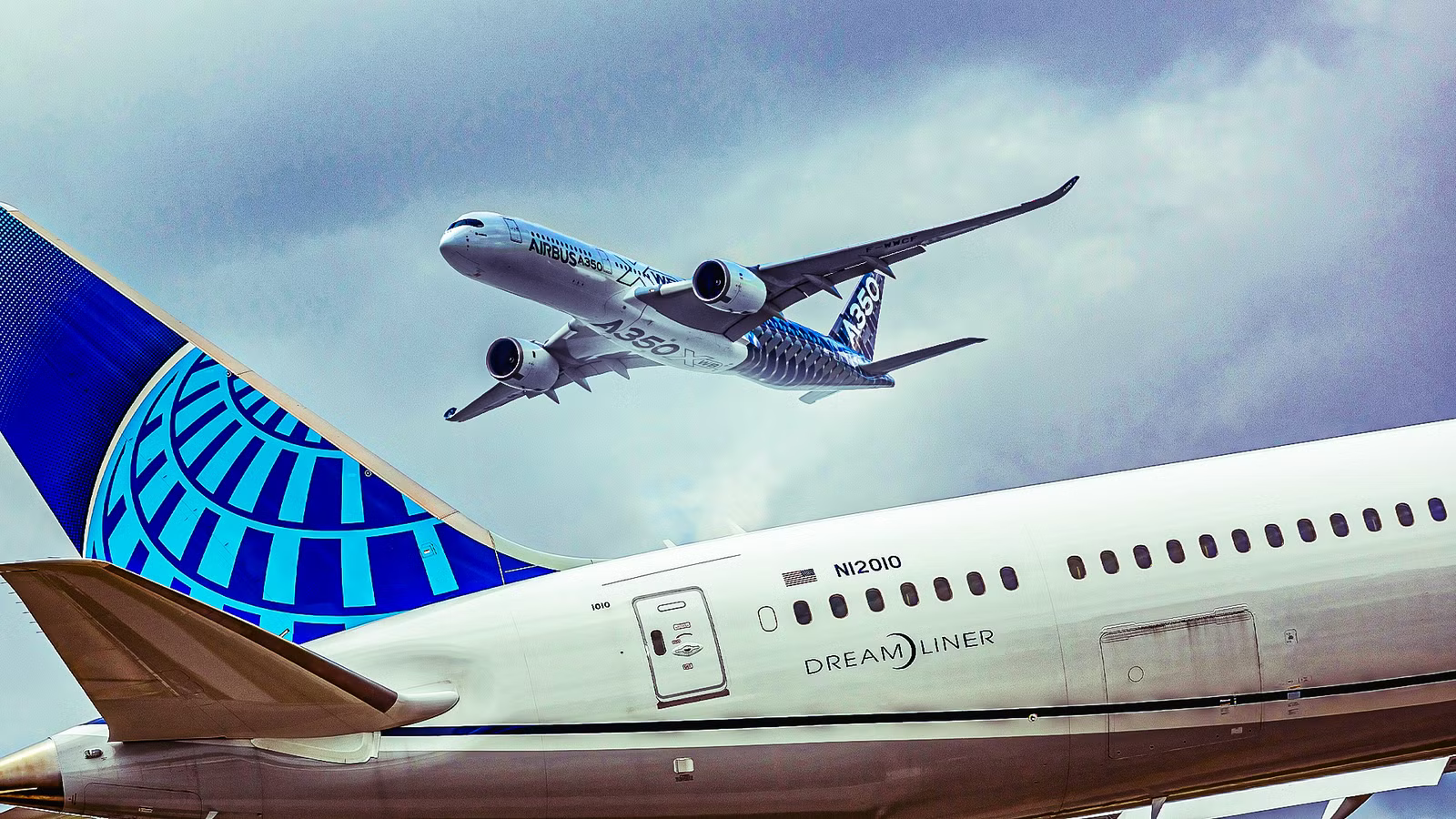
A microscopic layer of melted desert dust on a turbine blade might seem an unlikely reason for one of the world’s largest airlines to reconsider a 45-aircraft order. But that is the backdrop to  United Airlines CEO Scott Kirby putting Rolls-Royce in his “doghouse” as a contract dispute threatens to unravel the carrier’s long-delayed Airbus A350 plans. The immediate issue is contractual, but the consequences extend to engine durability, maintenance economics, and United’s wider fleet strategy.
The central question, then, is not simply why Kirby is angry with Rolls-Royce. It is why a dispute over engine agreements has escalated to the point of putting United’s A350 program at risk, particularly when the airline has already built an overwhelmingly  Boeing widebody fleet and has hundreds of 787s either ordered or committed. Behind the legal argument is an even more important issue: whether United wants to introduce an aircraft, either an A350-900 or an A350-1000, whose only available engine comes from a manufacturer it is now fighting.
A $175 Million Dispute Has Put The A350 In Limbo

The immediate trigger is a long-running contractual dispute between United and Rolls-Royce. According to United’s regulatory disclosures, the airline entered into agreements with Rolls-Royce in 2010 covering engine purchases and related maintenance services for widebody aircraft. In 2017, United paid Rolls-Royce a $175 million commitment payment under those agreements.
The dispute escalated in December 2025, when United said that Rolls-Royce had breached the agreements and demanded repayment of the $175 million commitment payment, together with contractual escalation. Rolls-Royce did not make the payment and instead terminated the agreements, asserting that United had breached its obligations. United disputes that termination, with both sides claiming the other owes damages.
That makes the A350 problem fundamentally different from an ordinary aircraft-delivery delay. Airbus has no alternative engine supplier for the A350, meaning United cannot simply keep the aircraft but switch to another powerplant. United has effectively removed the A350 from its near-term “expected aircraft deliveries” schedule, with the type no longer appearing in the delivery timeline through the end of the current planning horizon, even though the order remains listed as a long-term commitment. The question then becomes whether United still wants to build an entirely new widebody platform around Rolls-Royce.
The Engine Behind The Argument Is More Complicated Than A Contract

The commercial tension matters because Rolls-Royce’s “Power-by-the-Hour” philosophy places engine maintenance at the center of the manufacturer-airline relationship. Its TotalCare model was designed to give operators predictable costs while transferring much of the risk associated with engine maintenance and unscheduled events back to Rolls-Royce.
That arrangement becomes particularly important when an engine operates in demanding conditions. The Trent XWB-97, the higher-thrust member of the XWB family, is also the hottest version of the engine. Rolls-Royce explains that during takeoff and climb in dusty regions, mineral particles can enter the engine core, break down and melt onto turbine components exposed to temperatures of up to 1,400°C. The resulting calcium-magnesium-alumino-silicate, or CMAS, can penetrate the turbine’s thermal barrier system as components expand and contract, as explained in Rolls-Royce’s Trent XWB-97 Middle East durability program.
That is why the durability story cannot simply be separated from the maintenance dispute. A power-by-the-hour contract is attractive when an engine’s performance is predictable; it becomes considerably more complicated when harsh operating environments accelerate deterioration and increase shop visits. Rolls-Royce has acknowledged the challenge and invested heavily in solutions, but the existence of a major durability program underscores why airlines are increasingly focused on the gap between promised engine economics and actual lifecycle performance.
But one important note: United’s last order was for 45 A350-900s, not 45 A350-1000s. The order has changed variants several times since its original 2009 announcement, including a period when United selected the larger A350-1000 before returning to the A350-900. That distinction matters because the durability issues receiving the most attention concern the XWB-97 used by the A350-1000, while the A350-900 uses the lower-thrust XWB-84. Yet the airline began to doubt the entire order.
The Hot & Sandy Problem Shows Why Engine Durability Matters

The XWB-97’s experience in hot, sandy environments illustrates the technical problem facing Rolls-Royce. As the highest-thrust Trent XWB, the engine operates at exceptionally high temperatures, leaving its high-pressure turbine particularly exposed when mineral dust enters the core. The particles can become molten CMAS and attack the thermal barriers designed to protect turbine components from extreme heat.
Catch what other flight trackers miss
Emergency squawks, holds, NOTAMs — live signals, no signup.
Open tracker
Catch what other flight trackers miss
Emergency squawks, holds, NOTAMs — live signals, no signup.
Open tracker
Rolls-Royce has responded with several hardware changes. One of the most visible is a new gadolinium-zirconate coating designed to interact with CMAS and increase its viscosity, reducing its ability to penetrate the thermal-barrier material. The manufacturer has also worked on cooling improvements, turbine changes and ceramic-matrix-composite components around the high-pressure turbine, while developing further modifications to improve the engine’s durability, as per Rolls-Royce’s Trent XWB durability update.
The program is significant in scale. Rolls-Royce has committed £1 billion to a multi-year investment across its Trent portfolio, with the XWB-97 receiving a substantial share of the durability effort. Aviation Week reported that Rolls-Royce’s planned XWB-97 improvements include new high-pressure turbine coatings, revised cooling, and ceramic-matrix-composite components, with testing designed to achieve at least a doubling of time-on-wing in harsh conditions.
Rolls-Royce has subjected the coatings to engine testing at its Derby Testbed 80 facility, including exposure to calibrated contaminants and temperatures reaching 1,400°C. The manufacturer says the enhanced hardware is now incorporated into production engines and is also being applied to engines undergoing repair or overhaul. The remaining complication is timing: United must decide whether the promised improvement is sufficient to justify committing to the aircraft before the fully developed package reaches its planned 2028 service-entry milestone.
Why The 787 Gives United A Way Out

This is where the dispute becomes a fleet-strategy problem. United currently has no A350s in service and operates an all-Boeing widebody fleet, meaning its long-haul operations are already built around the 767, 777 and 787 families.
The alternative is already sitting inside United’s order book. The airline famously ordered 100 Boeing 787 Dreamliners in 2022, giving it a substantial platform for future widebody growth. Since then, its commitments have expanded considerably: United’s June 2026 SEC filing lists 146 firm 787 commitments, with 107 expected to arrive after 2027.
United widebody position | Latest picture |
A350 commitments in question | 45 |
787 firm commitments | 146 |
787 expected after 2027 | 107 |
A350 expected deliveries in the last filing | 0 through 2027 |
The numbers explain why an A350 cancellation is commercially disruptive but not necessarily operationally disastrous. United would lose the opportunity to diversify its widebody fleet and gain another modern long-range platform, but it could continue expanding the 787 family it already knows. The carrier would also avoid introducing a second widebody manufacturer into an operation that has become heavily standardized around Boeing.
That does not automatically make the 787 the better aircraft for every mission. The A350 offers United another large twin-engine platform with considerable range and capacity, potentially replacing older 777s while adding fleet diversity. But every new aircraft type brings training, spares, maintenance, tooling and crew-planning implications, and those costs become harder to justify when the aircraft is tied to a supplier relationship that has already deteriorated.
The 2028 Fix Could Arrive Too Late For United

The technical irony is that Rolls-Royce may be solving precisely the problem that could prevent United from ever taking the aircraft. The company’s current XWB-97 program is designed to substantially extend time on wing, with Rolls-Royce describing a progression of durability improvements that could ultimately double the engine’s endurance in demanding environments. Aviation Week reported that Rolls-Royce was targeting service entry of the upgraded XWB-97 in 2028.
The development path has already produced measurable results. Rolls-Royce says the new CMAS-resistant coating can extend the life of thermal barriers by up to 30%, and its broader durability program is intended to deliver substantially larger gains when the improvements are combined. Earlier testing reported by Rolls-Royce and Aviation Week indicated a 60% improvement in one phase and an additional 30% in a subsequent phase, with the overall objective of approximately doubling time on wing.
For United, however, technical success in 2028 does not necessarily repair a commercial relationship that has already reached the litigation stage. The airline has already lost patience and removed the A350 from its near-term delivery schedule and its long-term fleet plans.
That creates an unusual race between engineering and fleet planning. Rolls-Royce can spend £1 billion to demonstrate that the XWB-97 is substantially more durable, but United still has to decide whether that improvement will arrive soon enough and whether it is willing to restore the order amid a relationship that has become publicly contentious.
United’s A350 Order Is Not Dead Yet?

For all the uncertainty surrounding United’s A350 program, the latest regulatory filing leaves one important door open. As of June 30, 2026, United still listed all 45 A350-900s as firm commitments in its aircraft order book, but unlike its 787s, A321neos and A321XLRs, the carrier assigned no expected delivery dates to the A350s, including beyond 2027. That distinction matters: United has effectively removed the aircraft from its operational planning, but it has not yet fully erased the order from its contractual commitments.
There is also evidence that the Airbus relationship itself has not simply been abandoned. A United filing shows that the airline and Airbus signed Amendment No. 10 to their A350-900 purchase agreement on February 27, 2026, several weeks after the Rolls-Royce dispute became public. That does not mean the A350s are coming to United, but it makes a definitive cancellation harder to claim. If the Rolls-Royce dispute is eventually resolved on terms acceptable to United, the carrier could theoretically revisit the aircraft rather than starting an entirely new procurement campaign.
The bigger question is what would have to change for United to reverse course. Rolls-Royce would need to resolve the contractual dispute, restore confidence in its maintenance and support arrangements, and demonstrate that its XWB durability improvements deliver the promised results in service. United, meanwhile, would have to decide that the A350 offers enough fleet or network value to justify introducing the type after years of delays. That is a much higher bar than simply deciding whether the aircraft itself is good enough.
For now, the 45 A350s occupy an unusual legal limbo: ordered, but not scheduled; contractually retained, but absent from United’s expected fleet growth. That leaves the door open to another twist in a saga that has already lasted more than 15 years. The decisive development may ultimately come not from Airbus or Rolls-Royce’s engineering departments, but from the settlement table: if United and Rolls-Royce can repair their relationship, the A350 order could survive; if they cannot, those 45 aircraft may finally disappear from United’s fleet for good.

![United Airlines Launches 14 New Nonstop Routes From The World’s Busiest Airport [Full List]](https://dailynewsnblog.com/wp-content/uploads/2026/08/1787424297_united-airlines-boeing-787-taking-off-at-chicago.jpg)