dailynewsnblog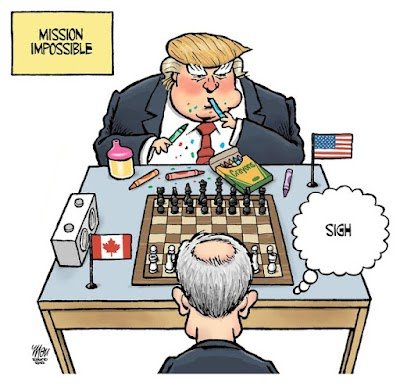

From what I am reading tonight, I suspect there are actually two Tariff Deals being negotiated now between Canada and the Trump administration.
TDStraight is the straightforward normal Tariff Deal where each side gets something. Tonight the Globe and Mail has an article with some details about the TDStraight deal, with some provisions that Canada won’t like and a few it will, and generally, at least, it does reduce Trump’s threatened steel and aluminum tariffs.
TDCrazy is the nutty Tariff Deal that Trump wants. It will be the nonsensical deal that panders to Trump’s ignorant prejudices, his mid-1970s world view and his knee-jerk complaints, plus a few goodies for Trump’s oligarch friends so they will call him up to praise it as a big “win”.
In TDCrazy, I’m thinking we will see things like allowing American booze back on our shelves, or letting American dairy producers sell us a little more cheese, or pandering to Zuckerberg by cancelling the Online News Act.
Some of this stuff actually doesn’t really matter much – who cares whether American bourbon is on our shelves again if nobody is buying it anyway?
But giving up the Online News Act would be a serious loss for Canada.
…I’m told, by sources not authorized to speak on the record, that Ottawa has told publishers to be ready for the death of the Online News Act. It would be just one concession offered up to alleviate — but not end — Trump’s punitive, illegal trade war.
Such a retreat wouldn’t just be bad policy. It would be a surrendering of our sovereignty.
The Online News Act requires that major social media, search and advertising technology companies compensate Canadian news outlets for lost advertising revenue. That law has only applied, thus far, to Google and Meta — and the latter hates it so much that they have blocked Canadians’ access to news on Facebook and Instagram for the past three years.
Google acquiesced to the law, paying out $100 million to Canadian publishers each year, but has made clear that they would rather face no regulations at all.
Thus far, Carney and his negotiators have been extremely tight-lipped about what is included in the U.S.-Canada deal. The White House has said the final deal will include “digital trade alignment,” though it is unclear what that means.
One source with knowledge of the talks but who spoke on background said the American negotiators have complained that our previous concessions to Big Tech haven’t gone far enough.
Neither Liberal MPs nor the premiers know the full extent of the deal. One MP told me there was “anxiety” in the caucus room Thursday, as MPs worried Carney may have been too desperate to get a deal. Quebec Premier Christine Fréchette has raised concerns about the deal and hasn’t indicated whether she will support it.
Another source briefed by Canadian officials confirmed that the Online News Act would be a likely concession, but stressed that things could change before Friday’s new deadline. It remains possible that there will be no deal at all.
The prime minister’s office has not returned a request for comment. As of deadline, details about the deal remain sparse.
If Ottawa is getting ready to kill the Online News Act, it would complete the dismantling of Canada’s meagre effort to rein in Big Tech. That would be a mistake.
Canada has already given in to American pressure to kill our Digital Services Tax — a three per cent levy on the revenue of major internet companies. Carney similarly kiboshed a plan to use the Online Streaming Act to force foreign media companies, like Netflix, to pay for Canadian media production.
Neither move earned us relief from the American extortion efforts.
“They don’t really get credit for doing something bad and then undoing it, right?” Jamieson Greer, Trump’s lead trade negotiator, said last month…
I’m hoping that, at most, Carney will just promise to “review” the Act to “co-ordinate” with American digital policies. At least until the Mid-Terms.
Moving on, I thought this was a perceptive comment. Dan Gardner argues that what Canada will actually get in the deal is time:
In The Globe and Mail, columnist Tony Keller writes:
Before you give a thumbs up or down to the unseen and uncompleted interim trade arrangement between Canada and the United States, get your head around the following:
U.S. President Donald Trump has never offered Canada a better trade relationship. That’s not what negotiations are about.
He has not offered a better, freer, easier trade relationship to any country.
The squeeze he put on every trading partner last year was this: Accept something worse than the status quo, or I’ll hit you with even worse.
He threatened higher tariffs, more trade restrictions and less free trade – while proposing that, if countries signed on the dotted line, the new tariff walls would be somewhat less high.
Not lower. Less high.
Remember the movie Dumb and Dumber? Trump trade policy is Bad or Badder.
Threatened with Badder, most countries settled for Bad. They accepted higher tariffs on their exports to the U.S., and promised not to retaliate.Two countries pushed back: China and Canada.
Ottawa would obviously prefer to be negotiating the removal of Mr. Trump’s suite of existing and threatened trade walls. But he wants trade negotiations to be about the height and breadth of his walls, not their removal….
Another good point here from Charlie Angus:
I would like to believe this too
Yes it would be very satisfying to “go to war” but it isn’t about me either, and I’m not the one who would be hurt – it would be autoworkers and honey producers and forestry workers and potash miners and so forth.
These are the people who need to survive Trump’s erratic cruelty.
Two days ago, the Financial Post wrote
…Economists said the 50 per cent tariffs would slow economic momentum and weaken business investment, which would negatively impact Canada’s labour market.
An RBC Economics analysis estimates the duties could hurt around 20 per cent of production and jobs in manufacturing sectors that will be impacted by the new tariffs. This includes manufacturing sub-sectors such as apparel, leather and allied products; electrical equipment and appliances; and textile and textile mill products.
Canada’s manufacturing sector has already been hit hard by job losses from existing duties. Data from Statistics Canada shows the manufacturing industry has lost 14,600 jobs since last July, or a 0.8 per cent decrease.Another report, while not specific to the new tariffs, suggests that Canada and the U.S. could lose hundreds of thousands of jobs if the Canada-U.S. Mexico Agreement isn’t renegotiated and the trade relationship worsens.
A report prepared for the Canadian American Business Council by Oxford Economics outlined three scenarios: a status quo situation where tariffs remain in place, a situation where the CUSMA breaks down and a situation where CUSMA is successfully re-negotiated and the trade relationship improves.
The report projected 102,000 Canadian jobs and 214,000 U.S. jobs would be lost if CUSMA breaks down. However, if CUSMA is successfully re-negotiated and the trade relationship improves, it would add around 98,000 jobs in Canada and 137,000 jobs in the U.S.”Weaker trade and investment feed quickly into hiring,” the report read….
The only real news today was JD Vance trying to dis both Carney and Poilievre. What a vain and inept man he is. I think someone must have told Vance what “Maîtres Chez Nous” means.
I momentarily allowed this to feed into my worries about Carney’s handling of things, before reminding myself that there are few people on earth who less deserve to be taken seriously than JD Vance. www.cbc.ca/news/world/v…
[image or embed]
— Adam Radwanski (@aradwanski.bsky.social) August 20, 2026 at 6:59 PM
About Poilievre, he said:
TrueNorthEmpath has a useful observation:
Some Americans are already aware of what they have lost.
In The Globe and Mail, investment reporter Tim Shufelt writes:
For the better part of two years, U.S. President Donald Trump has behaved as though he can push Canada around without consequence.
The language of the President, and his inner circle, hasn’t left much room for nuance.
Mr. Trump: “Canada’s nasty. One of the nastiest countries to deal with.”
Senior trade adviser Peter Navarro: “Some of the most dishonest people I’ve ever met.”
Commerce Secretary Howard Lutnick: “They suck.”
Since Mr. Trump returned to the White House last year, it has felt to many in Canada like they are under siege from a country suddenly hostile to its very existence. This sentiment is echoed by the MAGA faithful who seem to blame Canada for all the ills of the world.
His anti-Canada campaign is based in the belief that there is only upside, no cost – either economic or political. So why not tariff at will? Antagonize the entire country while you’re at it. …
Increasingly, Americans with the most to lose from a continental rift are pushing back.
A few weeks ago, the United Steelworkers – one of the largest private-sector unions in the U.S. – made waves when it broke with Mr. Trump over his treatment of Canada, saying the latest tariff threats could “drive a further wedge between our nations.”
U.S. automakers have also been quietly pressing the case that tariffs harm their competitiveness. Tariffs cost them US$12.5-billion last year alone, according to one report. New rules requiring a minimum of 50-per-cent U.S. content to qualify for lower tariffs would add another US$2-billion in annual costs for each company, according to another.
Canada has more friends in American business and politics than perhaps we realize. A slew of American policymakers have also recently spoken up in Canada’s defence after Mr. Trump’s latest tariff salvo.
“Canada is Kentucky’s No. 1 trading partner, and they have been a good trading partner,” Kentucky Governor Andy Beshear said in an interview this week on CNN.
“But because he has demeaned them, because he has questioned their sovereignty, they have taken Kentucky bourbon off their shelves, which hurts our economy.”
Frustration is mounting, largely because Mr. Trump’s treatment of Canada is harming Americans.
“Our tourism is down about 40 per cent,” Vermont Senator Peter Welch said at a U.S. Senate hearing last month. “A lot of that has to do with the rhetoric that the President has used.”
Travel boycotts have clearly left a mark, with Canadians making 7.1 million fewer trips to the U.S. in 2025 than the year prior…
Mr. Trump has done his best to turn Americans against Canada. The question heading into midterm elections is, how willing are voters to foot the bill for the President’s economic war of choice?
…This year the pickle came. A card came with it. Three sentences and an initial:
We’re not coming down. It isn’t you. Love to all of you. — Y.
I read it twice, the way you do, looking for the part where she explains. There isn’t one.
…She isn’t boycotting me.
A boycott is a statement. A boycott is a shelf in a liquor store in Halifax where the bourbon used to be, and a hand-drawn sign, and somebody feeling good about themselves for ten seconds. A boycott is loud, and a boycott ends.
What my cousin did was a risk assessment.
She sat down at a kitchen table and she thought about the border, and about whether a seventy-four-year-old woman with a Canadian passport and opinions and a phone full of text messages wants to stand in a secondary inspection line in a country that has been talking for eighteen months about making her country a state. She thought about how long it would take to get an answer if something went sideways. She thought about who she’d call.
And she decided the honey wasn’t worth it.
Those two things — the boycott and the risk assessment — are not the same thing at all, and the second one is worse. A boycott means somebody is angry at you. A risk assessment means somebody has quietly reclassified you. It means you have moved, in their mind, out of the column marked family and into the column marked conditions. Nobody announces that move. There’s no press release. There’s just a card in a box with a jar of pickle, and a light that doesn’t come on anymore.
…We are treating this as an economic dispute, and it is not primarily an economic dispute. Trade is the thing you can measure, so it’s the thing we discuss. What actually got spent was something that doesn’t appear on any customs form: the working assumption, held for generations by a hundred million people who live directly above us, that we are safe to be next to.
Eleven generations of my family made that, and a season and a half spent it, and it comes back the way it was built or it doesn’t come back at all — slowly, in small acts, by people who won’t live to see it finished…
…my cousin didn’t reclassify a proclamation. She reclassified a country, and she wrote it isn’t you on the card because she is kind, and because from her kitchen table it isn’t. From mine, I can’t work out how I get to stand apart from the country whose border she won’t cross…
Such a tone of regret and loss. And shame.