dailynewsnblog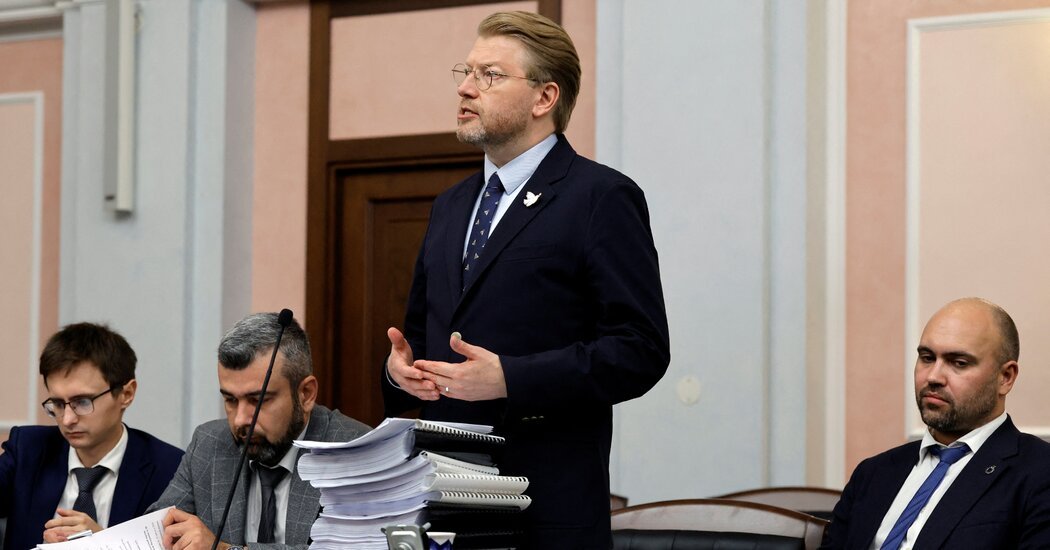
As Nikolai Rybakov, the leader of Russia’s only antiwar party, walked through central Moscow, the growing sentiment against the conflict in Ukraine was easy to see.
While I tried to interview him on his way to a subway station, he was constantly approached by passers-by requesting selfies and asking questions.
“Are you really against the war?” one young person asked him.
“Are you seriously against blockages?” another asked, referring to the Kremlin’s wartime bans or restrictions on popular apps such as Facebook and Telegram. He added: “Are you really going to take the metro? Wow!”
It was Friday, and Mr. Rybakov had just filed an appeal of a court decision to remove his party, Yabloko, from the ballot for next month’s parliamentary elections — a decision that the country’s Supreme Court would go on to uphold on Monday. The same fate has befallen other opposition parties during Vladimir V. Putin’s presidency.
Yabloko’s last-minute disqualification suggested that the Kremlin had belatedly realized not only how unpopular the war was but also that the party could become a vessel for that discontent. A recent poll found that Russians wanting peace negotiations outnumbered those who favor continued fighting by more than 2 to 1.
Mr. Rybakov said the reason for the party’s newfound popularity was people’s growing fatigue with what looked like an endless and fruitless war. Yabloko, he said, “has always been a party that opposes violent action.”
Its short, zippy slogans — “For peace and freedom!” and “For a Russia free from fear and political repression!” — have resonated with Russians, particularly younger people, while steering clear of directly condemning the war, which is illegal in Russia.
Mr. Rybakov said that the party’s admirers had come out “because we say the same things and do the same things they do.”
The new spotlight on Yabloko — which means “apple” in Russian but whose name derives from the surnames of its three founders — has brought life to what had looked like another dull, predictable and tightly controlled election campaign in Russia.
At the end of July, the country’s Central Election Commission registered Yabloko to run in parliamentary elections scheduled for mid-September. Days later, the Russian government appeared to change its mind. A party loyal to the Kremlin filed a lawsuit seeking Yabloko’s removal over minor copyright infringements and indirect foreign financing.
Afterward, popular bloggers and singers with huge followings among teenagers posted videos supportive of Yabloko. One singer’s old music video titled “Apple” went viral.
When a court hearing on the lawsuit was held last week, hundreds of protesters outside shouted “Yabloko!” and “Russia!” — something unseen in central Moscow for years.
On Monday, when the Supreme Court heard the party’s appeal, Russia’s current political reality kept sinking in for those watching as the presiding judge, Vladimir Y. Zaitsev, dismissed Yabloko’s pleas one after another. Russia’s autocratic leadership can be both sensitive to public opinion and completely dismissive of it.
The hearing again drew dozens of the party’s newfound supporters to the court building, and police officers detained more than 30 of them, according to party officials. Only a few managed to slip inside the courthouse.
One of them was Daria Alekseenko, who came at 6:45 a.m., more than two hours before the court opened, to make sure she could get in.
“I share their view that we need to live in peace and freedom, and that life should be lived without fear,” Ms. Alekseenko, 16, told me as she sat in the courtroom.
She said that she had looked at her parents, who were born in the 1980s, and saw that “they’ve never gone to the polling stations and never voted.”
“I want to do the opposite — to get involved, show some civic engagement and feel like my vote actually matters,” she said.
In a separate hearing on Monday, a court in the city of Pskov, northwest of Moscow, sentenced Lev Shlosberg, a prominent member of Yabloko, to more than 11 years in prison for his antiwar criticism.
Mr. Shlosberg is one of dozens of Yabloko activists who have been imprisoned, been fined or faced other forms of persecution over the years.
Yet this has not scared away the party’s new younger members. In St. Petersburg, Russia’s second-largest city, Marina Peslyak, 21, is running for a seat in the regional legislature on Yabloko’s ticket.
She first tried to run with New People, a pro-business political party widely accused of being controlled by the Kremlin. She said she quickly realized that she could not “say what I think.”
While campaigning for Yabloko, Ms. Peslyak said she had come to realize how the war was becoming unpopular. Many people have complained — though very carefully, she said — that despite the urgent need to invest in infrastructure, money was being spent on the war, instead.
“Regarding the military actions, I think most people probably don’t really like it,” Ms. Peslyak told me during an interview in St. Petersburg. “I feel like the majority is already in favor of an end to it.”
Over the past few weeks, more than 1,000 new members have flooded Yabloko’s headquarters in Moscow. They wanted to pick up leaflets and campaign on the city’s streets, said Dzhavid Agayev, a longtime member.
“They experienced a time of an open internet, and they experienced a period of relative political freedom,” Mr. Agayev, 29, said in an interview.
“But as the government systematically strips away the upper tiers of the opposition and higher forms of political liberty, young people realize that these crackdowns are reaching them directly — through internet blocks, the threat of mobilization and military recruitment,” he added.
They are eager to hitch themselves to whatever is left of the political opposition, Mr. Agayev said.
“More radical and prominent opposition figures and activists have been neutralized — either forced into prison cells or driven into exile,” he said. “As a result, the moderate opposition is all that remains.”