dailynewsnblog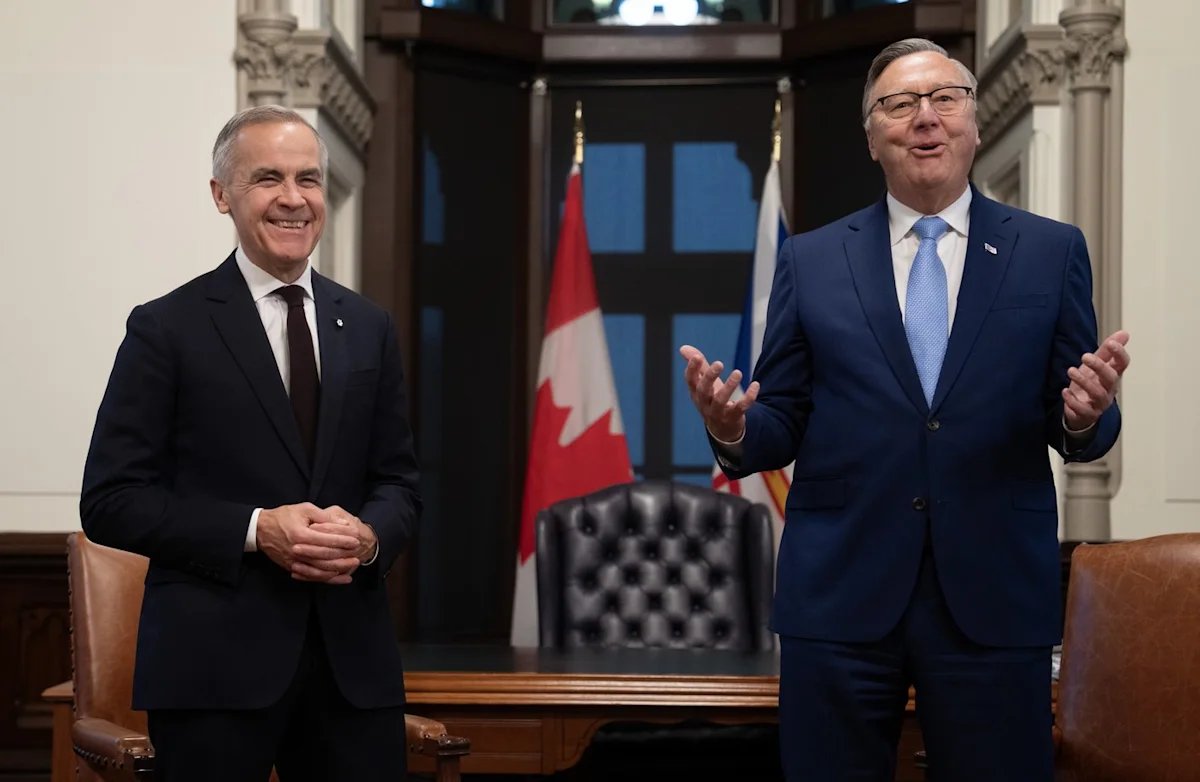

ST. JOHN’S — Hydro utilities in Quebec and Newfoundland and Labrador have reached a non-binding agreement to share energy from Labrador, with help from the federal government.
Prime Minister Mark Carney and the premiers of both provinces were on hand to unveil the sweeping tentative agreement on Monday in St. John’s.
It outlines plans for Hydro-Québec and Newfoundland and Labrador Hydro to divvy up power from the Churchill Falls generating station and launch new hydro, wind and transmission projects worth more than $50 billion.
If finalized, the proposal would realize a long-sought goal in Newfoundland and Labrador to transmit power from Labrador — up to 985 megawatts — through Quebec to markets in the United States.
Negotiators hope to hammer out a final deal by the end of this year.
However, Quebec Premier Christine Fréchette must call a provincial election by Oct. 5 and it’s not clear how the campaign, nor the installation of a new government, could affect those goals.
“Whatever happens in Quebec will happen. I can’t control what happens in Quebec,” said Newfoundland and Labrador Premier Tony Wakeham in an interview with The Canadian Press. “I think this is a win-win-win situation,” he added about the draft agreement.
The province’s utilities are eyeing up to 14,000 megawatts of new and existing hydroelectric developments in Labrador and along the Churchill River.
Newfoundland and Labrador is eager to turn the river’s hydroelectric potential into revenue, and Quebec is looking to secure a reliable power supply for decades to come.
They have been in negotiations for years, and came up with a framework agreement in 2024.
However, Wakeham sent them back to the bargaining table after he and his Progressive Conservatives were elected last year. He was looking for more power, more value and transmission rights through Quebec, he said at the time.
Wakeham kicked off his election campaign last fall promising to hold a public referendum on any final deals. He walked back that promise on Monday, saying a referendum would not happen.
“I know there will be people in our province who will be disappointed in that, but I accept that,” Wakeham said in an interview. “The time was now. There was an opportunity right now.”
Monday’s agreement proposes a new, 2,700-megawatt generating station at Gull Island on the Churchill River and upgrades to the existing 5,428-megawatt power plant at Churchill Falls.
It also includes plans for transmission lines and a feasibility study to build a second powerhouse at Churchill Falls.