dailynewsnblog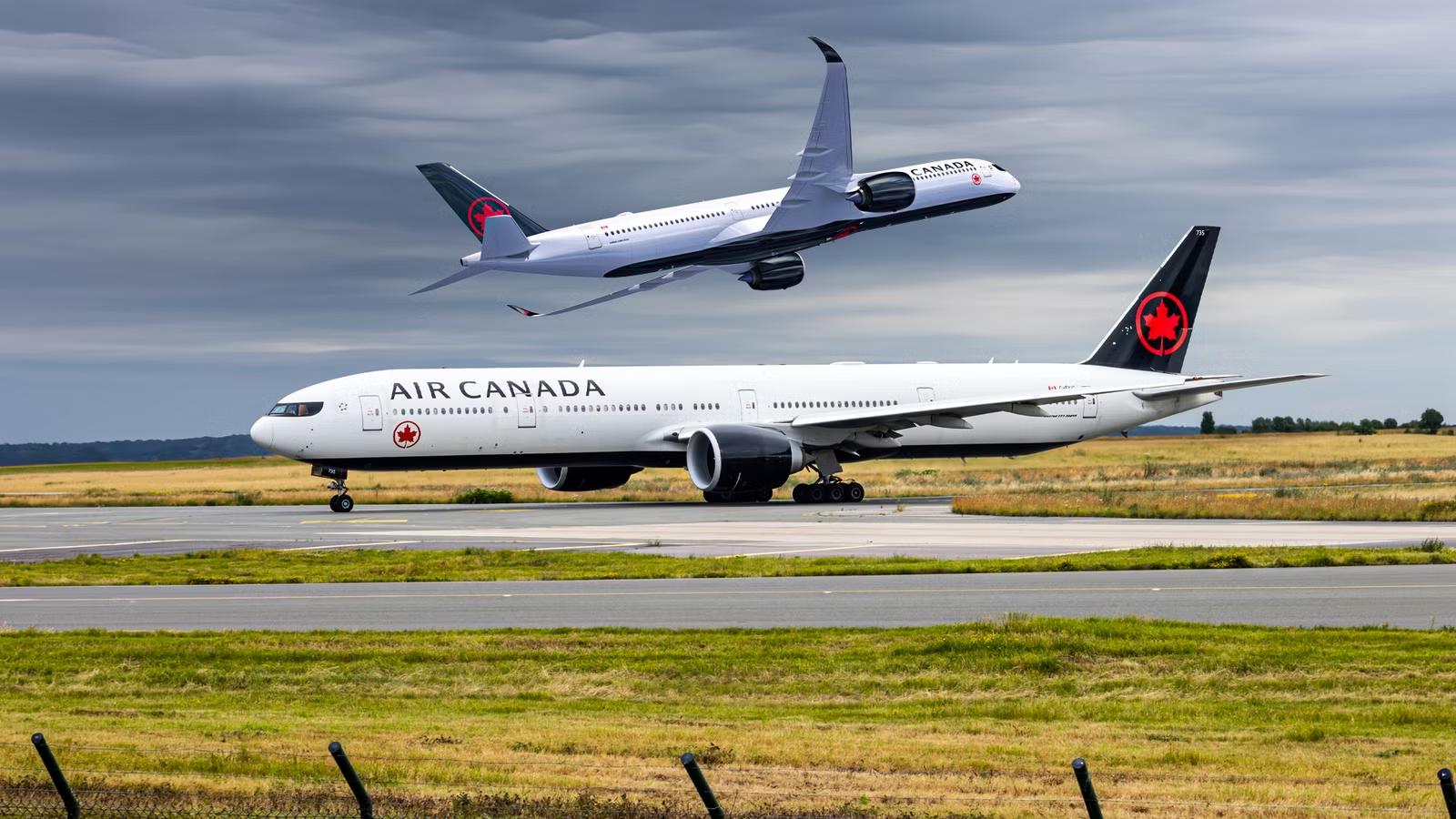
For nearly two decades, the Boeing 777-300ER has been at the very heart of Canada’s flagship carrier, dominating long-haul routes from  Toronto Pearson International Airport (YYZ) and Vancouver International Airport (YVR) across the Pacific and Atlantic oceans. When it came time to plan its flagship fleet successor for the decade ahead,
  Air Canada turned away from Seattle and placed its faith in the rival company Airbus. The airline confirmed a firm commitment for eight Airbus A350-1000s, with purchase rights for eight additional aircraft, bypassing Boeing’s delayed 777X program to opt for European composite-twin technology for its next era of international expansion.
It is a major change, especially for an operator that historically relied on Boeing twin-aisle jets for its heavy long-haul capability. Air Canada leadership, including Executive Vice President and Chief Commercial Officer Mark Galardo and Chief Financial Officer John Di Bert, chose an operational path focused on delivery certainty over delayed promises.
Time To Move On

Air Canada’s fleet planners faced a ticking clock for its long-standing 777-300ER fleet, mainly because operating aircraft over thousands of cycles eventually wears them down. According to fleet tracking data from Planespotters.net, the Canadian carrier operates 19 Boeing 777-300ER aircraft alongside six 777-200LR variants, forming the heavy widebody spine of its international network. With the 777-300ER fleet averaging 16.2 years of age and the 777-200LRs passing 18 years, these aircraft are rapidly approaching major structural overhaul thresholds where engine teardowns and airframe stress inspections become exceptionally expensive.
Operating older aluminum widebodies across 15-hour transpacific routes creates an escalating financial burden that directly compresses operating margins. As fuel prices fluctuate and international competitors move to lighter, next-generation jets, burning excess fuel on previous-generation airframes while absorbing higher unscheduled maintenance downtime puts a carrier at a competitive deficit. Extending the service life of these older twin-engine jets into the 2030s would mean Air Canada would need to invest heavily in maintenance programs for aging airframes that cannot match the efficiency of modern carbon-fiber wings.
The natural replacement choice within the  Boeing ecosystem was the 777X, specifically the high-capacity 777-9 variant, which offered immediate pilot type-rating overlap and familiar operational handling for Air Canada’s flight operations division. What has become clear is that relying on Boeing to deliver a seamless fleet replacement is no longer viable as the 777X program sinks deeper into certification delays and structural testing setbacks.
Falling Behind The Mark

The 777X program has accumulated $15 billion in cost overruns and pushed initial passenger deliveries into late 2026 or early 2027, six to seven years behind its original 2020 schedule. For carriers like Air Canada with strict airframe retirement deadlines by 2030, waiting on an uncertain certification schedule creates a commercial planning gap. The eight firm orders and eight purchase options for the A350-1000 therefore guarantee deliverable slots starting in the second half of 2030, offering reliable timeline planning that Boeing is failing to provide.
Catch what other flight trackers miss
Emergency squawks, holds, NOTAMs — live signals, no signup.
Open tracker
Catch what other flight trackers miss
Emergency squawks, holds, NOTAMs — live signals, no signup.
Open tracker
Air Canada’s decision is part of a broader global movement across flagship international carriers. Industry leaders such as are actively re-evaluating their long-haul strategies, weighing additional A350-1000 orders against their delayed 777-9 commitments and even preparing to reject early-built 777X airframes due to weight penalty concerns and delivery deferrals. Lufthansa also recently rejected taking first-built aircraft, becoming the second airline to do so. By choosing the A350-1000, Air Canada aligns itself with a growing cohort of global operators prioritizing certified operational availability over unfulfilled manufacturer projections.
Modernizing a long-haul network requires an airframe that pairs delivery certainty with dramatic efficiency gains over older twin-engine predecessors. Even with the promise the 777X program shows, nothing can beat an aircraft already proven to be highly efficient and valuable to global airline networks.
Why Specifically The A350-1000?

The justification for choosing the A350-1000 comes mainly from its structural materials and advanced propulsion efficiency. The A350-1000 features a composite airframe constructed from over 50% carbon fiber reinforced polymers, titanium, and advanced aluminum alloys. According to official performance metrics from Airbus and Air Canada, this lightweight design delivers up to a 25% reduction in fuel burn and carbon emissions per seat compared to the aluminum 777-300ERs it will replace. Powered by twin Rolls-Royce Trent XWB-97 turbofans, the flagship widebody substantially lowers direct operating costs, protecting airline margins against jet fuel price spikes that have become all too commonplace today.
The A350-1000 offers an impressive maximum operating range of 9,000 nautical miles (16,668 km). This means the airline can fill the aircraft with passengers while carrying high-yield cargo in the lower deck across 16-hour transpacific and South Asian sectors. On 777-300ER operations, extreme distance combined with high summer temperatures or severe winter headwinds often forces dispatchers to cap passenger seating or offload belly freight to stay within takeoff weight limits. The composite A350-1000 does not face these operational compromises, meaning it can capture full payload revenue on ultra-long-haul routes.
Integrating a new long-range flagship is never an isolated decision. Fleet planners will always be evaluating how a new widebody integrates alongside incoming single-aisle and medium-widebody airframes across the broader network. For Air Canada, with a very diverse fleet, the A350-1000 complements the other aircraft very well.
The Rest Of The Fleet Will Make The A350 Stand Out

Air Canada’s long-haul strategy is built on a disciplined, three-tiered fleet architecture that segments route profiles by capacity and range. Single-aisle A321XLRs have been brought in to be the long-range spearhead for secondary transatlantic pairs, opening point-to-point markets from Montreal and Halifax to Western Europe, far more seen as long-thin routes in the overall network. Intermediate thick routes, such as high-density transcontinental legs and transatlantic corridors between major hubs, account for 14 incoming 787-10 Dreamlinerorders. The flagship Airbus A350-1000 sits atop this structure, serving as the heavy-lift backbone designed specifically for premium high-density trunk routes and nonstop ultra-long-haul operations.
Operating this modern multi-tiered layout across main hubs in Toronto, Montreal, and Vancouver yields major operational synergies. Both the A350-1000 and 787-10 feature lower cabin pressure altitudes, maintaining cabin environments equivalent to 6,000 feet (1,828 meters) or lower during cruise compared to legacy metal airframes pressurized to 8,000 feet (2,438 meters). Higher cabin humidity and lower effective pressure significantly reduce passenger fatigue on flights longer than 12 hours.
Aircraft Model | Network Role | Engine | Delivery Timeline | Primary Network Focus |
Airbus A321XLR | Thin long-haul and secondary transatlantic | Pratt & Whitney PW1100G GTF | 2026 onwards | Eastern Canada to secondary European destinations |
Boeing 787-10 Dreamliner | High-capacity transatlantic and trunk domestic | General Electric GEnx-1B | 2025–2027 | Toronto and Montreal to major European hubs |
Airbus A350-1000 | Ultra-long-haul flagship & heavy cargo trunk | Rolls-Royce Trent XWB-97 | 2030 onwards | Transpacific, South Asian, and deep South American corridors |
Pairing slender single-aisle economics on thin long-haul routes with the immense range of its new flagship, Air Canada can reallocate widebody assets to previously unreachable destinations. It may seem that the arrival of the A350 will be the biggest difference maker, but it is actually the other aircraft in the fleet that can make it shine.
More Possibilities Are Now Available

Under current operations, flying ultra-long routes like Vancouver to Delhi or Toronto to Mumbai pushes the 777-300ER to its absolute limits, especially with current Russian airspace closures requiring lengthy polar detours. Heavy winter headwinds over the North Pacific or hot summer departures in South Asia frequently force dispatchers to trim passenger lists or offload high-yielding cargo pallets just to carry enough fuel. According to AirInsight, Mark Galardo, Executive Vice President and Chief Commercial Officer at Air Canada, noted that the flagship widebody will “unlock new possibilities for long-haul flying for our customers,” enabling direct, uncompromised nonstop links to high-growth markets across India, Southeast Asia, and Australia that were previously unviable.
Connecting eastern and western Canadian hubs to high-growth markets in South Asia, Southeast Asia, and Australia without payload compromise reshapes Air Canada’s competitive position against foreign carriers. No longer having to head to intermediate foreign hubs like Hong Kong, Tokyo, or Los Angeles allows the airline to capture high-yielding, point-to-point business and diaspora traffic directly from Toronto, Montreal, and Vancouver. This new position is one of serious promise: the airline now has a seemingly perfect fleet mix that can truly start to rival its geographical competition.
This position is not exactly good news for Boeing, as many other carriers may be influenced to follow suit. Losing such a highly valued, long-time customer to the biggest rival manufacturer is only the beginning; if it can happen once, it can happen many times again.
Moving Into The Future With Certainty

Air Canada’s transition to the A350-1000 is a big change, and one that reflects the current state of affairs at Boeing. While the airline continues to partner with Boeing on its incoming 787-10, passing on the delayed 777X shows that flag carriers will no longer leave their long-haul replacement timelines vulnerable to chronic certification setbacks, even with a strong partnership.
Capping capital expenditures at or below 12% of annual revenues, Air Canada has set out a measured, high-yield fleet modernization strategy. Locking in eight firm slots alongside eight purchase options gives fleet planners the agility to replace aging 777-300ERs gradually while scaling up transpacific capacity as international market demand dictates. As the first delivery arrives in the second half of 2030, European composite technology will take over as the flagship anchor of Canada’s global network, and there is very little Boeing can do about it.
Ultimately, selecting the A350-1000 secures delivery certainty, lowers fuel burn by 25%, and gives the airline 9,000 nautical miles (16,668 km) of uncompromised range that can open up its future. By choosing a proven, in-service widebody over an uncertain development timeline, Air Canada enters the next decade of aviation with a resilient, ultra-long-haul fleet ready to connect North America to the world.