dailynewsnblog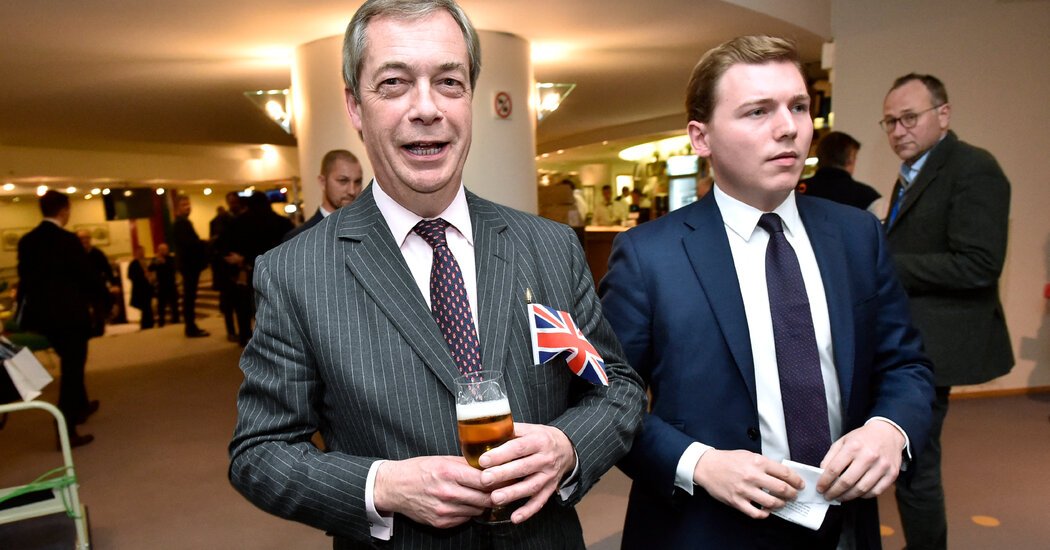
Before George Cottrell became famous in Britain as “Posh George,” a near-constant sidekick to the right wing politician Nigel Farage, he traveled to Las Vegas to meet with drug traffickers for whom he’d offered to launder money.
It was 2014, and Mr. Cottrell was 21. He had met the traffickers on the dark web. Under the pseudonym “Bill,” he said he would take $20,000, send it to offshore accounts, and return it clean. Later, according to a federal indictment filed in 2016, he threatened to extort the traffickers for the Bitcoin equivalent of $80,000.
It was not until Mr. Cottrell was arrested at O’Hare International Airport in Chicago two years later that it became clear the drug dealers he had met in Las Vegas were actually I.R.S. agents conducting a sting. On July 22, 2016, he and Mr. Farage were heading back to London after a whirlwind week at the Republican National Convention — where Mr. Farage was lauded for his role in Britain’s recent Brexit vote — when five agents detained Mr. Cottrell as he came off a connecting flight.
For many high-profile political figures, an aide pleading guilty to wire fraud and serving an eight-month prison sentence might have been enough to end ties. Not so for Mr. Farage, a maverick politician and ally of President Trump who worked for two decades to engineer Britain’s departure from the European Union and who now leads Reform U.K., an anti-immigration party that has outpolled the Conservative Party for 18 months.
Mr. Cottrell, 32, has remained among Mr. Farage’s closest advisers. In 2017 he told The Telegraph that he saw him as a father figure and in an interview with Tatler in 2024 he jokingly referred to him as “Daddy.” The bond between the two men has become the subject of intense interest in Britain in recent weeks, following revelations in The Sunday Times of London that Mr. Cottrell provided Mr. Farage with undisclosed gifts and support before the 2024 general election.
The police are separately investigating the legality of two donations to Reform of 250,000 pounds each from Mr. Cottrell’s mother, Fiona, and said last month that they had questioned two people, although no arrests have been made.
“There are some relationships Farage has which are enigmatic. Cottrell is one of them,” said Ben Habib, a former Reform official who left when Mr. Farage returned to lead the party in 2024. He called Mr. Farage’s continued association with Mr. Cottrell “inexplicable and high risk for a man who is so prominently in the public and subject now to ever-increasing scrutiny.”
A spokesman for Reform did not respond to several requests to speak with Mr. Farage or Mr. Cottrell for this story. A lawyer for Mr. Cottrell would not make him available for comment on this story.
The revelations about Mr. Cottrell have intensified a swirl of questions around Mr. Farage and his financial support, after The Guardian revealed in April that the Reform leader had received £5 million, about $6.7 million, from a British cryptocurrency billionaire based in Thailand.
A parliamentary standards investigation into whether Mr. Farage should have disclosed that gift, which he received in the weeks before the 2024 election, was underway when Mr. Farage abruptly resigned his seat in Clacton last month and said he would immediately run again.
“I have decided that the people of Clacton should be the judges of my actions,” he said.
Mr. Farage won the resulting special election on Thursday easily. None of the other major parties fielded a candidate, calling the vote an electoral stunt. But Mr. Farage’s triumphant return to Westminster immediately restarted the investigation into possible financial irregularities.
‘Posh is extremely well connected.’
Arron Banks, a former aide to Mr. Farage who helped bankroll the Brexit campaign, was the first one to call Mr. Cottrell “Posh George” — a way of ribbing him for his upper-crust background. In his 2016 book, “The Bad Boys of Brexit,” Mr. Banks wrote that Mr. Cottrell eagerly volunteered to help win the referendum that year on whether Britain should sever its ties to Europe.
“Posh is extremely well connected (his model mother is an old flame of Prince Charles; his godfather is reputed to be a billionaire) and he was working for Nigel on the back of a personal recommendation from his aristocratic uncle,” Mr. Banks wrote. “He was wealthy enough to give his time for nothing, and had proven hard-working and loyal.”
Born in 1993 into a wealthy English family, Mr. Cottrell is the nephew of Lord Hesketh, a former Conservative lawmaker and Brexit supporter.
His parents, who lived in Mustique, a private Caribbean island favored by British aristocrats and celebrities, sent him to Malvern College, an elite boarding school in England. The Times of London reported that he was expelled because of a gambling addiction in 2010.
Mr. Cottrell is often seen wearing dark sunglasses and impeccably tailored suits. Mr. Habib recalled that in 2024, Mr. Cottrell once arrived to campaign for Reform in Wellingborough, England, in a Lamborghini S.U.V..
“I was absolutely bloody gobsmacked,” Mr. Habib said, pointing out that the area had pockets of poverty.
After leaving school, Mr. Cottrell took a series of jobs in finance, including one at an offshore private bank. By 2016, he was running Mr. Farage’s private office and serving as a fund-raiser for the Brexit campaign.
“It was very important for [donors] to have face time with Nigel, and that’s where I came in,” Mr. Cottrell told The Telegraph after he was released from prison in 2017. “My role with fund-raising meant that I was also looking after Nigel.”
In that same interview, he said that at the time of the Brexit vote, in June 2016, he was “a compulsive, habitual, addicted gambler.” On the night of the result, once he realized Britain might vote to leave the European Union, he raced to bet tens of thousands of dollars on the prospect that the value of the British pound would drop.
“When it got to 3 a.m., I was getting my managers out of bed to get me another 50 grand on here, another 50 grand there, to short sterling. I just couldn’t help myself,” he said.
After his arrest in the United States, Mr. Cottrell was charged with 21 counts, including conspiracy to commit money laundering, mail fraud, wire fraud, blackmail and extortion. He pleaded guilty to one count of wire fraud.
Claire Gill, a lawyer representing Mr. Cottrell at Carter-Ruck Solicitors, said in a statement: “To be clear: he was not convicted of any offense of money laundering, nor did he admit to any activity constituting money laundering.”
In his plea agreement, Mr. Cottrell said: “I communicated online with individuals seeking to launder proceeds of criminal activity via an encrypted group instant messaging platform known as Cryptocat. I explained various ways criminal proceeds could be laundered — for example, methods to transfer large amounts of cash out of the United States without triggering reporting requirements.” He added that he had falsely claimed he would launder criminal proceeds through his bank account for a fee, but that he intended, along with an accomplice, to “retain the money.”
In his book, Mr. Banks recalled how Mr. Farage and Mr. Cottrell and several other aides had spent the Thursday night before Mr. Cottrell’s arrest at an Italian restaurant in Cleveland with Roger Stone, an infamous Republican political operative and one of Mr. Trump’s oldest friends.
When Mr. Cottrell was arrested, “Nigel was stunned,” Mr. Banks wrote.
‘I don’t dump trusted friends unless they betray me.’
In the years since, Mr. Cottrell appears to have become involved in crypto currencies. He moved to Montenegro, a tiny nation-state on the Adriatic Sea, where The Sunday Times reported that he was involved with a crypto-betting operation known as Tether.bet, citing court documents and unnamed sources.
Ms. Gill, Mr. Cottrell’s lawyer, said that he “has no interest in Tether.bet — indeed he has no interest, direct or indirect, in any gambling operations.” She added that “his relationship with Tether.bet is limited to being a customer, in addition to which he knows and is friends with the owner.”
In February, Mr. Cottrell published a book titled “How to Launder Money: A guide for law enforcement, prosecutors and policymakers.” The publisher’s description says “the criminals already know how to launder money,” adding that “this book is for the rest of us who want to know how the laws that are supposed to protect us are in reality doing more damage than ever before.”
Mr. Cottrell continued to be closely tied to Mr. Farage and Reform in the run-up to the 2024 general election. The Sunday Times reported last month that Mr. Cottrell let Mr. Farage use a five-story house near Buckingham Palace, a benefit that could represent an in-kind donation. Mr. Cottrell’s lawyer told the paper: “As a close friend, our client did, and does, allow Mr. Farage to stay in our client’s rental property.”
In a recent podcast interview, Mr. Farage confirmed Mr. Cottrell let him use an office in one of his London homes and a camera crew in 2023 and 2024 but said it was “irrelevant” because he was not in politics at the time.
He also referred to the police investigation into donations to Reform, initially referring to the donation as coming from Mr. Cottrell, before correcting himself and saying it came from Mr. Cottrell’s mother and had been reported to the National Crime Agency in September 2024. “Why is it now a story?” he asked.
In an interview with The Spectator last month, he questioned the media focus on Mr. Cottrell.
“This ‘Posh George’ stuff. I mean, what are they even on about?” he said. “Of course, he’s a ‘Tatler’ figure, an interesting bloke and a colorful guy. But these are trusted friends. I don’t dump trusted friends unless they betray me — it’s as simple as that.”