dailynewsnblog
Bear markets usually have to take a wrecking ball to prices to make stocks cheaper. Tech found another route.
Tech’s forward price-to-earnings ratio — the price investors pay for expected earnings — fell about 30% from a year earlier at its July low, a drop seen around the dot-com bust and financial crisis.
This time, the S&P 500 (^GSPC) was near a record high.

The timing makes it even stranger.
The Technology Select Sector SPDR Fund (XLK) had just ripped off its March 30 low. Measured by its 45-day rate of change — simply how much the price moved over the previous 45 trading days — it was the strongest surge in XLK’s history going back to 1999.
For the PHLX Semiconductor Index (^SOX), only the March 2000 surge was stronger in data going back to 1994.
So how can stocks rocket higher and still get cheaper?
Start with a stock trading at $100 that is expected to earn $5. Investors are paying $20 for every dollar of expected profit, giving it a forward P/E of 20 times.
If the stock jumps 40% to $140, it sounds more expensive.
But suppose expected earnings jump 80% to $9. Investors are now paying only about $16 for every dollar of expected profit.
The stock went up. It got cheaper.
Something similar happened across tech. Over the past year, tech prices rose roughly 40%, while expected earnings jumped roughly 80%. Earnings outran prices.
Bear markets usually get there through pain. Prices collapse, recessions knock down profit forecasts, and optimism gets beaten out of investors. By the time the smoke clears, buyers are often paying much less for the profits that survive.
That helps explain why some of the strongest rallies begin while the economic headlines still look terrible. Stocks start looking toward the recovery before the economy does.
This time, tech got much of that benefit without dragging the whole market through the demolition site.
But there is an obvious way this falls apart.
The lower P/E only stays low if those expected profits actually arrive.
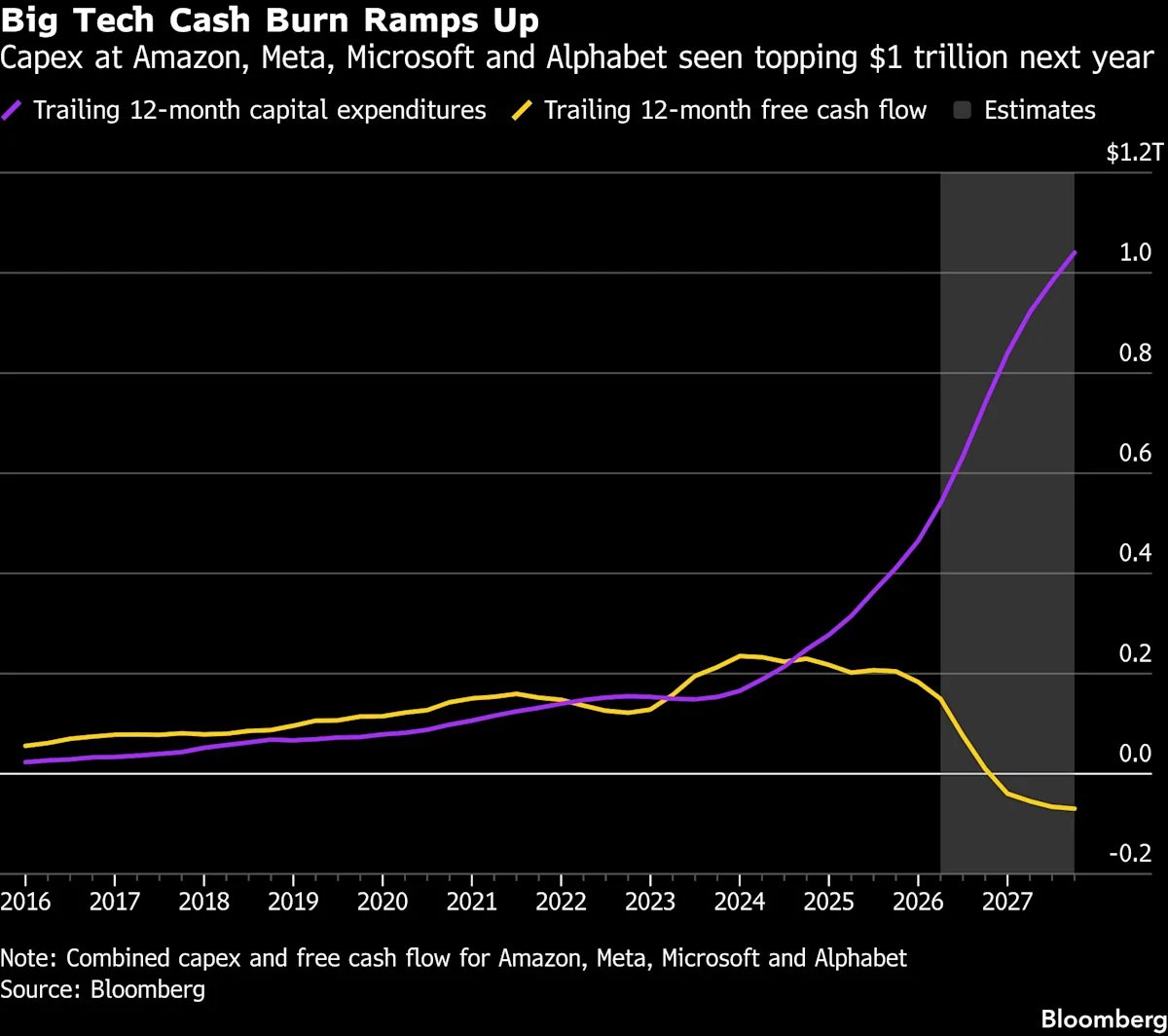
Big Tech is spending enormous sums on chips, data centers, networking, and power. Investors are already asking who gets paid from that AI spending boom and who gets stuck with the bill.
If AI capacity gets overbuilt, customers slow their spending, chip pricing weakens, or the economy hits corporate tech budgets, analysts could start cutting those future profit forecasts.
Then the trick works in reverse.
That same $140 stock earning an expected $9 costs about 16 times earnings. Cut the forecast to $6, and the stock suddenly costs more than 23 times earnings without its price moving a penny.