dailynewsnblog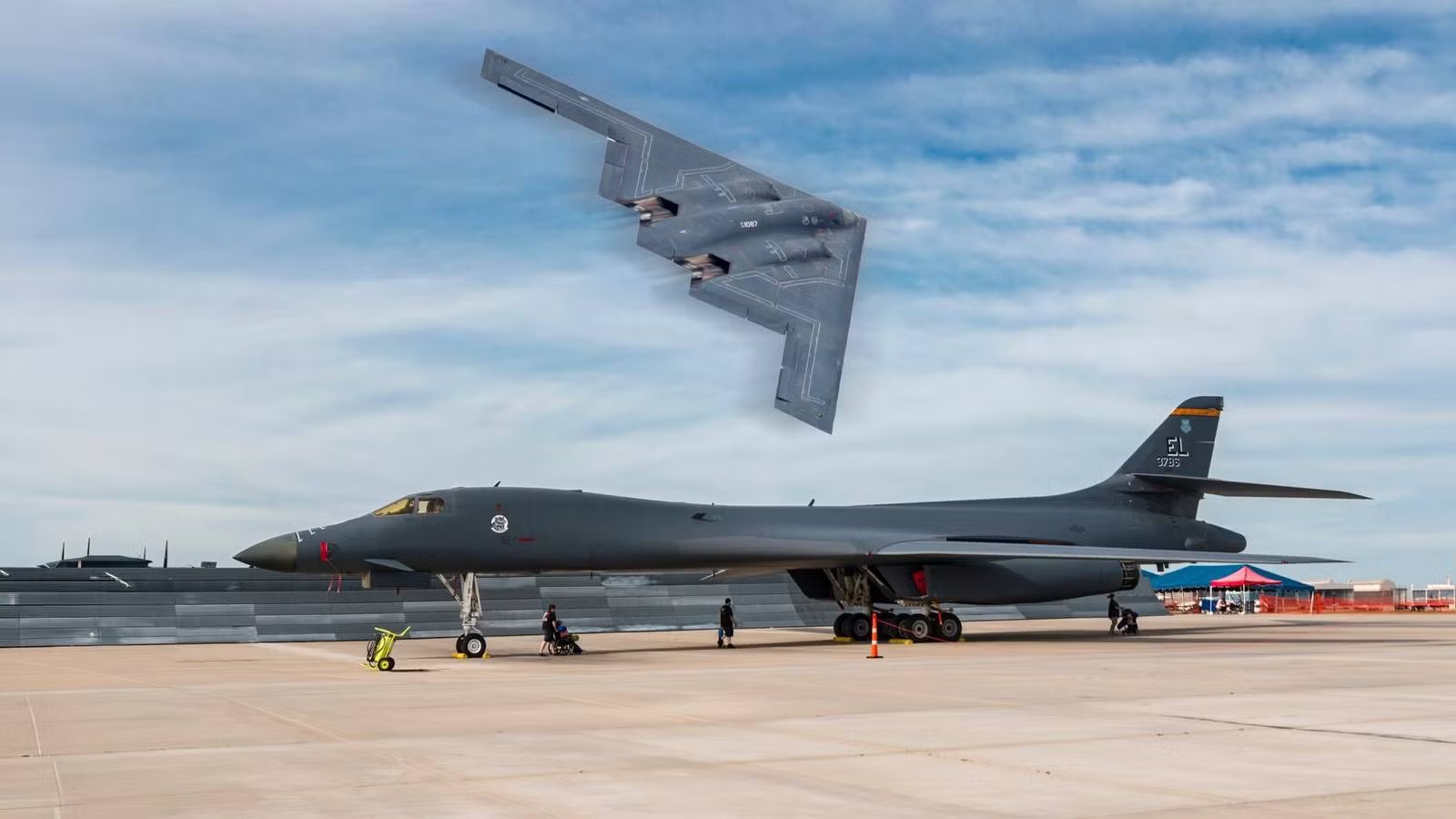
The Northrop Grumman B-21 Raider remains on track to enter service in 2027. Currently, there are an unknown number of B-21s under construction, and the aircraft is now in advanced testing. After it enters service, it will complement the B-1B, B-2, and B-52 until it has sufficiently matured and is available in substantial numbers. The B-1 is expected to phase out by around 2037 and the B-2 sometime afterwards.
While many of the B-21’s improvements remain classified, one area where observers have identified an apparent design evolution is its trailing-edge control surfaces. Let’s examine how new photos of the Raider’s control surfaces may indicate how the aircraft has found a new way to improve its stealth profile. It is worth keeping in mind that the Raider is heavily classified, as several articles and even reports by the US Air Force itself have recently been scrubbed from the internet.
New B-21 Trailing Edge Spotted

The Northrop Grumman B-21 Raider is expected to be a comprehensive upgrade over the aging Northrop B-2 Spirit bomber. It is expected to feature longer ranges, better fuel economy, enhanced sensor fusion, MUM-T capabilities, advanced networking, lower infrared signatures, powerful sensor fusion, a lower radar cross-section, and many other improvements and new capabilities.
According to recent analysis by Janes, photographs of the B-21 Raider’s trailing edge control surfaces display “a unique surface deflection, for what appears to be for yaw, roll, or drag control.” The photos were taken in June 2026 of a B-21 test flight coming into land at Edwards Air Force Base in California.
According to reporting by The Aviationist, the B-21 wasn’t tracked online, but was visible from the ground. It was using the radio callsign RAIDER17. The publication reported that although the B-21 did not appear on public flight-tracking websites, it was visible from the ground using the radio callsign RAIDER17.
During the flight, two KC-46A Pegasus tankers using the ARRIS callsign were flying a racetrack pattern nearby, while Scaled Composites’ Hawker 4000 N639RA operated in the same airspace using the callsign SCAT21. Meanwhile, on approach, Janes noted the aircraft “displayed deflection of the inboard and outboard control surfaces to opposite sides.“
Janes added that the surface closer to the wing root and fuselage appeared to deflect downward as the outer surface appeared to deflect upward. Predictably, the Air Force declined to provide answers to Janes’ questions, citing operational security.
The B-2’s Split Control Surfaces

The Aviationist surmises that the surfaces suggest that the Raider’s flight-control system may use differential deflection of adjacent surfaces rather than a simple B-2-style split drag-rudder arrangement. Incidentally, the new Chinese Chengdu three-engine prototype (dubbed online as the J-36) has a similar arrangement to the old B-2 Spirit bomber.
The publication also wrote that “unlike the B-2, the B-21 appears to feature multiple discrete outboard trailing-edge control surfaces.” The precise function of the Raider’s unique surfaces and associated control laws is classified. However, the photos are considered enough to discard simplistic assertions that the B-21 used split drag rudders exactly like the B-2.
Northrop Grumman B-21 Raider Specs (Per USAF) | |
|---|---|
First flight | 2023 |
Expected in-service date | 2027 |
Number planned | At least 100 |
Lead command | Air Force Global Strike Command |
Primary role | Nuclear-capable, penetrating strike stealth bomber |
The B-2 and other similar aircraft lack a vertical tail or a conventional rudder. Instead, they have control surfaces that are split into two halves that assist in both the yaw and roll of the aircraft. The split control surfaces work as airbrakes by inducing drag at each wingtip. They both help maintain control of the tailless aircraft, while also increasing drag in all conditions of flight.
The Problem With Split Surfaces

As stated, the B-2 has no vertical tail and so makes much use of its split drag rudders at the outer trailing edge. While this is an elegant solution for a flying wing aircraft, it does pose issues with its stealth profile. When the split drag rudders open, they expose internal cavities containing actuator mechanisms, hinges, and structural members, interrupting the aircraft’s otherwise smooth flying-wing outer mold line.
It also creates discontinuities, exposed panel edges, and changing angles, which are the exact type of features stealth engineers try to minimize with smooth continuous surfaces. Opening the split drag rudders can briefly increase radar returns. This is the same issue that applies to opening bomb bay doors, landing gear doors, air brakes, and refueling probes. These break the outer mold line of the aircraft, increasing its radar cross-section.
This was one of the contributing factors to the ‘lucky shot’ the Serbs got against the F-117 Nighthawk in 1999 with an outdated surface-to-air missile. At the time of the engagement, the F-117 opened its bomb bay doors, temporarily increasing its radar signature. This briefly aided in creating a firing opportunity at the same time as the Serbs switched the radar on. Other contributing factors included flying a predictable flight path and not having a fighter jet escort.
Boosting Raider Stealth

If the analyst’s assessments are correct and the Raider is able to generate yaw and drag by moving neighboring surfaces instead of splitting one surface open, then it suggests it has made improvements to this aspect of maintaining a stealth profile. It means that no large cavity will be exposed. As an analogy, instead of opening the aircraft like a clamshell, it will only expose narrow hinge gaps with a conventional hinged panel.
A conventional control surface generally presents fewer exposed edges, internal surfaces, and right-angle reflectors. It may also reduce infrared disturbances, as split brakes can disturb airflow more violently. With that being said, this latter infrared point is more speculative. It should be stressed that neither Northrop Grumman nor the US Air Force has provided an explanation for the engineering choice, and so discussion here hinges on deductive reasoning.
For example, it is known that stealth design philosophy seeks to minimize cavities and moving gaps while also avoiding exposed internal structures and preserving the aircraft’s external smooth geometry as much as possible. Put another way, it is a reasonable guess to say it appears engineers have found a way to reduce radar reflections on B-21s while maneuvering.
How The B-21’s Role Differs

While the B-21 Raider can be broadly understood as a generational upgrade over the B-2 Spirit, the full picture is more nuanced. The B-2 Spirit was originally designed primarily to penetrate Soviet airspace and deliver nuclear weapons, although it was later adapted into a highly capable conventional precision-strike bomber. It was a high-end first-day effector to degrade enemy air defense and hit time-sensitive targets.
These missions did not require a high sortie rate. In a conventional role, it was designed to help set the conditions for other bombers to enter the campaign. However, the Spirit’s extremely high maintenance and the fact that raids are often flown nonstop from the mainland United States mean it has a poor sortie rate. This is made worse by its low inventory numbers (just 19 in 2026).
By contrast, the B-21 is designed to be the backbone of the Air Force’s future long-range strike force, able to penetrate some of the world’s most heavily defended airspace. It is designed to operate from forward bases, be less maintenance-heavy, generate higher sortie rates, and be more affordable.
Importantly, while the B-2 Spirit is something of a classic independent bomber, the B-21 is designed to be something of a node in a much larger kill chain. It is intended to operate as part of a family of systems alongside satellites, fighters, tankers, eventually collaborative combat aircraft, and other off-board assets, while also carrying munitions. A major part of its role is expected to be something of a command center, although this is expected to take time to mature.
Stealth Is Only Half Of The Battle

The B-21 Raider’s cutting-edge stealth is expected to make it one of the most difficult aircraft in the world to detect, track, target, and successfully engage. However, that is only half the challenge. On the ground, the Raider will be as vulnerable as any other aircraft. Perhaps it will be more vulnerable given that it will be extra difficult to provide it with specialized hardened shelters or even mountain-cut hideouts as some Taiwanese fighter jets have.
Over the course of the conflict in Ukraine since 2022, Russia has lost a substantial share of its long-range bomber force. At the time of writing, the Oryx blog has visually confirmed that Russia has lost (damaged and destroyed) 12 Tu-22M3s and 11 Tu-95MSs. This can be understood as a baseline, as not all losses may be visually confirmed.
Of these, only one (a Tu-22M3) is known to have been successfully downed by a Ukrainian missile. The rest have been lost on the ground, plus the three Tu-22M3s that have crashed during mishaps. While the dynamic between adversaries like the US and China is likely to be considerably different, it does highlight that protecting the aircraft on the ground is the other half of the equation.
There is likely no single answer to this issue. Forward bases will almost certainly be vulnerable in a high-end conflict. The US appears to be looking for a combination of layered measures like its Agile Combat Employment (ACE) to protect them on the ground.
Catch what other trackers miss
Emergency squawks, holds, NOTAMs — live signals, no signup.
Open tracker
Catch what other trackers miss
Emergency squawks, holds, NOTAMs — live signals, no signup.
Open tracker


![Allegiant Air’s Massive Expansion: 7 New Routes Announced [Map]](https://dailynewsnblog.com/wp-content/uploads/2026/08/allegiant-air-takeoff.jpg)