dailynewsnblog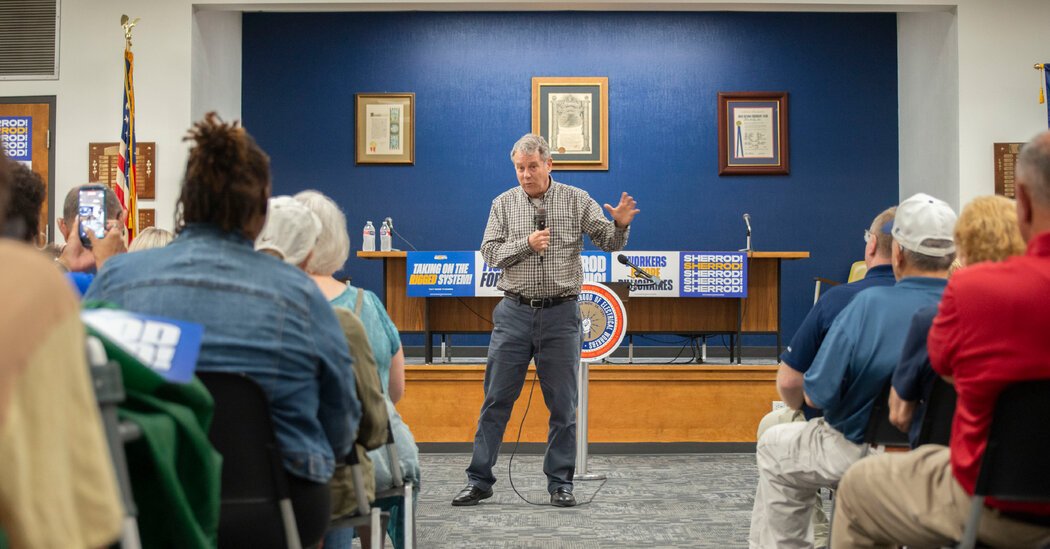
This week in New Philadelphia, Ohio, at a coffee shop called the Daily Grind, Sherrod Brown told a crowd of 100 or so people about the last big thing he did as a United States senator.
“How many of you benefit from the Social Security Fairness Act?” he asked, referring to bipartisan legislation he co-wrote to get full retirement pay for millions of public workers.
Some hands went up. “Thank you!” a retired teacher named Becky Bender called out.
“Well, the best way to say thank you is to get all your friends to vote for me,” he replied. “It’s going to be a really important year.”
In this really important year, Mr. Brown is a really important Democrat — one of the most important running for office.
He is trying to pull off a difficult political comeback — a quick return to the Senate, where he served three terms before losing his seat in 2024, amid shifting partisan preferences in his state and a tsunami of spending by the cryptocurrency industry to oust him.
This time, he is hoping the environment will prove more favorable. When he lost two years ago, President Trump was on the ballot and Republican enthusiasm was strong. Now Mr. Trump is broadly unpopular, and Mr. Brown is running against Senator Jon Husted, who was appointed to the Senate to fill the seat of JD Vance when he left to become vice president.
Democrats see flipping this Ohio Senate seat as key to their hopes of taking back control of the chamber.
On the roster of the party’s hopefuls, though, Mr. Brown cuts a singular figure. He is somehow simultaneously what Democratic voters say they definitely don’t want — and also what they do.
In focus groups and polls and at the ballot box, the Democratic electorate largely clamors for anti-establishment, anti-Washington, younger non-politicians. Mr. Brown is 73. He was first elected to office in 1974. He has spent most of the past three and a half decades working the halls of Capitol Hill.
And yet, as issues of affordability fuel a left-wing insurgency, Mr. Brown is above all else an economic populist. The message more and more people seem to want to hear is the one he’s been preaching for longer than many of them have been alive.
“What he is, is what I think most people desire,” said Dennis Eckart, a former Ohio congressman and longtime friend. “He’s been the senator for the waitress. He’s been the senator for the laborer.”
Republicans, on the other hand, see Mr. Brown as a has-been and a hanger-on, a loser two years ago who will be a loser this year, too, because he’s too far to the left for a state that has spent the last decade tilting to the right.
“It’s pathetic,” Mr. Husted said in an interview.
“It’s either his system, or he was a failure at changing the system,” said Mr. Husted, who was elected to the State Legislature in 2000 and was the secretary of state and the lieutenant governor before being appointed senator. “He can claim either one, but he was a failure one way or the other.”
At the Daily Grind, Mr. Brown worked the room. In contrast to Joseph R. Biden Jr., the former president, or Mitch McConnell, the fading senator — pre-eminent emblems of their respective parties’ aging leadership — Mr. Brown presents on the hustings as comparatively vigorous and fit. In a town and county that voted for President Trump, he finished his remarks, met with local reporters, sat for a picture with a Vietnam veteran in a wheelchair and chatted with one-time and would-be constituents for the better part of an hour.
“We need new blood,” Tammy Dixon, a retired administrative assistant from the Akron area, said in an interview.
But Mr. Brown, she said, was different.
“Who else,” she said, “could take on this fight?”
Roosevelt and Reuther
To know Sherrod Brown’s politics is to know the names of his dogs.
Franklin is a King Charles spaniel with some husky and poodle added in. Walter is a yorkie-poodle mix.
Franklin is for Franklin Delano Roosevelt. Walter is for Walter Reuther.
“The greatest president,” Mr. Brown said in an interview before a meet-and-greet at a bar in North Canton. “And the greatest labor leader.”
The son of a physician, Mr. Brown, a Yale graduate, was four days shy of 22 years old when he was elected to be a state representative — a “liberal” with “labor support” who was already a civil rights, environmental and antiwar activist and organizer in high school, his hometown newspaper, The Mansfield News Journal, reported at the time. “The system reeks,” he said to a reporter. He was re-elected in 1976, 1978 and 1980.
He was elected Ohio’s secretary of state in 1982 and re-elected in 1986 before losing his spot in 1990.
He was elected to Congress in 1992, and he was re-elected in 1994 when so many Democrats were not. He was re-elected five times after that — partly because of his early and ardent opposition to the North American Free Trade Agreement.
NAFTA, he wrote in his 1999 book, “Congress From the Inside,” contributed to anger and cynicism among labor union members as “they saw their wages stagnate and their communities’ factories close and their president send their jobs to Mexico.”
In his 2004 book, “Myths of Free Trade: Why American Trade Policy Has Failed,” he targeted America’s elite.
“If the leaders of our institutions would take the time to listen to people who work with their hands, they might learn something about the reason for workers’ anxiety, about the hopelessness with which many look to the future,” he wrote.
Mr. Brown had remarkable resiliency even as the country’s taste in leaders toggled ceaselessly. He was elected when Gerald Ford was president. He was elected when Jimmy Carter was president. He was elected when Ronald Reagan was president. The year Bill Clinton was elected president, Mr. Brown was elected to the House — the former a so-called New Democrat, the latter a more stubborn acolyte of the New Deal.
Mr. Brown’s 2018 Senate victory, after Mr. Trump had won Ohio in 2016, was sufficiently unlikely that plenty of Democrats wondered whether Mr. Brown himself should run for president.
His message has not changed.
His assessment of the foundational problem of American politics and public policy of the last half-century is that business has been getting bigger and stronger and labor has been getting smaller and weaker — a relentless and systematic diminishment of Lyndon Johnson’s Great Society of the 1960s built atop Roosevelt’s New Deal of the 1930s.
Is it possible that this is a hinge from one political epoch to another? For Democrats, and for him, is the new way the old way?
Mr. Brown walks his dogs.
“History and politics,” he said in the interview in North Canton, “are cyclical.”
‘Not a whole lot new’
In Steubenville, a former steel town hard on the Ohio River, 45 minutes west of Pittsburgh, Mr. Brown walked into the local union hall of the International Brotherhood of Electrical Workers to applause.
He stood in front of campaign signs. “Workers before billionaires,” said one. “Taking on the rigged system!” said another.
“Sherrod Brown has always stood with us,” Kevan Brown, a union official — no relation — said in his introduction.
Sherrod Brown took the microphone, spotted a man in the crowd and said hello to him by name. He spotted a woman in the crowd and said hello to her by name.
“Always good to see the camo shirts,” he said, nodding to the retired mine workers in their telltale tops. “I know that you’re here for the same reason I’m doing this,” he said. “Because you fear for your country and you see what’s happening. You see the direction we’re going.”
When Mr. Brown first ran for office in 1974, an ad for his candidacy described him as “a change for the better.”
Now, 52 years later, he is advocating for the same sort of change.
“In this country, you see the system, right?” he said.
“You see what happens when corporations are making more and more money,” he said.
“The executives are paid more and more, the profits are bigger, you’re working harder, you’re more productive — and there’s more money going out the door than coming in,” he said.
“That’s why we fight,” he said. “That’s why I’m in this race.”
There are compelling, up-and-coming Democrats in Ohio — Aftab Pureval, 43, the mayor of Cincinnati; Justin Bibb, 39, the mayor of Cleveland; Dani Isaacsohn, 37, the minority leader of the State House. But when the opportunity to run for the Senate arose this year, none of them jumped in.
“As a young person, I wouldn’t want anyone running other than Sherrod,” Mr. Pureval said in an interview. “Affordability, cost of living — that has been Sherrod’s bread and butter and his focus the entire time he’s been in public service.”
Mr. Eckart recalled the speeches Mr. Brown made on the floor of the Ohio House in the 1970s. “He was reincarnating F.D.R.,” he said. “There’s not a whole lot new.”
For Mr. Brown’s critics, this is precisely the problem. “After 32 years of bending the knee to the radical left in Washington,” Nick Puglia, a spokesman for Senate Republicans’ campaign arm, said in a statement, “Sherrod Brown remains completely out of step with Ohio as he fights to hike taxes to give government benefits to illegals.”
Mr. Brown, though, has raised more money than any Democrat running for the Senate except James Talarico of Texas and Jon Ossoff of Georgia. Independent election analysts’ ratings of the race range from a “Republican lean” to a “tossup.” Polling suggests Mr. Brown could win.
“I don’t talk a lot about my opponent, but I’m going to this year,” he said at the coffee shop in New Philadelphia.
“I want to tell you some of the things he’s said,” he said at the bar in North Canton.
“He’s said things like people who are struggling just don’t know how to navigate the real world. He said that people just have to work harder and they have to work smarter and they should just go out and make more money.”
“And then the worst thing, the thing that to me is the most insulting thing,” he said in Steubenville. “The work ethic in this country is ‘broken.’”
“A lie,” Mr. Husted said in the interview.
“He’s never worked in a factory or done hard labor a day in his life,” Mr. Husted said of Mr. Brown.
In his Cole Haan loafers and L.L. Bean slacks and with his characteristically scratchy voice and unfussy air, Mr. Brown mingled in the union hall, lingering with the workers and retirees.