dailynewsnblog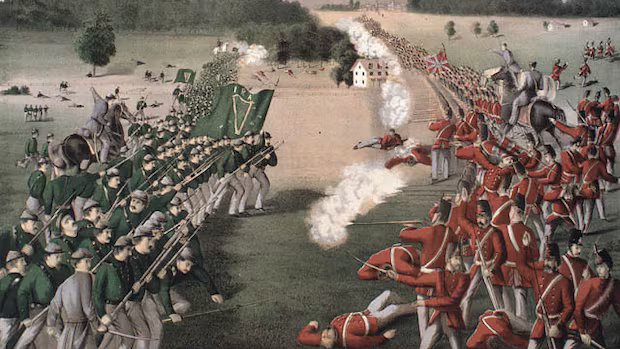
An obscure battle that took place on Canadian soil just a year before Confederation may not reverberate in the historical consciousness of Canadians outside of the town of Fort Erie, Ont. — but it lays claim to a number of historical focal points.
The Battle of Ridgeway — or Limestone Ridge — in 1866 was the first time a battle was fought by Canadian troops led by Canadian officers. It was also the inspiration for Decoration Day, a predecessor to Remembrance Day that is still marked annually in parts of the country.
Yet the nine men who died in the battle are not among the names listed in the Books of Remembrance, an eight-book collection on Parliament Hill that lists the names of soldiers who died in service to Canada.
A new petition set to be presented in the House of Commons is seeking to have those nine men and the dozens who died in the wake of the battle added to the list.
“It really just boils down to Canada recognizing those who died defending it,” Conservative MP Fred Davies, who is sponsoring the petition in Parliament, told CBC News.

The Niagara South riding that Davies represents includes Fort Erie, where the battle took place.
“I drive by Limestone Ridge two or three times a week and I always find myself looking at that Ridge,” Davies said.
“It sort of just digs at me that this needs to have national recognition.”
The story of the Battle of Ridgeway is not one of a decisive Canadian victory. Inexperienced volunteers faced off against Fenian raiders, most of whom were veterans of the American Civil War.
The Fenian Brotherhood was an Irish American movement whose ultimate goal was Irish independence from the British Crown. They attempted to accomplish this by trying to invade and occupy parts of British North America and essentially ransom them back to Britain in return for Irish independence.
In 1866, hundreds of raiders crossed the Niagara River with the aim of attacking the Welland Canal and were met by roughly 800 Canadian volunteers from numerous regiments at Limestone Ridge near the towns of Ridgeway and Fort Erie.

Peter Vronsky, a historian and author of the book Ridgeway: The American Fenian Invasion And The 1866 Battle That Made Canada, told CBC News that he thinks it’s “remarkable” that hundreds of Canadians from around the Golden Horseshoe region mobilized as quickly as they did. But he said the Canadian troops were ill prepared for what he called Canada’s first modern battle.
“They went into combat without food rations, without water. Some of them didn’t have proper footwear — they would wear their civilian shoes into battle. There was a shortage of ammunition,” he said.
The Canadians advanced on and exchanged fire with the invaders, but ultimately scattered in a somewhat chaotic retreat following a Fenian bayonet charge. Still, the Fenians abandoned their incursion after the battle and eventually fled back to the U.S. side of the Niagara River.
“It was a battlefield defeat, but in the end the campaign was broken by this battle. So it was in a way, a victory for Canadians in that we turned the Fenians back,” Vronsky said.
Davies said the battlefield defeat at Ridgeway doesn’t take away from the sacrifice of those who died.
“While the organization may have been weak and the preparation pretty much nonexistent, it does not diminish the fact that these people fought to defend Canada against an invader,” he said.
“That in and of itself is enough for me to [push to] provide recognition for those who died.”

A memorial site dedicated to the nine who died at Ridgeway was raised on the 150th anniversary of the battle in 2016. Fort Erie Mayor Wayne Redekop says the town has lobbied for years to have their names added to the Books of Remembrance, but all attempts have been rebuffed thus far.
“They’re a major part of our history, and we should at least do them the honour of recognizing the part they played in making Canada the country that it is,” the mayor said.
Even though the battle took place before the country of Canada officially formed, the books of remembrance include the names of soldiers whose deaths predate Confederation, including in the War of 1812.
Redekop, Davies and Vronsky all suggested that the battle had a direct impact on Confederation as well.
Vronsky said it spurred some of “those who were still reluctant” to get on board with the idea.
“In some ways, this is the battle that kind of made Canada both on paper and in our hearts,” he said.
A number of the regiments who fought in the 1866 battle are still around today, including the Queen’s Own Rifles and the Royal Hamilton Light Infantry.
“It was the testing, the blooding of our modern armed forces,” Vronsky said.

Alexander Muir, writer of The Maple Leaf Forever, penned the patriotic ballad after fighting in the 1866 battle. It’s reputed that he was inspired by the falling leaves of a silver maple tree in Toronto’s Leslieville neighbourhood.
But Vronsky posits that Muir may have been inspired by another maple leaf: the one that forms the Queen’s Own Rifles insignia, the regiment he fought with during the Battle of Ridgeway.
“It’s the first battle where Canadians consciously were now fighting for their own home community as opposed to as British colonial subjects,” he said.
“We were fighting for the maple leaf first and the Queen, the crown, second.”