dailynewsnblog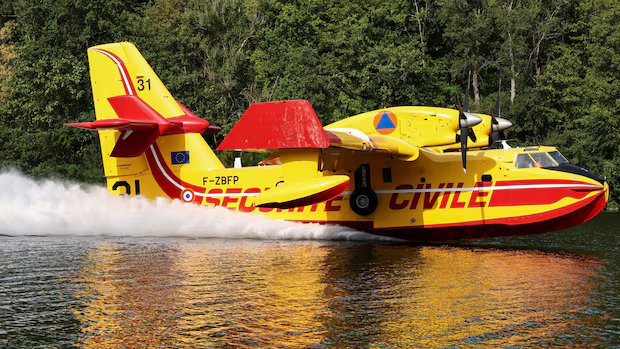
As Canada, the United States and Europe grapple with another brutal wildfire season, pressure is building on the manufacturer of the Canadair “Super Scooper” water bombers to increase production, and on the federal government to bulk order the planes.
Calgary-based De Havilland is taking the rare step of reviving production of the Canadair after acquiring the water bomber program. The planes had been built by Bombardier up until 2015.
The world-renowned aircraft are built by hand with the majority of assembly in Calgary, from a supply chain across the country. The revived production line was announced in 2022 and is beginning to produce results as the first two aircraft are taking shape and on schedule to be completed and delivered in early 2028.
Canadian premiers and European leaders are desperate to get their hands on those aircraft amid current shortages and aging fleets.
First produced in the 1960s, the Canadair amphibious firefighting plane was designed for fighting vast fires in the Canadian wilderness. Its unique design allowed it to navigate narrow canyons at low altitude and scoop thousands of litres of water directly from lakes, rivers and oceans in seconds.

The aircraft was purpose-built as a firefighting aircraft, as opposed to other planes and helicopters that are often modified to be able to carry water.
The latest version of the Super Scooper will be remarkably similar to past Canadair aircraft, with high wings spanning 30 metres, a 6,100-litre water tank, and the distinct yellow and red exterior.
Political heat
In recent weeks, opposition politicians in France and Spain have criticized governing leaders for not having enough operational Canadairs, leading to a lack of preparedness to tackle extreme weather and control wildfires.
Some provincial premiers have lamented the lack of new water bombers for consecutive summers, including Manitoba’s Wab Kinew, who said in June 2025, “We could use every water bomber we can get our hands on.”
The political heat is being felt by De Havilland.
“We are under pressure. We know that this is a very important aircraft not only for Canada but for the world. We take our responsibility to our customers and the people they serve very seriously,” said Neil Sweeney, the company’s vice-president of corporate affairs, in an interview inside the Calgary assembly plant.

Demand is so high that De Havilland is considering whether to build a second production line, even as it works to produce its first aircraft at existing facilities.
In recent weeks, Alberta Premier Danielle Smith said she is working with her provincial counterparts and the federal government to support a firm order by Ottawa, which would give the aircraft manufacturer enough certainty to begin constructing a second line.
“We told the Canadian government that if they made an order of 50 aircraft,” said Sweeney, then, “we would build a second line tomorrow.”

Currently, De Havilland — which produces a range of aircraft and employs about 4,000 people predominantly in Calgary, Ontario and Victoria — will be able to produce about 10 water bombers annually at full capacity. A second production line would eventually increase output to 20 each year.
De Havilland has existing orders for 38 water bombers. The wait time for delivery of any new orders is between 2032 and 2033.
The Canadair require tens of thousands of parts, of which about 80 per cent are made in Canada. Some of the equipment on the production line dates back to the 1960s.
‘Demand is huge’
There is a need for a second and even a third production line for the Canadairs, said John Gradek, an aviation expert at McGill University.
Several countries are panicking because of the wildfire situation and the lack of new water bombers, said Gradek, who estimates hundreds of the aircraft would be snatched up if there were any available.
Demand is coming from around the world, he said, because of a warming planet.
“Right now we’re stuck in a situation where the demand is huge,” said Gradek. “The world is looking for more water bombers, newer water bombers, and we’re not ready.
“Every continent on the Earth, from Australia to Europe to South America to North America — the world is burning up. We need equipment to be able to fight those fires and fight those fires effectively. Canadair water bombers have proven their effectiveness over the last 60 years, no doubt about it.”
De Havilland did not provide the price tag for a Canadair, although the figure is believed to be about $80 million per aircraft, based on government announcements.

Threat of potential competition
If De Havilland is unable to respond to the growing demand for water bombers, there is the risk that foreign companies may develop their own rival firefighting aircraft.
Designing a new aircraft would take several years, but it’s a realistic threat to Canadian manufacturing jobs, said Gradek.
“Whether it’s Russia, whether it’s France, whether it’s the U.K., whether it’s Greece or whoever — they’re going to come out and they’re going to come out fast and furious,” he said.
The warning comes at a time when the federal government is focused on improving the national economy and bolster domestic manufacturing.
“We have the best scooping aircraft in the world, bar none. We’ve had it for 60 years. But having it for another 60 years is not guaranteed,” said Sweeney.

National fleet proposal
One of the recommendations from a Senate report released in June, on the growing issue of wildfires in Canada, encourages the federal government to create a national fleet of modern firefighting aircraft.
This year, the federal government did lease 10 airplanes and helicopters, which are helping provincial wildfire crews this summer.
“The federally funded aircraft are in high demand,” said Alexandria Jones, a Winnipeg-based spokesperson for the Canadian Interagency Forest Fire Centre, a national not-for-profit organization responsible for wildland fire management in Canada.
“There definitely have been situations where we’ve had to triage requests that come through,” she said.
While demand is high, different types of aerial firefighting units are just one tool in helping battle wildfires, said Jones.
Aircraft are best suited to slowing the spread of wildfires, helping create perimeters and reducing heat to aid ground crews, she said. But helicopters and planes can also be hindered by widespread smoke and certain terrain.
“Planes don’t put out fires, firefighters put out fires,” said Jones. “They’re not the silver bullet to firefighting. While planes are the sexy part of firefighting, there’s a lot of other things that we need to consider with the ongoing threat that we’re seeing from wildfires today. And that’s mainly prevention and mitigation.”
The federal government is committed to protecting Canadians and strengthening the national capacity to respond to “increasingly intense wildfire seasons,” said Soraya Lemur, the press secretary for Eleanor Olszewski, the federal minister for emergency management.
“Minister Olszewski remains in close contact with her provincial and territorial counterparts to co-ordinate efforts and identify the best ways to support one another in the face of the growing impacts of wildfires,” said Lemur in an emailed statement.