dailynewsnblog
Launch costs disparity
SpaceX has also made significant gains in controlling costs compared to other nations. A decade ago, the United States and Europe had similar launch costs. Today, according to publicly available data, launch costs in Europe are now three times higher than for comparable payloads in the United States.
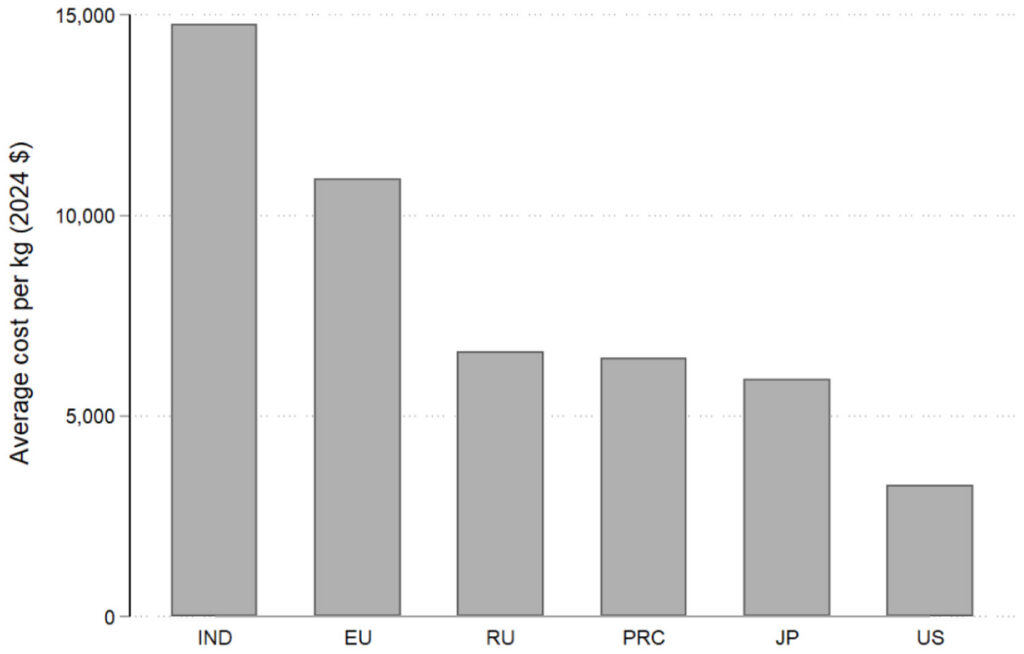
The researchers estimate that the average cost of sending a kilogram of payload to orbit in the United States is now $3,225, compared to higher costs elsewhere: Japan ($5,287), China ($5,809), Russia ($6,682), and Europe ($9,897). India is higher still at nearly $15,000 a kilogram.
Credit:
Economics Letters
Average cost per kg to orbit by country in 2025.
Credit:
Economics Letters
“The very high figure for India might be counterintuitive as it stands in stark contrast with the narrative of the country’s frugal space program,” the authors write. “However, this is a result of focusing on small rocket sizes, which implies that, albeit being low by international standards, fixed costs get amortized over a limited payload.”
The key factors in bringing down costs are larger rockets, increased cadence, and reuse of launch vehicles.
“Poorly scalable domestic technology”
As for what other countries should do about this, the researchers assert that nations in Europe and elsewhere that decide to rely solely on their domestic rockets for launch needs will see their costs go up, which could slow their efforts to expand space-based operations such as satellite constellations. This leaves policymakers in a difficult position.
“Looking specifically at Europe, for now the continent is stuck between a rock and a hard place, having to choose between continuing to depend on lower-cost American launch technology and relying on expensive, poorly scalable domestic technology to expand its strategic presence in space,” the authors write.
Ultimately, to remain competitive, spacefaring nations will need to develop better and more modern launch capabilities. The United States is far and away the current leader of reusable launch, and virtually all new commercial rockets under development incorporate some aspect of reuse. Chinese firms are similarly pushing forward with this technology. To date, Europe’s efforts have been slow and stodgy.
For example, a European Space Agency program to demonstrate small, suborbital hops called Themis was originally supposed to perform low-altitude hop tests by 2022. So far, the vehicle has yet to get off the ground.