dailynewsnblog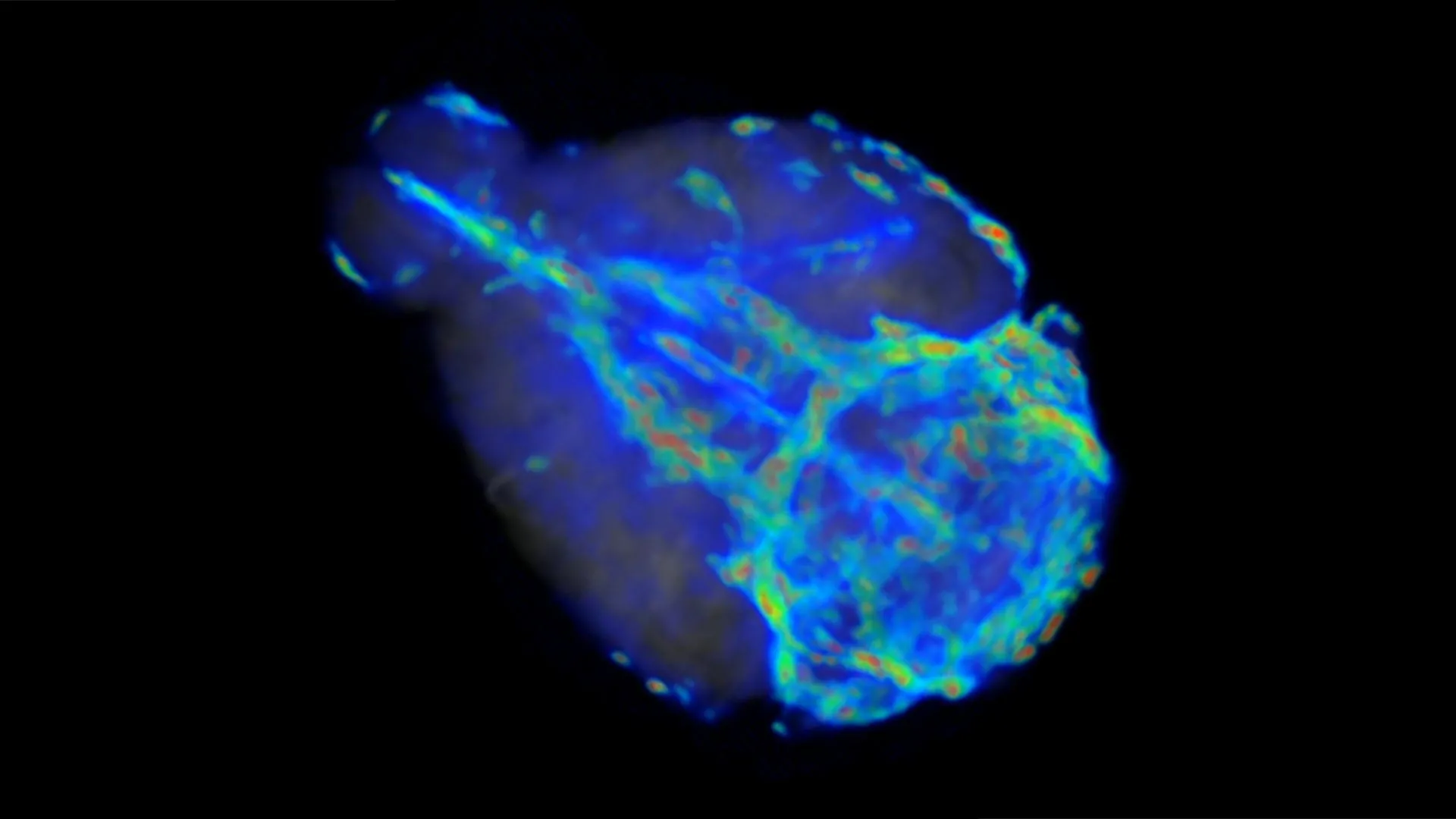
During deep sleep, a water-like fluid moves around the brain and helps remove metabolic waste associated with diseases such as Alzheimer’s. This cleanup process is part of the glymphatic system, which was first described in 2012 by Maiken Nedergaard — a pioneering neuroscientist and co-director of the University of RochesterCenter for Translational Neuromedicine.
Scientists still do not fully understand how this system works, including one important detail: how quickly the fluid moves around and through the brain. Measuring such slow circulation inside a living brain is especially challenging because researchers need methods that can observe the process without causing permanent damage.
The Challenge of Measuring Brain Fluid Flow
“You can put a microscope on a small patch of the brain and watch what’s happening there with a lot of detail, and we’ve worked with that type of data in the past, but it’s only a tiny view of the overall process,” says Professor Douglas Kelley from URochester’s Department of Mechanical Engineering. “If you want to image whole brains, an MRI is a great approach because it gives you a three-dimensional view. But an MRI has serious limitations too, the biggest of which is that it does not capture the fluid flow velocity, at least not for flows this slow.”
To overcome that limitation, Kelley and researchers from URochester, Brown University, and the University of Copenhagen used artificial intelligence. In a new study published in Science Advances, the team describes a physics-informed AI approach for calculating fluid flow speeds from magnetic resonance imaging (MRI) data.
The researchers trained neural networks using videos that showed dye spreading through brain tissue over time. By analyzing how the dye moved, the AI could estimate both the speed of the fluid and the permeability of the surrounding brain tissue.
Two Very Different Speeds Inside the Brain
The findings revealed two major routes by which the glymphatic system removes particles from the brain, including amyloid beta proteins associated with Alzheimer’s disease — and the speeds of those routes are dramatically different.
In more open areas around the brain, including the space near the surface between the skull and the brain, the water-like fluid travels at a few microns per second. Deeper inside brain tissue, however, the fluid moves much more slowly. Researchers found that this deeper flow is about 50 times slower.
The team is currently using animals such as mice to establish baseline measurements of how fluid normally moves through the brain. Those measurements are helping researchers develop and improve the AI tools. Eventually, they hope to compare circulation patterns between healthy and diseased brains, as well as between younger and older brains.
Toward Measuring the Human Brain
A major long-term goal is to extend the approach to people. Measuring fluid circulation in and around the human brain could open the door to new ways of studying neurological disease and brain injury.
“We’re working hard toward being able to measure the flow of water-like fluids in and around human brains because then the clinical applications get a lot more important and exciting,” says Kelley. “We hope to someday be able to see whether an Alzheimer’s patient has poor circulation in their brain or even screen for poor circulation earlier in life to try to stave off Alzheimer’s. Or we could check when somebody has been concussed to see whether the fluid circulation in their brain is disrupted. This study gets us a step closer.”
The research is supported by the NIH National Center for Complementary and Integrative Health and the NIH BRAIN Initiative. Kelley’s collaborators on the study include Brown University PhD student Juan Diego Toscano, URochester computational scientist Yisen Guo, Brown University PhD student Zhibo Wang, URochester PhD student Mohammad Vaezi, University of Copenhagen Associate Professor Yuki Mori, Brown University Professor George Karniadakis, and URochester Assistant Professor Kimberly Boster.