dailynewsnblog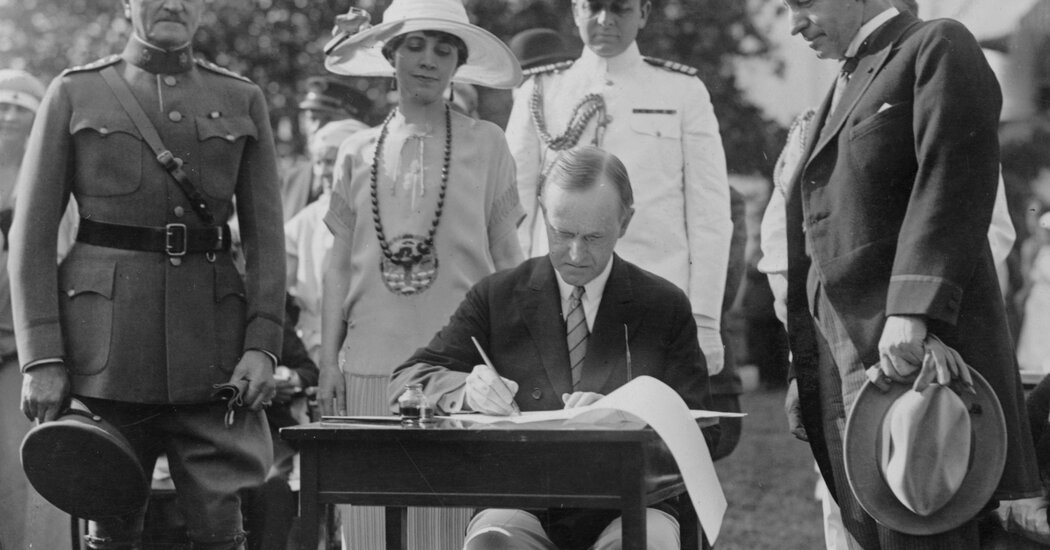
In 1924, Congress sent a message to the world: We are no longer ready to take “your tired, your poor, your huddled masses.”
Seized by fears around crime, demographics and economic losses, it set quotas that limited immigration from Italy, Poland and Russia. It effectively barred immigration from Asia. It also instituted a cap of 150,000 immigrants allowed into the country in a given year, rejecting the vision laid out by the writer Emma Lazarus in her famous poem.
“It has become necessary that the United States cease to function as an asylum,” Representative Albert Johnson, Republican of Washington, said at the time.
Today, many historians see those dynamics repeating — except this time, President Trump is hardening the country’s borders against the huddled masses largely on his own authority.
Using administrative action, and backed by expansive new powers upheld by the Supreme Court, Mr. Trump has drastically pulled back on all forms of immigration. He has banned asylum at the southern border. He has ended deportation protections for people from disaster- and war-scarred countries. He has blocked refugees except a group of mostly white South Africans. He has instituted policies essentially halting long-term immigration from parts of the Middle East and Africa. And he has tried to limit green cards for those who could be seen as relying on government benefits.
At the same time, he has deported hundreds of thousands of people and paid others to leave voluntarily, using threats of being banished to dangerous third countries if they stay.
“There are clear echoes of the 1920s in the Trump administration’s approach to immigration. Then, immigration was restricted through explicit national quotas set by Congress,” said Julia Gelatt, an associate director of the immigration policy program at Migration Policy Institute, a nonpartisan think tank. “Today, we’re seeing country-based restrictions enacted through expansive use of executive authority. But both sets of actions were based on concerns about who belongs in the United States, and who is viewed as able to integrate into a desired national culture.”
Abigail Jackson, a White House spokeswoman who has since left that role, said in a statement that the president and his administration were concentrating on present-day problems.
“The Trump administration remains laser-focused on arresting and deporting criminal illegal aliens, keeping our border secure from aliens who seek to enter illegally and putting Americans first in all our policies — from travel restrictions to deportation operations,” she said. “The president’s guiding focus remains doing what’s best for the American people.”
As a candidate, Mr. Trump pledged to seal off the border and purge the country of illegal immigrants. But more recently, much like the anti-immigration movement of the 1920s, the administration has been explicit about its belief that the country’s culture and economy are being destroyed by unfettered legal migration from parts of the globe. That is clearly communicated in slogans adopted by the Trump administration on social media, including “import the third world and you become the third world.”
When explaining why the administration had allowed only Afrikaners, a group of mostly white South Africans, to enter as refugees, Secretary of State Marco Rubio cited their ability to assimilate into the country.
When the Supreme Court upheld birthright citizenship in June, which confers citizenship on anyone born in the United States, Trump administration officials used the moment to denounce certain cultures.
“We have people from all over the world, from third world nations, nations that on their own would have never invented the wheel, let alone modern technology, let alone medicine, let alone air travel,” Stephen Miller, a senior White House adviser who drives much of the administration’s immigration policy, said on “Jesse Watters Primetime” on Fox News. “And they can just come into the country, have a baby at a hospital, paid for it by you and me, and then that baby’s automatically a citizen.”
In the weeks since, the administration has attempted to revive parts of their birthright ban.
The 1920s Crackdown
The 1924 Immigration Act was driven in part by the idea that particular cultures are inferior and therefore cannot assimilate into the United States. Mr. Johnson, the Washington congressman, was affiliated with a powerful organization that openly promoted eugenics and held sway in policy-making circles.
“On the whole, immigrants from Northwestern Europe furnish us the best material for American citizenship and for the future upbuilding of the American race,” the group wrote in endorsing the rollback of immigration to 1890s levels, as the legislation did, according to a Jan. 7, 1924, article in The New York Times. “They have higher living standards than the bulk of the immigrants from other lands; average higher in intelligence, are better educated, more skilled, and are, on the whole, better able to understand, appreciate and support our form of government.”
The report’s writers said that turning away newcomers from southeastern Europe would reduce immigration of those they concluded, through now-discredited research, were more likely to commit crimes and had “the lower grades of intelligence.” But they claimed their intention was not to demean them compared with northwestern Europeans.
“It is simply a question as to which of these two groups of aliens, as a whole, is best fitted by tradition, political background, customs, social organization, education and habits of thought to adjust itself to American institutions and to American economic and social conditions; to become, in short, an adaptable, homogeneous and helpful element in our American national life,” it said, according to the article.
In the years that followed, the effects of the law were clear as immigration dropped significantly. The share of the foreign-born population fell to just 4.7 percent in 1970 from nearly 12 percent in 1930, according to the Migration Policy Institute. The impact on specific nationalities was stark as well: Arrivals from Italy, for instance, dropped from about 42,000 in 1921 to roughly 6,000 in 1929, according to the group’s analysis.
Similar trends are already becoming evident under Mr. Trump. Census figures show immigration numbers shrank last year by more than 50 percent from the previous year. The combination of low birthrates and slowing immigration led to one of the slowest growth rates in U.S. history in the year leading up to July 2025.
A New Era of Immigration, and a Backlash
The era of strictly limited immigration ushered in by the 1924 law ended in 1965, when President Lyndon B. Johnson and Congress again remade the country’s immigration system amid the civil rights movement. They opened new pathways for immigrants from outside Western Europe to make America their home and allowed U.S. citizens to apply for green cards for family members abroad.
Mr. Miller has condemned the 1965 law as undermining the country’s long-term success, saying in an interview on “The Will Cain Show” on Fox News last year that it allowed “this global ability of people in every part of the world to come to America, to bring their families to America, and then eventually empty out their entire towns and their entire villages to the United States of America.”
Mr. Miller has called it “the single largest experiment on a society, on a civilization that had ever been conducted in human history,” Mr. Miller said on that Fox News appearance in December. “Not just the 76 million immigrants that were brought in, largely from the third world, but their descendants, too.”
Mr. Miller has looked back at the era following the 1920s as a period of American greatness.
“What they don’t teach you in school, is that from 1920 to 1970, there was negative migration,” Mr. Miller said in the Fox News interview. “There was a half-century of negative migration. The foreign-born population declined by 40 percent for half a century.”
In that same period, he said, “the U.S. population doubled from natural childbirth. That was the cauldron in which a unified shared national identity was formed.”
That is why some former immigration officials believe that Mr. Miller and the Trump administration are quietly stamping out the 1965 measures, particularly through a ban on long-term immigration from 75 countries issued in January. Many of those countries have Muslim majorities or are in Africa.
“In 1924, a nativist-era Congress imposed racial quotas. In 1965, a civil-rights-era Congress eliminated them,” said Doug Rand, who was a senior official at U.S. Citizenship and Immigration Services in the Biden administration. “Today, Trump is trying to snap them back by fiat.”