dailynewsnblog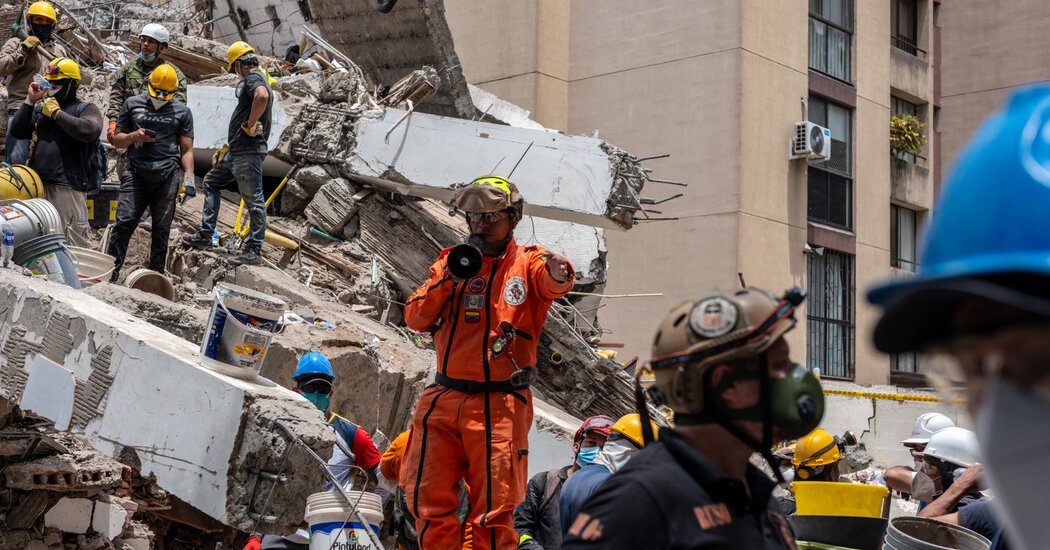
For 40 days they labored in Venezuela, rescuing survivors from the wreckage and later recovering bodies from La Guaira, the coastal region that was the nexus of death and destruction triggered by back-to-back earthquakes.
After a quake struck in neighboring Colombia on Monday they hopped on a red-eye flight. By Wednesday morning they were at collapsed buildings in Cali, Colombia’s third-largest city, trying to dig out survivors.
“By the time we were at that point in La Guaira, it was strictly body recoveries,” said Alex Rodríguez, 36, who had been in Venezuela. “And right now we’re here at the site, fighting and racing against time to find signs of life.”
The rescue workers were from Topos Azteca, a Mexican volunteer search-and-rescue team that has become one of the best-known names in disaster response across Latin America and beyond. Its members have traveled to earthquakes, floods, hurricanes, landslides and other disasters around the world, as far as Turkey, Ukraine and the United States after the Sept. 11, 2001, terrorist attacks.
Cali residents recognized the orange-uniformed volunteers almost immediately, thanking the group’s founder and president, Héctor Méndez, 80, and taking photographs amid the rubble, as he coordinated the rescue response. The mayor’s office featured him in a video.
The reaction reflected a reputation built over four decades. The group’s origins trace to the enormous earthquake that struck Mexico City in 1985 and killed as many as 10,000 people. Mr. Mendez, the founder, recalled going to search for his brother after that disaster, but, after finding him unharmed, he instead stopped to help at a collapsed apartment building.
He spent about 10 hours helping rescue a woman and her niece. He emerged exhausted, with injured knees, a sore arm and aching fingers after working without gloves or proper equipment.
He described the experience as an epiphany: He realized that rescue work was his life’s mission.
Since then, Topos Azteca has expanded beyond Mexico. The group began working internationally during a 1986 earthquake in El Salvador, where Mexican rescuers trained local volunteers. It eventually developed affiliated brigades in other countries, including El Salvador, Guatemala, Brazil, Panama and Venezuela.
Some members are trained as firefighters and paramedics. Others have day jobs that have nothing do with disaster response. All are volunteers, many paying their own expenses. The group has 250 to 300 people based in Mexico, and it had deployed a team of about 20 to Colombia.
Miguel García, 25, joined Topos Aztecas through his father, a longtime rescue worker who taught him first aid and firefighting skills as a child. He now runs a traditional Chinese medicine business with his spouse and described rescue work as a hobby.
“We have people ranging from the local bus driver on the corner to someone selling sandwiches on the subway,” he said.
Another member, Juanita Dueñez, 49, has been a firefighter in Mexico for 20 years. She first encountered the volunteer rescue group when a friend invited her to one of its training courses. She kept returning for more courses until she formally became a member.
Ms. Dueñez said what attracted her was the group’s philosophy: that distinctions of race, nationality, gender, religion or politics disappear in the face of an obligation to help another person.
The training itself is intensive — three-day courses covering first aid, ropes, dragging and rescue techniques, structural stabilization and simulated disasters. Rescuers generally must first participate in several disasters in their own country before being sent abroad.
Mr. Méndez said that is because there is no training exercise that can reproduce the real experience of disaster response.
“In no course in any country are they going to bring you someone whose child has died so you can embrace them and feel their pain. rThat doesn’t exist,” he said. “You have to live that to be a real volunteer, a true rescuer from your heart.”
Mr. Rodríguez, the member from Venezuela, arrived at Topos Azteca through disaster itself. When back-to-back earthquakes devastated La Guaira, where his grandmother lived, he traveled from Caracas to look for her. Her building had collapsed, but she survived because she was not home at the time.
But at one of the first destroyed buildings he encountered, Topos Azteca rescuers were searching for two children who might still be alive. He stayed to help.
A professional rock climber and circus aerialist, he used his knowledge of ropes and rigging to help move concrete slabs weighing several tons. He quickly learned how to operate thermal cameras and sound equipment.
“The Topos saw my skills, my endurance, my emotional control,” Mr. Rodríguez said. “And I felt a connection with them. The fraternal family bond was true brotherhood.”
So this week he was assisting in Colombia, where the earthquake in the western part of the country has killed nearly 270 people, according to the Colombian government.
Mr. García described the group as a fraternity of rescuers who repeatedly find themselves together responding to disasters.
With each deployment they try to grow their ranks. After international missions, they try to identify local volunteers who showed aptitude and train them so that the country is better prepared for the next disaster, Mr. García said.
“That uncertainty of knowing whether you’ll make it out of a collapsed structure or not creates a brotherly and sisterly bond among the people we work with in our squad,” he said. “We have a calling to serve.”