dailynewsnblog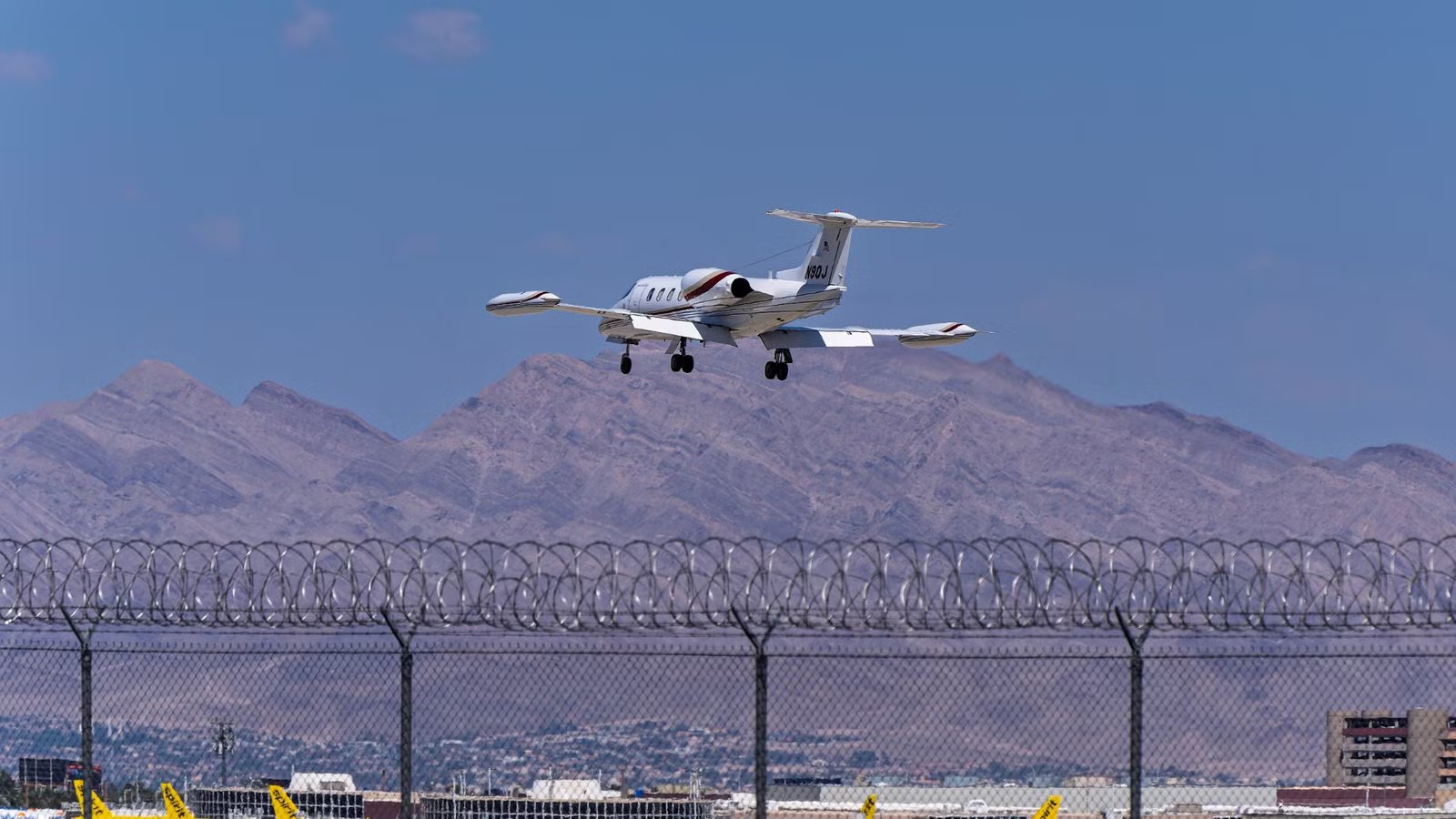
On Monday evening, the tower at Las Vegas’  Harry Reid International Airport (LAS) cleared a Learjet to land on 19R as police helicopters chased drones flying over runway 26. View From The Wing shared an audio recording of the exchange between air traffic control and the pilot, and at least in the clip, it does not seem that ATC informed the aircrew of the potential hazard.
Unlike a bird strike, when a drone collides with a jet, it acts like a heavy projectile owing to the hard and dense structure filled with batteries, motors, and metal parts. Fortunately, there was no report of a mishap that resulted from the small drone’s illegal airspace violation.
Harry Reid Rolls The Dice

One of the reasons the incident on August 10 raised eyebrows was due to the fact that the pilot of the Learjet did not appear to be aware of the danger. In the conversation between the tower and the helo over the radio, local police were expected to intervene imminently after finding the operator on the ground. Still, the decision to continue landing aircraft on the side of the airfield away from the drone may seem cavalier to many when compared to other recent events like the airspace closure in El Paso.
Earlier in February, the El Paso Airport (ELP) shut down its airspace due to reports of drones flying over the airfield along with laser activities that turned out to be related to the US military. All the planes waiting to depart were grounded, and arrivals were rerouted after the airport authorities were notified of the hazard. This incident was quickly resolved with a 10-day emergency flight ban that was lifted after just several hours.
The difference in response from ELP is stark compared to how Vegas handled Monday’s events. The threat that drones pose to the safety of flight is very real for all types of aircraft, from the smallest helicopter to the biggest widebody. Yet, the number of drone sightings near airports every month is now into the triple digits, according to the Federal Aviation Administration.
A Dangerous Trend For American Air Travel

The presence of military-grade counter-drone lasers makes the El Paso example a degree more extreme, but just over a month ago a drone was sighted in the vicinity of Newark Liberty Airport (EWR) as well. Around that same time, a JetBlue flight landing at JFK International (JFK) was struck by an object during landing approach that they believe was a drone. Just prior, a United Airlines flight landing at San Diego International reportedly struck a drone landing on April 30.
CNN reported that during the incident in Newark on June 27, a Boeing 737 operated by United reported to the tower that it almost struck a drone at 3,000 feet (915 meters), and just minutes later a United Express regional jet also had a near miss around 2,000 feet (600 meters). That is consistent with the San Diego International (SAN) incident, when another United 737 believed it struck a red drone around 3,000 feet (915 meters) despite the absence of damage after it landed.
The JFK incident mirrors the close call at Harry Reid on Monday the most closely, as the JetBlue aircraft reportedly hit the drone while turning in for its final approach. The pilots called into the tower to say that it hit the plane right above the cockpit. Hours later on the same day, a helicopter pilot called ATC at JFK to report another close call with a remotely controlled airplane.
The Fallacy Of Equating Drone Strikes To Bird Hits

As noted by A View From The Wing and its coverage of Monday’s near miss, many members of the public incorrectly assumed that hitting a drone is no worse than a bird strike on a jetliner. Not only is the drone a much harder target that does greater damage, but bird strikes are already extremely hazardous to air traffic without the additional danger.
While it is true that hitting a bird generally won’t knock a plane out of the sky, it can do millions of dollars in damage. Now, when it comes to small aircraft like helicopters or general aviation planes, there is a genuine risk that a severe midair collision could induce a loss of control. This is especially true if a drone is ingested by a turbine engine or propeller and the flammable batteries explode upon impact.
To illustrate the danger, the following video shared by News Now shows the catastrophic damage from a bird strike on an American Airlines jet in South Carolina on the same day as the Vegas drone spotting.
Due to the danger to the integrity of aircraft and the safety of air travelers, the FAA imposes heavy penalties for individuals who choose to recklessly fly their drone in restricted airspace. The FAA levies civil penalties of up to $75,000 per violation. Knowingly operating a drone in a manner that endangers or disrupts an aircraft is a federal felony carrying up to 20 years in federal prison. Even reckless operation without intent carries a sentence of up to one year in prison.