dailynewsnblog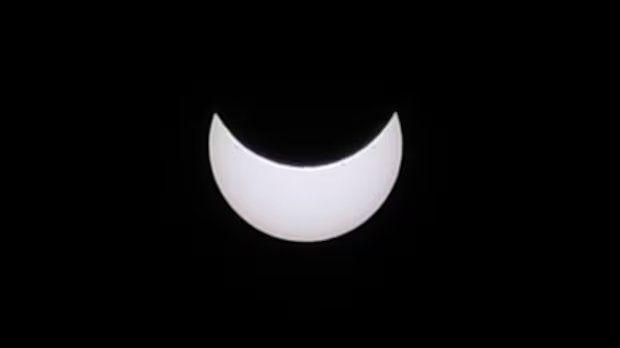

Listen to this article
Estimated 4 minutes
The audio version of this article is generated by AI-based technology. Mispronunciations can occur. We are working with our partners to continually review and improve the results.
Depending on the weather, people who turned their eyes upwards in Newfoundland and Labrador Wednesday afternoon were able to see a partial solar eclipse.
Churchill Falls was the first area to catch a glimpse of the partial eclipse, starting at 1:37 AT (2:07 NT).
The eclipse gradually appeared across the province on Wednesday afternoon. The partial eclipse will end in St. John’s at 4:37 p.m. NT.
While the range of the eclipse varies depending on location, in Newfoundland the moon was expected to cover approximately 50 per cent of the sun.
At the Johnson Geo Centre in St. John’s, an excited watch party watched the moon slowly pass in front of the sun Wednesday afternoon — with special safety viewing glasses in tow.
The watch party was going on from 12 p.m. NT to 5 p.m., alongside the Royal Astronomical Society of Canada and STEM Girls.

Hiding Neilson, an astronomer at Memorial University, told CBC that he could see the moon “eating the sun up” through this telescope.
“I think it’s kind of wonderful,” Neilson said at the watch party.
“I mean, we live in a very large solar system. There’s only so many rocky planets, but we’re the only one with a large moon. And then there’s all these other planet’s moons, they don’t have solar eclipses. We do. We have the best eclipses in the solar system,” he said.
Neilson said the partial eclipse is rare, because it repeats only about every 50 years.
“It takes a long time between eclipses. So we might not see another one in Newfoundland now for a while,” he said.

‘Pretty spectacular’
The Geo Centre’s lead of education and interpretation said ahead of the event that there would be activities where kids can create solar viewing tools so they wouldn’t look directly at the sun.
“Viewing it, it is pretty spectacular,” Andrea van Nostrand told CBC News Tuesday.
“You don’t normally see something moving in front of the sun like that and with the glasses on and the viewers… It’s phenomenal.”

A total solar eclipse will be visible across Greenland, Iceland and Spain, along with a very small part of Portugal.
Been there, saw that, want to see it again
Seeing the total eclipse two years ago prompted mother-daughter duo Jennifer Waye and Gabriela Fuentes Waye to travel to Europe so they could witness the total solar eclipse from Spain.
“It’s going to be really beautiful and it’s going to be packed, so we’re going to be experiencing that with a lot of other people,” said Fuentes Waye over Zoom while in Mallorca, Spain on Tuesday.

Waye said they wanted to see if from Spain, not only because of a family connection to Spain, but also because of the weather.
“You don’t get a lot of rain. You don’t get a lot of clouds. So the weather, you know, 99 per cent of the chance, you know, it’s going to work out,” she said.
In Canada, people farther north and east were expected to see a more complete solar eclipse. Alert, Nunavut, was expected to have the best view in the country, with the sun 94 per cent covered.
Download our free CBC News app to sign up for push alerts for CBC Newfoundland and Labrador. Sign up for our daily headlines newsletter here . Click here to visit our landing page.