dailynewsnblog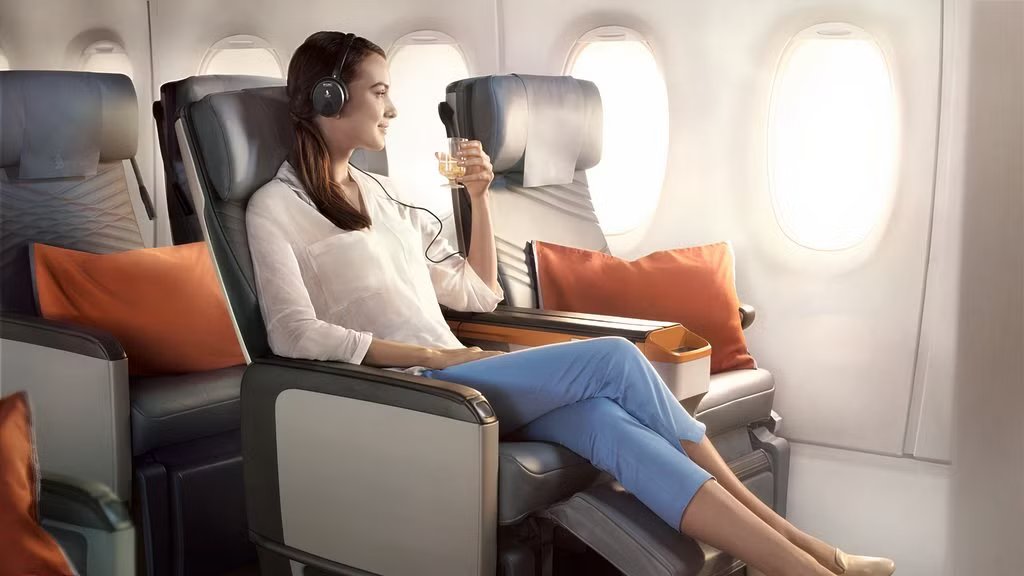
The world’s longest flight is currently Singapore Airlines’ mammoth trip from New York to Singapore, requiring 18 hours in the sky. Given this time, there is no true economy class product available, with 67 business class and 94 premium economy seats. The hard product for both classes is undeniably strong. However, it has been suggested that the cramming of 94 premium economy passengers into an area with one galley and three washrooms is breaking the product.
Qantas’ Project Sunrise will soon overtake this Singapore Airlines flight in terms of distance. It will grow from lessons taken from Singapore Airlines’ Airbus A350-900ULR jets. The cabin will be far more wellbeing focused, going further than simply offering a strong hard product. An example is the dedicated “Wellbeing Zone.”
Singapore Airlines’ Premium Economy Experience

Nobody is arguing that Singapore Airlines doesn’t have an excellent premium economy product. Passengers aboard the lengthy Airbus A350-900ULR flights can enjoy 38 inches (97 cm) of pitch and 19 inches (48 cm) of width, plenty of space for even flights that exceed 15 hours. Additional comfort is provided by a calf and footrest built into the seat. While the layout is 2-4-2, customers can pay an additional $140 for the two to become one. The four do slightly protrude into the aisle, making for a cramped experience outside the seats themselves.
Refreshments and food come in the form of a main course, seasonal appetizer, complimentary drinks and snacks, and more. You can preview this menu up to six weeks before your flight. Another choice is to upgrade to the expanded Book the Cook menu. “Enjoy the perks in Premium Economy Class! From check-in to boarding and baggage handling, experience priority treatment throughout your journey,” writes Singapore Airlines.
Points to Seats summarized the overall positive experience taking the world’s longest flight: “The premium economy seats are noticeably wider and better-padded than economy seats, and I appreciate how the seats have a happy medium between traditional reclining and fixed-shell slide-forward reclining seats. In all settings I thought the seats were comfortable. I also very much enjoyed the food, and for all meals both my husband and myself made use of Singapore Airlines’ ‘Book the Cook’ feature, which allows preselection of main dishes from a variety of options.”
The Problem With Singapore Airlines’ 18-Hour Flight

The problem is that  Singapore Airlines hasn’t upgraded the lesser-considered aspects of premium economy, which is most felt at the aircraft’s rear. Seats are also crammed in with little room not dedicated to passenger seating.
Travel Dealz sums up the issue in their flight review: “Behind is the curtain to the kitchen and lavatories. This is the only galley for the 94 passengers. Since the seat is practically hidden behind the curtain, a passenger is constantly slamming into the seat when they want to go back to their seat… I really felt sorry for the gentleman in row 43 on such a long flight.”
The table below shows the current Singapore Airlines fleet, and how the A350-900ULR fits into it. It makes use of the Civil Aviation Authority of Singapore’s data:
Aircraft | In service | Orders |
|---|---|---|
Airbus A350-900 | 58 | None |
Airbus A350-900ULR | 7 | None |
Airbus A380 | 12 | None |
Boeing 737 MAX 8 | 24 | 5 |
Boeing 777-300ER | 22 | None |
Boeing 777-9 | None | 31 |
Boeing 787-10 | 28 | 3 |
Total | 151 | 39 |
These 94 premium economy passengers also share just three washrooms. Queuing up for a few minutes to use the lavatory is no issue for standard long-haul flights, but it can be an issue during ultra-long-haul trips. Bathroom activities become longer, with many passengers wanting to brush their teeth, wash their faces and more to feel far fresher. The additional queues for the lavatory are an annoyance for those with seats towards the rear of the cabin. The problem is particularly great when passengers are trying to sleep. Catching some shut-eye is non-negotiable given the length of the flight.
How Project Sunrise Could Address These Issues

Qantas Project Sunrise is set to use an A350-1000ULR rather than a -900ULR. The carrier will offer seating for 238 passengers, including six first class suites (1-1-1) and 52 business class suites (1-2-1). There will also be 40 premium economy seats (2-4-2). Unlike Singapore Airlines’ A350-900ULR, there will be 140 economy seats in a 3-3-3 configuration.
The additional space provides the carrier with opportunities to make flying in premium economy a more pleasant experience. This will partly be done by not maximizing the possible cabin space not taken up by seating. Passengers will find the “Wellbeing Zone” located between the premium economy and economy cabins. In this space, passengers can use a hydration station and a premium hydration station. The zone will also hold large monitors preloaded with guided movement programs. The “Wellbeing Zone’s” surfaces are also sculpted with integrated handles to make stretching easier.
The table below uses Civil Aviation Safety Authority data to show the full Qantas fleet, and how the A350-1000ULR fits into it:
Aircraft | In service | Orders |
|---|---|---|
Airbus A321XLR | 7 | 26 |
Airbus A330-200 | 16 | None |
Airbus A330-300 | 13 | None |
Airbus A350-1000 | None | 12 |
Airbus A350-1000ULR | None | 12 |
Airbus A380 | 10 | None |
Boeing 737-800 | 79 | None |
Boeing 787-9 | 14 | 4 |
Boeing 787-10 | None | 8 |
Total | 139 | 78 |
The effect of the “Wellbeing Zone” is to create an unusually high amount of time away from the seats for economy and premium economy passengers. It comes as part of a developing rich tradition among Australasian airlines of reimagining economy class flying to make it tolerable and sustainable for trips over 15 hours. Another example is Air New Zealand’s Skynest, sleeping pods which economy class passengers can book for four-hour blocks to get a far better quality of sleep than can be expected sitting bolt upright in economy class.
Qantas’ Economy Class Seating Could Make Project Sunrise A Brutal Experience

Project Sunrise is set to revolutionize ultra-long-haul aviation, making it both longer and more comfortable. However, it diverts from the all-premium cabin established by Singapore Airlines with the inclusion of an economy cabin (140 seats). Over 20 hours in economy class will be a struggle even for young travelers on a budget likely to use it.
It should be noted that Project Sunrise will feature an upgraded economy class to provide a little more comfort. Qantas’ economy class passengers will experience its most spacious pitch for the lowest class at 33 inches (84 cm). They will also have a six-way adjustable headrest and a multi-use seat back table. The extra shelf for personal devices, entertainment touchscreen with Bluetooth connectivity, and fast-charging USB-C outlets will ensure these passengers remain entertained throughout the many waking hours.
The Instagram post embedded below features additional analysis of what Project Sunrise economy class will be like, and how it has been made possible:
Regardless of the upgrades from Qantas, one Reddit user perfectly sums up concerns that must be widespread, asking whether Project Sunrise is a dream or a nightmare. They wrote: “If I was flying in first then OK sure I could probably be quite happy, but 20+ hours in economy? Qantas is offering an extraordinary generous 33 inches of seat pitch which is.. well… exactly what JAL already has. It’s an improvement yes and certainly noticeable but it certainly doesn’t make 20+ hours bearable or pleasant.”
A Spartan Philosophy To Ultra-Long Haul Aviation

Perhaps it is unsurprising that Singapore Airlines didn’t think to install a “Wellbeing Zone” given that the range increase for the A350-900ULR has been as much about taking components away as adding them on. It is true that Airbus’ engineers added an additional 6,340 gallons (24,000 liters) of fuel capacity through modifying the wing and center wing box. However, this was done through volumetric optimization rather than bolting on an additional fuel tank. That way of adding fuel also adds weight and aerodynamic inefficiency, meaning that each gallon of fuel added reduces the miles per gallon of the entire aircraft.
Qantas also takes a different approach for its Project Sunrise
Catch what other flight trackers miss
Emergency squawks, holds, NOTAMs — live signals, no signup.
Open tracker
Catch what other flight trackers miss
Emergency squawks, holds, NOTAMs — live signals, no signup.
Open tracker
Airbus A350-1000ULR. The carrier will use a specialized rear center fuel tank. Still, the modifications added plenty of weight and physical stress to the airframe. Further modifications were needed to increase the maximum takeoff weight to 617,000 lb (280,000 kg). This also put other weight added on to the aircraft at a premium, explaining why the A350-900ULR’s capacity is significantly lower than the standard A350-900. Another weight-saving measure of similar importance was to completely deactivate the forward cargo hold. That decision forced Singapore to give up 41,900 lb (19,000 kg) of high-yield commercial freight. It also fixed any weight distribution problems that could have been caused by the additional fuel.
Sacrificing this cargo isn’t just a hit to overall revenue. Cargo revenues are inherently stable. Airlines can use it to compensate for fluctuating demand and ticket prices. As a result, Singapore Airlines is forced to ensure that it only flies its A350-900ULRs on routes that it can guarantee sales of high-value tickets. Operating a premium-only aircraft helps the carrier to meet this requirement.