

 dailynewsnblog
After years of battles over Ontario electricity prices that mobilized protests and toppled two premiers, it just sounds too good to be true.
But free electricity is not a fantasy. It’s real and being offered in multiple countries around the world, right now.
This summer, people in parts of Australia and the U.K. are getting their electricity for free.
It’s not all the time, but it is often enough that folks can schedule their laundry, charge their EVs and crank up the A/C and not pay a penny to do so.
And it’s all thanks to renewables. Both countries have so much wind and solar that surges into the grid regularly, it leaves the electricity system operators with a good problem: more power than they know what to do with.
So, they’re giving it away.
Under the Australian sun, it’s three hours a day, every day. In the U.K., it’s less regular, but whenever the North Sea wind is blowing, customers receive notices on their phones and can plan accordingly.
Of course, the power isn’t free to generate, but renewables are now so productive that they create times of day when wholesale electricity prices fall below zero — and residential customers, regular people, are finally reaping the rewards.
While free electricity has been marketed as an affordability measure in these times of inflation, what the power companies and local governments don’t say is that it’s also good climate policy. Because the lion’s share of emissions reductions worldwide will come from electrification, convincing people to switch away from using fossil fuels to run their cars, furnaces and stoves only works if using electricity is cheaper.
“We’ll never solve climate change for moral reasons,” wrote Saul Griffith, an Australian inventor, MacArthur Fellowship “genius grant” recipient and one of the world’s most respected thinkers on the global energy transition.
”(We) need to make the economics work, everywhere for everyone. That is a project of making electricity very, very cheap.”

A team installs solar roof panels on a domestic property in Sydney.
UCG UCG/Universal Images Group via G
How Canada is racing to electrify its grid
After a gas plant scandal prompted suburban protests and forced the resignation of premier Dalton McGuinty, and the privatization of Hydro One contributed to the downfall of his successor, Kathleen Wynne, the electricity file has come to be referred to as the third rail of Ontario politics.

The Ontario energy system played a key role in the downfall of both Dalton McGuinty’s and Kathleen Wynne’s premierships.
Toronto Star Staff
Energy has reared its head again, nationally this year, with new fossil fuel pipeline proposals taking up most of the political conversation. However, a central role for electricity in our future is quietly advancing on multiple fronts.
In May, the federal government published a National Electricity Strategy that put electrification at the centre of economic development, requiring massive amounts of new power that’s affordable, clean and resilient, as well as the power lines to move it around.

Ontario Premier Doug Ford, left, and Prime Minister Mark Carney at the Darlington Energy Complex. Carney’s government has committed to a future of cheap, abundant electricity for Canada, which would include the province’s new nuclear power stations.
Laura Proctor The Canadian Press File Photo
In Prime Minister Mark Carney’s latest “forward guidance” video, he commits to a future of cheap, abundant electricity for Canada, one that will make life more affordable, insulate us from fossil fuel price spikes and stop exacerbating climate change.
But how to find the hundreds of billions of dollars needed for new electrical generation and transmission without causing rates to skyrocket is a massive problem, one that requires rethinking who pays for the infrastructure, how it’s paid for and when, according to a new policy paper put out by the Canadian Climate Institute and Michael Liebreich, a visiting professor at Imperial College London and founder of BloombergNEF, an energy research institute.

The transition to net zero emissions is not only possible, but already happening.
In order to meet the challenge, Canada would do well to look at how the U.K. and Australia have built new generation, reduced emissions and made power cheaper — all at the same time.
The ‘accidental’ solar revolution that changed Australia
Australia is no climate champion. Successive prime ministers have questioned whether climate change is real and if international climate rankings are legitimate.
And yet, over the last 20 years, the country has transformed its electricity grid, going from less than two per cent wind and solar to almost 50 per cent. This wasn’t accomplished because the government set an emissions reduction target and worked toward it. It was thanks to a policy empowering households to take control of their own power through rooftop solar.
“People often describe it as accidental. It wasn’t guided by a huge vision. A long-standing conservative government in Australia brought in the initial scheme that supported solar panel rollout,” said Francis Vierboom, CEO of Rewiring Australia, a non-profit that promotes electrification. “It just turns out to have been a great decision for us.”
That generous subsidy program — which started out in 2007 paying $8,000 (Australian dollars, roughly equal to Canadian) toward a typical $12,000 rooftop solar array, and has dropped to $2,500-$3,500 on a similar system this year — coupled with simplified installation rules and an open energy market has paved the way for nearly 4.5 million homes to put in rooftop solar systems — that’s 41 per cent of all homes in the country.
“It’s an extraordinary fraction of the rooftops that we have. And it’s the biggest single generator on the grid on many days,” he said.
The initial program was a good deal for the government because subsidizing rooftop solar was cheaper than building new generation. It was a good deal for homeowners because it allowed them to offset their own energy use and feed excess power into the grid.
A few years ago, so many people had installed solar, the stage was set for batteries to make a good deal even better. When the Australian government started subsidizing home batteries last year, it supercharged adoption among those who already had rooftop solar and nearly half a million households installed one in the first year alone.
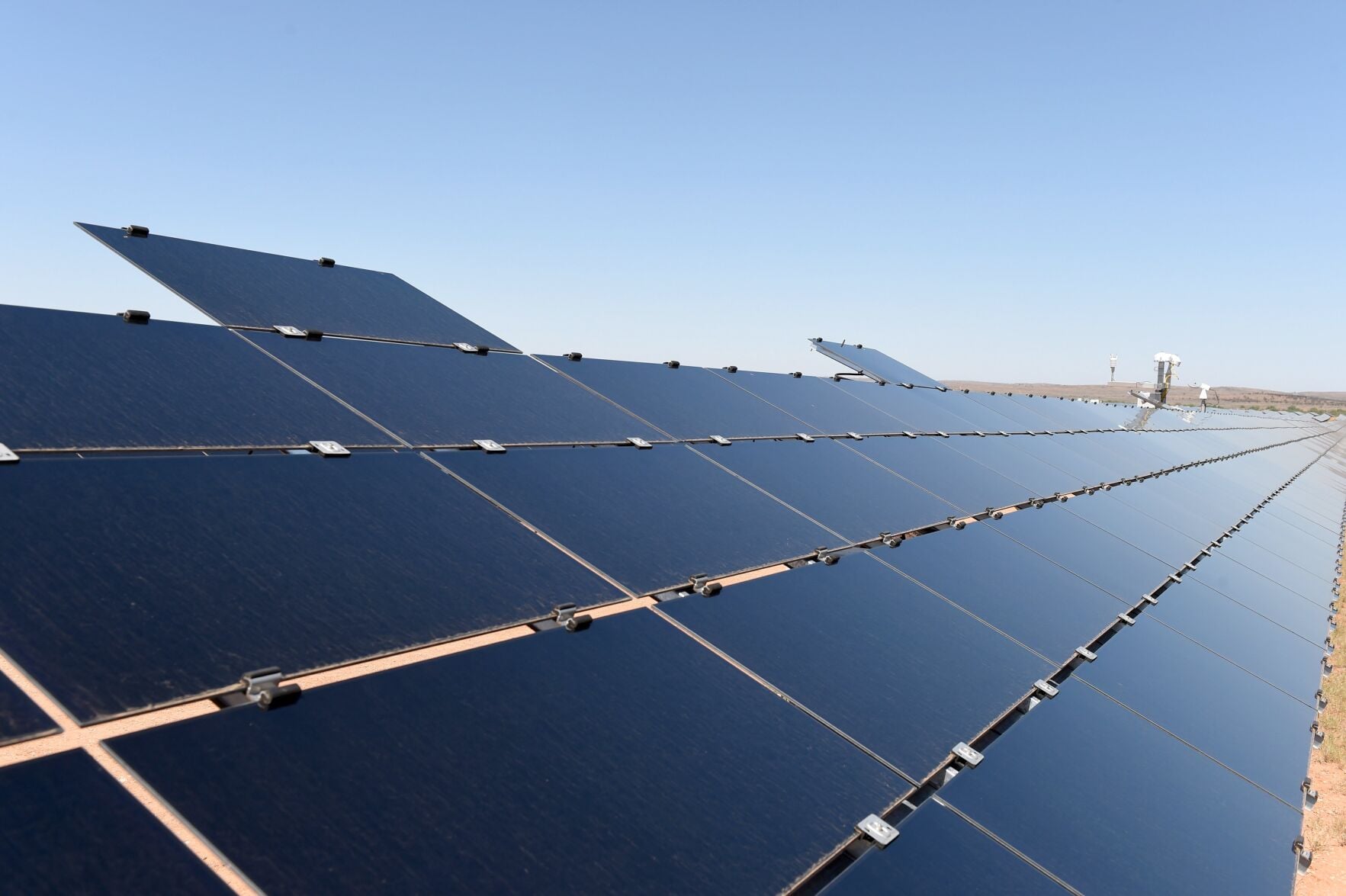
Australia’s subsidy program started out in 2007 paying $8,000 (AUS) toward a typical $12,000 rooftop solar array.
Carla Gottgens Bloomberg File Photo
“When you have solar panels, you get out of paying electricity for eight hours a day or so,” said Vierboom. “The battery scheme means it’s around the clock. On many days of the year you’re using zero grid electricity.”
But this “king of your castle” option was only available to homeowners with the means to pay for all these upgrades. So last fall, Australian Energy Minister Chris Bowen announced the third phase of Australia’s electricity experiment: free electricity for all.
Since so much solar was being generated during the middle of the day, all residential customers should benefit, regardless of whether they had any panels on their roof or not. (Though people without smart meters, who are concentrated in older apartments and social housing, are not eligible, Australian climate activists have pointed out.)
“Ultimately, this isn’t about actual free electricity, but about what abundant renewables do to a grid and essentially force it to be dumping electricity when it’s got too much on hand,” said the Australian inventor Griffith, in an interview with the Star.
It’s the mirror image of cheap overnight electricity rates, which were an incentive to use power generated by coal and nuclear plants that couldn’t be turned off, Griffith said. With renewables, it’s just at a different time of day.
The Australian policy of three hours of free electricity “is really just a very, very blunt instrument at the cultural level to tell everyone: ‘Hey, change your behaviour. Use energy at a different time of day,’” he said.
The Star, simplified
Breaking news, interactive polls, video, and voice notes. Star stories you’ll want to share, delivered where you’re already chatting. Follow the Star on WhatsApp.
While it’s still early (the free electricity policy only took effect July 1), there have already been some schemers and dreamers pushing the limits of what you can do with free power, including bitcoin miners, and folks trying to run data centres on batteries and solar, Griffith said, but the biggest effect is on the mainstream Australian household — like his.
“I wake up in the morning and I feel like I’m living in the abundant, amazing future,” he said.
The cost of typical household solar and battery systems is about $12,000 and the government will subsidize that by approximately one-third. The payback on the after-rebate cost of the system is about four years. Griffith’s setup is much bigger than most.
(Ontario offers subsidies of up to $10,000 for rooftop solar and battery, but does not allow recipients to feed their power back into the grid.)
“It’s not about free electricity,” he said.
The big question for electricity systems worldwide, Griffith says, is: Will widespread adoption of rooftop solar and batteries be cheaper than the old systems that relied on coal and gas?
“The answer is going to be ‘yes, it is cheaper,’” he said. “I am proof that this new system averages out cheaper than the old systems.”
How the U.K. is using wind to power a different path
While some electricity customers in the U.K. are also getting free electricity this summer, their power system took a very different path to get there.
The U.K. has had some of the most aggressive government climate policy in the world, and recently reduced its national emissions by over 50 per cent from their peak down to the level they were at in 1872.

The U.K. has large offshore wind farms that provide nearly a third of its power, allowing it to reduce its national emissions dramatically.
Gareth Fuller AP File Photo
A lot of this was achieved by phasing out coal for generation and a rapid buildout of renewable power, according to the U.K.-based think tank Carbon Brief. The country has large offshore wind farms in the North Sea that provide nearly a third of the country’s power, but also has been installing small-scale and rooftop solar.
Climate change has been making those solar installations more beneficial as rainy England gets sunnier. Last year was the U.K.’s sunniest year on record and solar pushed renewables to provide more power than they ever have before, the BBC reported.
Seeing the benefits of surging renewables and the threat to households posed by surging gas prices after the Russian invasion of Ukraine, the U.K.’s Climate Change Committee, an independent body that advises the government on climate policy, issued a recommendation to reduce electricity bills to accelerate electrification and insulate Britons from fossil fuel inflation.
“The fossil fuel era is over — cheap, clean electricity is our future,” interim chair Piers Forster said.
This spring, the U.K.’s National Energy System Operator (NESO) announced a program that would allow local power providers to encourage people to increase usage during the increasingly common periods when weather conditions result in surplus electricity, driving the wholesale price down to zero (or even negative).
“We believe that this is the future and we’re running these programs that allow customers to experience negative prices,” said Kieron Stopforth, head of flexibility at Octopus Energy, one of the U.K.‘s biggest power providers.

One impact of the U.K.‘s sunnier weather is that solar has helped pushed renewables to provide more power than they ever have before.
TOBY SHEPHEARD AFP via Getty Images
More than two million Octopus customers now get free power for one hour, typically on summer afternoons, but only over and above the amount of electricity they would have normally used. Octopus emails customers to tell them about the green hour ahead of time, and issues a credit for the excess power used afterward.
Octopus is all-in on electrification as a climate solution and has EV charging and heat pump programs to encourage Britons to switch off fossil fuels in their lives. “Low cost renewable energy really helps customers see the benefit of these electric devices,” Stopforth said.
Could Canada follow in the U.K.‘s footsteps?
“This is absolutely a pathway that other countries and other grids could follow,” he said. “Every grid works in a slightly different way. But at the end of the day, an electron is an electron: you need to generate it, transport it and use it. The important thing is that you encourage behaviours that are helpful for decarbonization.”

Though renewables have a role to play in Canada, it has unique geography and political factors that make it difficult to use other countries’ energy policies in the exact same way.
Steve Russell Toronto Star File Photo
Canada’s large geography and provincial jurisdiction over electricity grids makes bringing these policies here difficult, said Kate Harland, research director, clean growth, with the Canadian Climate Institute.
“There are some innovative ideas, for example offering folks who live near wind turbines cheaper electricity to make sure that electricity gets used near its source (that could) make it less expensive.”
What free electricity really means for climate change
While free electricity is a catchy marketing pitch, and remains available only to residential customers in two countries for a few hours at a time, what it represents is the very first benefits of a future of abundant renewable power.
Energy abundance is a vision that’s becoming popular in the climate community because it counters the widespread impression that taking action to slow global warming necessarily involves sacrifice.
Instead of driving less, flying less, eating less meat and cutting back on overseas vacations, a net zero future where no fossil fuels are burned can be powered by copious amounts of renewable energy.
Fossil fuels provided more power for less cost than the energy sources they replaced, unlocking widespread economic development and prosperity. Cheap electrification can do the same, opening up new economic possibilities and addressing inequality, allowing more people to flourish in a future that isn’t destabilizing our environment.
Or, as Griffith puts it: “Every day I feel enormously optimistic that we’re going to live in a world of energy abundance.”



![18-Hour Flights: Qantas’ 11 New Ultra-Long Nonstop Flights Revealed [Full List]](https://dailynewsnblog.com/wp-content/uploads/2026/08/209-qantas-airbus-a380-ceri-breeze-merrillie-redden-_-shutterstock.jpg)