dailynewsnblog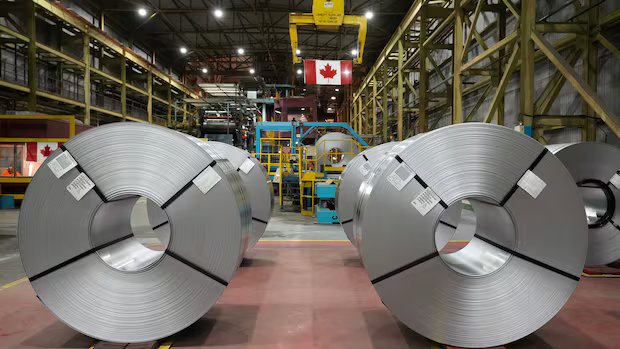

Listen to this article
Estimated 3 minutes
The audio version of this article is generated by AI-based technology. Mispronunciations can occur. We are working with our partners to continually review and improve the results.
The federal government is pumping $100 million into Canada’s steel industry with a new program that will pay for half the costs of transporting Canadian-made steel by ship or by rail within the country.
Transport Minister Steven MacKinnon made the announcement Monday in Hamilton, where he said the Commodities Sectoral Support Program is a direct response to U.S. tariffs being slapped on Canadian goods.
The U.S. currently has imposed anywhere from 10 to 50 per cent tariffs on Canadian steel, aluminum and copper, and derivative products.
“Hamilton’s steel industry is of vital, strategic, national importance, as are the producers in steel industries from all over Canada,” MacKinnon said.
“We will defend this industry to the very end, and we will make sure that this industry not only survives, but thrives and prospers.”

Speaking in Hamilton, Transport Minister Steven MacKinnon announced the Commodities Sectoral Support Program, a $100-million initiative to help move Canadian steel between provinces by offering a 50 per cent rebate on eligible transportation costs.
The program, which launches today, will offer rebates to companies for 50 per cent of the cost of transporting certified Canadian-made steel interprovincially.
The program is slated to operate for one year, or until the $100-million funding envelope runs dry, with a single producer eligible for a maximum rebate of $50 million.
Asked what will happen to the program if it runs out of money before the end of its one-year timeline, MacKinnon hinted that an extension may be considered.
“We’ll adjust as we go along. This is a lot of money, and we’ll see how the take up goes,” he said. “But supporting the steel sector in one form or another will be something that we continue to evaluate … so we’ll see how this works out.”
Conservative Leader Pierre Poilievre, speaking in Quebec, where is campaigning in the upcoming Chicoutimi–Le Fjord byelection, said the best way to help make steel transport more affordable is to extend the current gas and diesel excise tax holiday and to scrap the industrial carbon tax.
“Trump’s tariffs are bad enough; Carney’s taxes are even worse,” he said.
The rebate program is being rolled out as a part of Prime Minister Mark Carney’s effort to strengthen the Canadian economy by making it easier and cheaper to ship products within the country.
Ron Bedard, president and CEO of ArcelorMittal Dofasco, one of Canada’s largest steel producers, said the program will have a “tremendous” impact on the industry and will reap benefits for every province.
“There are projects going on in every single corner of this country and they will now have lower-cost access to Canadian steel produced across this country,” he said.
Jason Card, with the Chamber of Marine Commerce, which represents all marine shipping on the Great Lakes-St. Lawrence Seaway, as well as in the Arctic and on the East Coast, told CBC News he was pleased with Monday’s announcement.
“Steel is moved in all forms, for all kinds of purposes,” Card said. “Having a blanket program like this to help facilitate the movement of the steel, you’re helping the steel industry, you’re strengthening supply chains, you’re bolstering the national economy. It’s a really great initiative.”