dailynewsnblog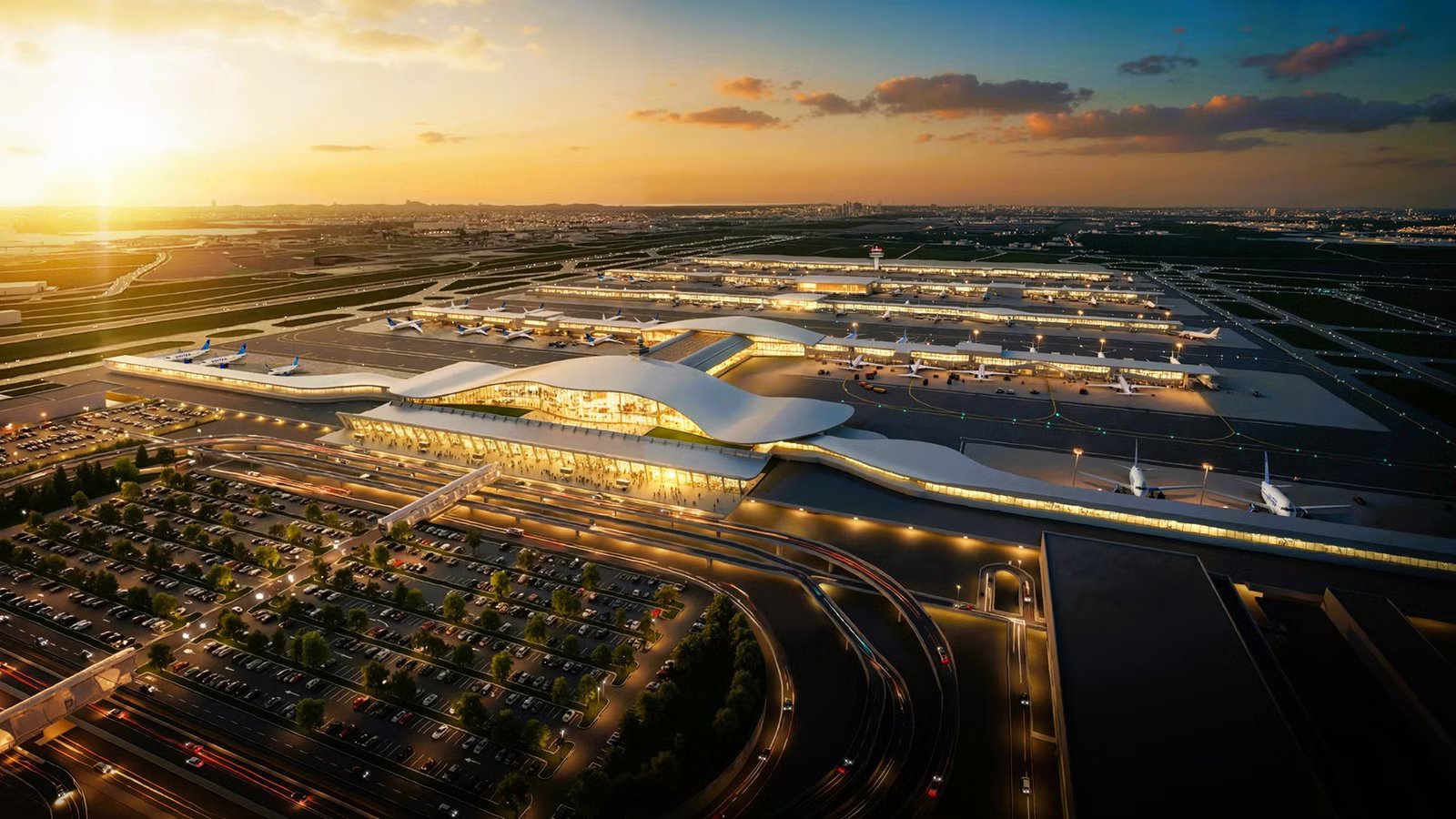
President Donald Trump used a laser pointer and architectural renderings in the Oval Office to deliver a blunt verdict on Washington Dulles International Airport (IAD): the capital’s primary international gateway is “the worst airport.” His proposed $22.5 billion answer includes more than 5 million sq feet (0.4 million sq meters) of new or renovated space, replacement concourses, expanded rail and walking connections, a vast close-in parking garage, and the eventual retirement of Dulles’ distinctive mobile lounges.
Yet one of the most important people standing beside Trump was  United Airlines CEO Scott Kirby. United carried two-thirds of Dulles’ 29 million passengers in 2025, and operates the 50 gates in Concourses C and D. It has also pushed for years for a complete overhaul of the airport’s aging facilities, but had limited success. So Kirby, who has proven very adept at earning the favor of the president, took his plans to Trump, asking for his assistance “to build… a beautiful big open terminal and spaces.” There were even some not-so-subtle indications of a new Donald J Trump terminal in some of the architectural renderings.
The gambit worked. Trump is now supplying significant political momentum and a highly visible deadline. But United is gaining a far rarer prize — the opportunity to completely reshape a major hub around the airline it plans to become.
Trump Has Put An Existing Plan On The Fast Track

The administration’s interest in Dulles didn’t begin with the most recent July announcement. The US Department Of Transportation sought ideas for revitalizing Dulles, and the final proposal from the Metropolitan Washington Airports Authority (MWAA) and United is being pushed forward after officials reviewed more than 30 submissions. Kirby disclosed that United presented Trump with a design he believed could produce “the best airport in the country,” describing it as both spacious for travelers and “operationally good for airlines.”
The current plan goes back much further, as it is rooted in the much longer-term Master Plan for Dulles that the MWAA began updating years ago, with its board approving the final draft in July 2025. The airport had already allocated approximately $7 billion to modernization, and construction of the first 14-gate section of Concourse E, which is set to open this Fall, began well before the new $20 billion-plus program was unveiled.
So, contrary to some commentary, the Dulles transformation is not a new airport plan invented inside the White House. But it is true that Trump’s real contribution is acceleration, as explained by MWAA CEO Jack Potter.
“This new construction effort builds upon the multiyear Dulles Master Plan, developed in consultation with our airline partners, to modernize Washington’s main international airport. We are grateful for the Trump administration’s interest in accelerating the pace and scope of our plans, and we look forward to building new facilities that will be a source of pride for our nation.”
That distinction matters: United has waited decades for permanent facilities to replace concourses C/D, but presidential backing could move projects from a long-range planning document into a coordinated construction program with unusual political urgency.
The Transformation Reaches From The Curb To The Aircraft

The revised plan begins landside, with expanded close-in parking, easier airport entry, modernized check-in areas, and more efficient security screening. Trump and Transportation Secretary Sean Duffy have also described a 32,000-space above-ground garage near the terminal. The iconic exterior of Eero Saarinen’s main terminal would be preserved, but much of the journey behind it would be rebuilt.
Dulles’ Transformation By The Numbers | ||
|---|---|---|
Measure | Current Airport | Transformation |
Capital program | About $7 billion previously allocated | More than $20 billion; $22.5 billion announced by Trump |
New or renovated space | — | More than 5 million sq feet (0.4 million sq meters) |
Concourses C/D | 923,000 sq feet (85,749 sq meters); 50 jetbridge-equipped United gates | Complete replacement |
Revenue-producing public parking | About 18,400 spaces | Proposed 32,000-space close-in garage |
Mobile lounges | 19 vehicles; 630 trips daily | Replaced by rail and walking connections |
International arrivals | 268,000-sq-feet (24,898 sq meters) facility; capacity for 2,400 passengers hourly | Larger Customs facility with walkable access |
United lounges | Four, including Polaris | More club space and a major new Polaris Lounge |
Airside, the current C/D complex would ultimately disappear. New and modernized concourses would provide brighter holding rooms, more concessions, and gates capable of serving more flights and larger aircraft. New AeroTrain connections, a central walking tunnel, and additional moving walkways would replace an operating model that still depends on 19 mobile lounges making an average of 630 trips per day.
International processing is just as important. The plan includes a walkable sterile route to a new, larger US Customs facility, upgraded baggage handling, more shopping and dining, additional United Club capacity, and one of the world’s largest United Polaris Lounges. Taken together, the program targets almost every weak point in a United itinerary at Dulles—from curbside arrival and domestic connections to international processing and the premium experience.
Record Growth Has Overwhelmed A Temporary Hub

The central contradiction at Dulles is that United’s operation still revolves around temporary buildings that were designed as an interim response to rapid growth. Concourses C and D were constructed in the mid-1980s, when rising traffic and the development of hub-and-spoke networks created an urgent shortage of jetbridge-equipped gates. Completed in 1985, the complex became Dulles’ first midfield concourse and formed the foundation for the hub United subsequently established at the airport.
These concourses were only ever meant to be a short-term stopgap until Dulles could afford larger, permanent midfield concourses. Their basic, temporary nature — evident in their corrugated-metal exteriors, low ceilings and limited passenger space — was never designed to represent the airport’s finished form. That also explains why the AeroTrain station serving the area was constructed beneath the location reserved for a future permanent concourse, leaving today’s Concourse C connected to it by an underground walkway and Concourse D without direct train access.
Dulles’ Recent Passenger Growth | |||
|---|---|---|---|
Year | Total Passengers | Annual Change | International Passengers |
2022 | 21.38 million | – | 7.37 million |
2023 | 25.14 million | 17.6% | 9.35 million |
2024 | 27.25 million | 8.4% | 10.38 million |
2025 | 29.01 million | 6.4% | 10.53 million |
2030 outlook | 35 million+ | 30% above 2024 | 14 million+ |
This decades-long compromise is becoming almost impossible to sustain because Dulles is growing rapidly. The airport handled a record 29.01 million passengers in 2025, up 6.4% year over year, and the highest growth rate of the nation’s 50 largest airports. This also included a record 10.53 million international travelers, a notably high proportion of the total. By year-end, 46 airlines offered more than 340 daily departures to 164 destinations, while MWAA expects annual passenger activity to rise by more than 30% between 2024 and 2030.
The pressure is visible during United’s connecting banks. MWAA says the airport’s gates are fully utilized several times each day, while waiting areas and concessions fill with passengers. Concourse D has no AeroTrain station, and terminating international travelers still rely heavily on the mobile lounges or plane mates to reach Customs. As Kirby joked, “Only in aviation does ‘temporary’ mean 45 years.”
Concourse E Is United’s Prototype For The Future

The first tangible piece of the new Dulles is already nearing completion. The initial Concourse E facility is scheduled to open in fall 2026 with 435,000 sq feet (40,412 sq meters), 14 gates, 46,000 sq feet (4,273 sq meters) of concessions, and a 40,000-sq-foot (3,716 sq meters) United Club. It sits directly above an existing AeroTrain station and includes a dedicated passageway for arriving international passengers.
Concourse E At A Glance | |
|---|---|
Feature | Detail |
Scheduled opening | Fall 2026 |
Size | 435,000 sq feet (40,412 sq meters) |
Gates | 14, all dedicated to United |
Concessions | 46,000 sq feet (4,273 sq meters) |
United Club | 40,000 sq feet (3,716 sq meters) |
Increase in United lounge space | Approximately 70% |
AeroTrain | Direct station access |
International arrivals | Dedicated secure passageway |
Future expansion | Designed for additional phases |
Every gate in the first phase will serve United. The facility will accommodate larger mainline and widebody aircraft, while its new United Club will increase the carrier’s lounge space at Dulles by approximately 70%. Generous seating, natural light, bigger operating areas, and direct rail access offer a preview of the standard that United expects across the rest of the airport.
Concourse E is not, by itself, the replacement for C/D. Its first phase primarily creates capacity to retire United’s gates in Concourse A, and a later central section of the planned E/F complex would provide the gate capacity needed to begin demolishing C/D. Before the administration’s intervention, that portion was not expected until around 2030 or 2031. Trump’s push is therefore aimed at compressing the gap between United’s prototype and a fully rebuilt hub.
Why Dulles Could Become United’s Ultimate Hub

The future Dulles has been described as “United’s ultimate hub”, but ultimate does not necessarily mean largest. Data from Cirium shows that Dulles was only United’s sixth-largest hub by passengers in 2025, behind far more extensive operations at the likes of  Denver International Airport (DEN) and
  Chicago O’Hare International Airport (ORD). The opportunity is different: Dulles could become the United hub where the airline’s network, aircraft, connecting flows, and premium strategy are most completely reflected in the airport’s actual design.
United Hub | Total Passengers (2025) | United Passengers (2025) | United Share |
|---|---|---|---|
Denver (DEN) | 82.4 million | 41.4 million | 50% |
Chicago O’Hare (ORD) | 84.9 million | 39.9 million | 47% |
Houston Intercontinental (IAH) | 48.0 million | 35.2 million | 73% |
Newark Liberty (EWR) | 47.0 million | 31.9 million | 68% |
San Francisco (SFO) | 54.5 million | 26.6 million | 49% |
Washington Dulles (IAD) | 29.0 million | 19.7 million | 67% |
Los Angeles (LAX) | 73.7 million | 11.9 million | 16% |
Central to this promise is the parallel linear-concourse concept in MWAA’s master plan. A layout built around linked, expandable concourses can group gates logically, handle concentrated connection banks, and separate domestic and international passenger flows more cleanly. Think of the incredibly busy but very well-organized  Hartsfield-Jackson Atlanta International Airport (ATL), but on a smaller scale. For United, that could mean fewer vehicle transfers, shorter and more predictable connections, fewer delays, better baggage performance, and facilities that support large aircraft without forcing the airline to improvise around 1980s infrastructure.
Dulles also has something that United cannot manufacture at its facilities like  Newark Liberty International Airport (EWR) or
  San Francisco International Airport (SFO): room. The airport occupies 11,184 acres, has four runways, supports the largest commercial aircraft, and preserves space for another runway and additional concourses. Combined with United’s dominant market share, expanding international network, and premium push, that land makes IAD arguably the airline’s best opportunity to build a hub for the next several decades rather than merely renovate one inherited from the past.
The Risks Facing The $22.5 Billion Dulles Transformation

The financing remains one of the largest unanswered questions. MWAA says the airport authority and airlines will fund new concourses and terminal facilities through municipal bonds, with some other elements potentially offered to public-private partnerships. Officials insist the program will not require direct federal construction dollars, but the ultimate division of the bill — and how much reaches travelers through airline costs, facility charges, or fares — has not been detailed.
The timetable is equally uncertain. Official materials describe a phased transformation over the next decade, even as Trump has suggested that the airport should be rebuilt “all at one time,” attaching a two-year timeframe to the project. That would seem extremely ambitious, given that the designs remain conceptual, some elements will require congressional approval, and Dulles must somehow continue to expand beyond 30 million annual passengers even as concourses, rail links, baggage systems, and international facilities are rebuilt around them.
Nevertheless, the alignment is unusually powerful. The president wants a highly visible infrastructure legacy in the capital, MWAA needs capacity for a rapidly growing airport, and United wants permanent facilities worthy of its global network. The White House can supply the money, momentum, and spectacle, but United will ultimately operate the gates, schedule the banks, fill the lounges, and determine how the new capacity is used. So while Trump may be trying to build America’s airport, United is leveraging the momentum to quietly build its ultimate hub.
Catch what other trackers miss
Emergency squawks, holds, NOTAMs — live signals, no signup.
Open tracker
Catch what other trackers miss
Emergency squawks, holds, NOTAMs — live signals, no signup.
Open tracker