dailynewsnblog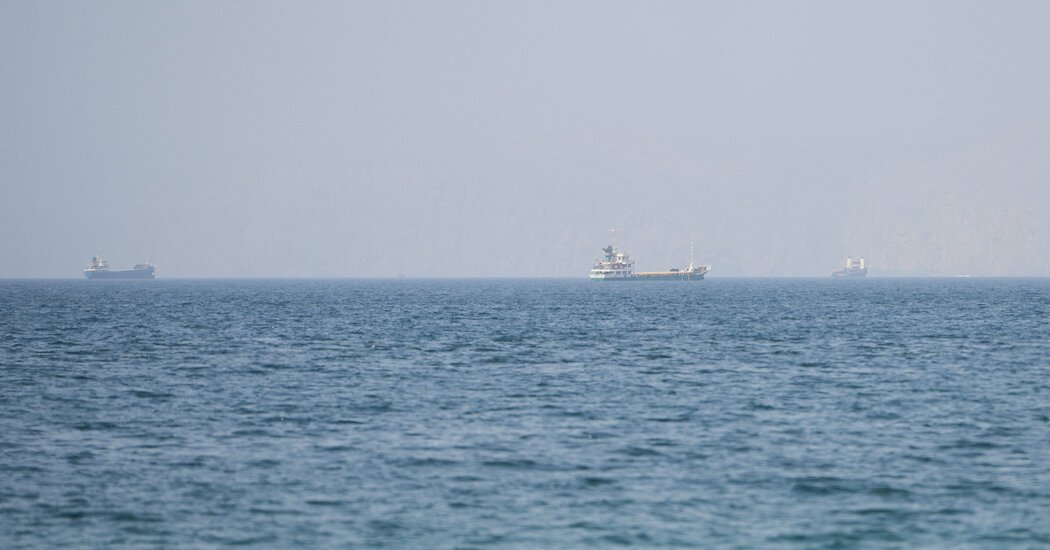
A top Iranian national security official delivered a sweeping set of demands on Saturday that he said the United States must meet before the Strait of Hormuz can reopen to maritime traffic, throwing the fate of the critical trade waterway into question.
Mohammad Bagher Zolghadr, the secretary of Iran’s Supreme National Security Council, issued a statement carried by state media laying out multiple requirements for reopening the strait. He called for the United States to lift its naval blockade and sanctions on Iran, withdraw the U.S. military from around Iran, pay war reparations and release frozen Iranian assets, as well as end attacks on Iran’s allies in the region and threats against the country.
The White House did not immediately respond to a request for comment on Iran’s demands. A previous cease-fire between Iran and the United States, agreed to in June, had said that sanctions would be fully lifted only in the event of a final deal regarding Iran’s nuclear program. And U.S. officials have said in the past that Iran could only access its frozen funds if it committed to giving up its highly enriched uranium first.
The statement from Mr. Zolghadr came as Iran and Oman have been negotiating an agreement on the future management of the Strait of Hormuz, which sits between the two countries. Iran effectively closed the strait in retaliation for being attacked by the United States and Israel in February.
Mr. Zolghadr’s list of demands upended expectations that a deal with Oman would soon allow commerce to flow through the strait once more and ease global energy prices. They will likely put pressure on President Trump to consider Iran’s conditions if he wants to lower consumer prices for Americans, which pose a risk for Republicans ahead of November’s midterm elections.
Even before Mr. Zolghadr’s statement, Iranian officials had hinted on Saturday that the reopening of the strait was not imminent. Hossein Mohebbi, a spokesman for Iran’s Islamic Revolutionary Guards Corps, said that reopening the strait was “not contingent on the Iran-Oman negotiations.”
In comments carried by Tasnim, an Iranian news outlet affiliated with the Guards, Mr. Mohebbi said that it would depend “on the United States fully accepting Iran’s conditions.” He did not specify those conditions, other than to say that the United States must not interfere in Iran’s ongoing negotiations with Oman or other countries.
Abbas Araghchi, Iran’s foreign minister, said on Saturday that Iran and Oman were “very close” to an agreement, according to Tasnim.
“However, the reopening of the Strait of Hormuz is contingent on other conditions, including the United States compensating for its violations of the Islamabad Memorandum,” Mr. Araghchi was quoted as saying, referring to the cease-fire agreement that Iran and the United States signed in June.
The June agreement — a “memorandum of understanding” brokered by Pakistani mediators in Islamabad — called for the opening of the Strait of Hormuz and the temporary lifting of oil sanctions on Iran. Yet the deal’s language was vague, and the United States and Iran had differing interpretations of what it meant.
The United States backed a southern route for ships that skirted Oman’s coastline and avoided Iranian waters, and Iran responded by warning and striking ships that took that route. The cease-fire soon collapsed, and the United States reimposed its naval blockade of Iranian ports.
“The Americans were seeking to establish new routes through the Strait of Hormuz, and despite the warnings issued by our country, they sought to undermine Iran’s management of the strait,” Mr. Araghchi said. “Therefore, any violation of the memorandum of understanding or of Iran’s management of the Strait of Hormuz is absolutely unacceptable to the Islamic Republic of Iran.”
Mr. Araghchi said that Iran and Oman were discussing a temporary route through the strait, and that the two countries’ militaries were negotiating the specifics. Officials familiar with the emerging deal have said it could formalize some of Iran’s claims of control over shipping in the waterway.
The comments by Iranian officials could be part of an effort to manage domestic political concerns. Mr. Araghchi and the Iranian president, Masoud Pezeshkian, have been under fire from hard-liners who oppose any deal with the United States.
Raz Zimmt, an Iran expert at the Institute for National Security Studies, an Israeli research institute, said the comments by Mr. Mohebbi and Mr. Araghchi reflected Iran’s view that its negotiations with Oman were intended “at most” to work out how the waterway will be reopened in the future.
Even if Iran and Oman agree to specifics on the strait, “it is clear that Tehran will not agree to implement them without a return to the U.S. commitments under the memorandum, including lifting the naval blockade and resuming the process of sanctions relief,” Mr. Zimmt wrote on social media.
On Saturday, the Emirati foreign ministry said an Iranian attack had targeted a tanker belonging to the state-owned Abu Dhabi National Oil Company as it crossed the Strait of Hormuz. The company said on Friday that at least 15 of its vessels were attacked in the waterway since the conflict began, leading to one death and 20 injuries among crew members.
In a statement, Oman’s foreign ministry on Saturday condemned “repeated attacks on ships transiting the Strait of Hormuz,” saying they constituted a violation of international law and territorial sovereignty.
The statement said that negotiations with Iran were “proceeding in a positive and constructive atmosphere” and urged “avoiding any actions that could affect these negotiations and the progress that has been achieved, which is to the benefit of all the parties.”
In an interview with Fox News on Saturday, Vice President JD Vance portrayed the United States as a player in Iran’s discussions with Oman, and said the talks were in “the middle of the game” — even though U.S. officials had previously said that a deal to reopen the strait was nearly in hand. It was unclear whether he was aware of Iran’s latest demands at the time of the interview.
“What we’re really working through now is how you can actually set up a traffic scheme so that the ships that pass can pass through safely,” Mr. Vance said. “That includes of course demining, but it also includes a commitment from the Iranians that they’re not going to fire at commercial vessels.”
Mr. Vance did not say what the United States might concede to Iran as part of a possible deal. Instead, he argued that Washington holds major leverage over Tehran.
“They’re hurting in a big way,” he said. “They want this thing to be over. The question is whether they’re able, their system is able, to give the things that are necessary for us to be happy.”
Just over a dozen ships per day have navigated the strait over the past week, according to Kpler, a maritime data company. Before the war, an average of 130 ships used the route daily.
To avoid detection by the Iranian or American forces imposing blockades on the strait, some ships switched off the transponders that transmit their locations, making an accurate count of crossings difficult to compile.
Maggie Haberman contributed reporting.