dailynewsnblog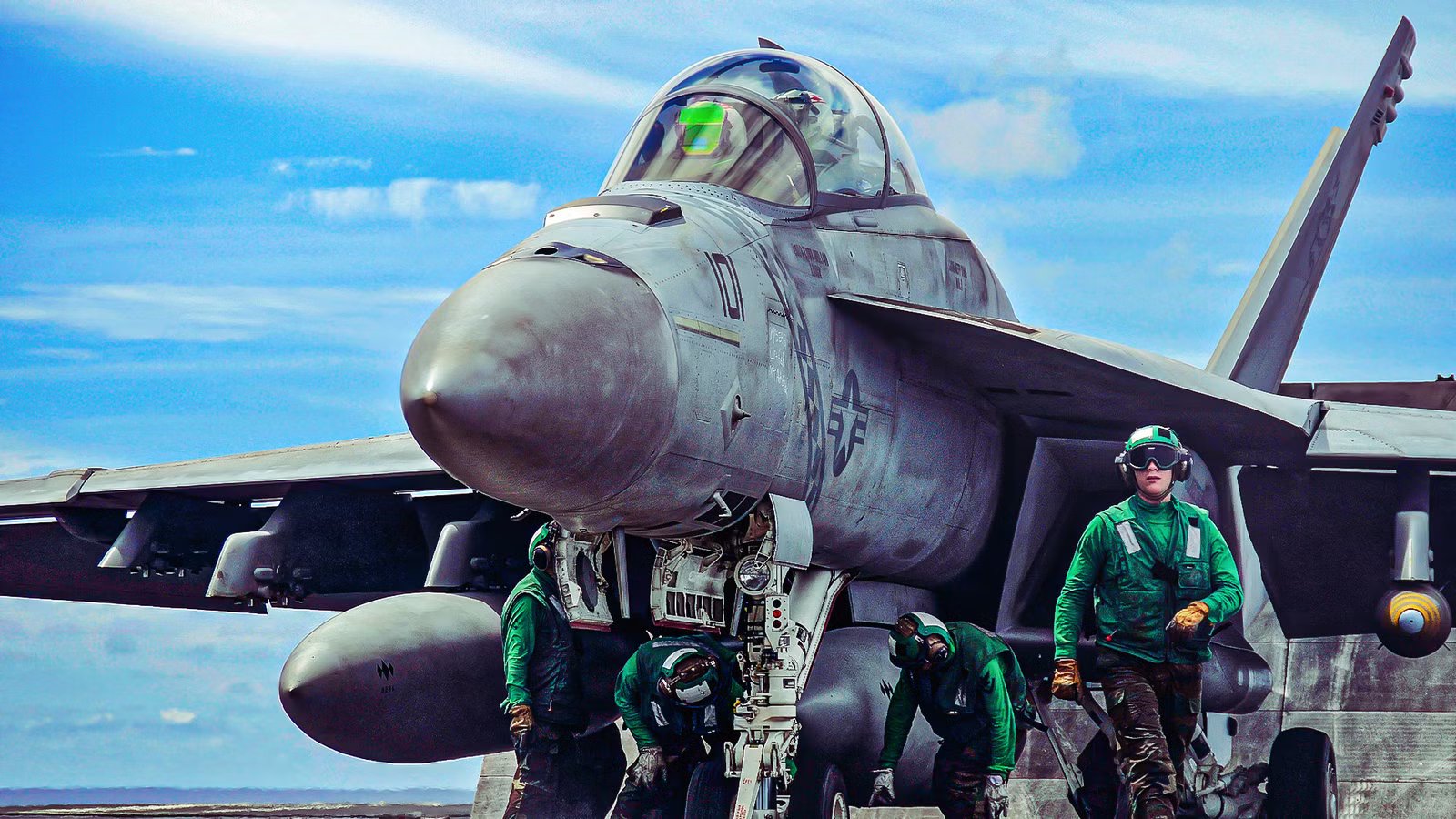
In the world of military aviation, tail codes tell a deep story about the aircraft they are painted on with just a few symbols. The US Air Force, for example, has a large two-letter code that identifies the base an airplane is assigned to, while a smaller two or three-letter marking shows the command it belongs to. Finally, its five-digit code identifies the individual airframe and the year it was made.
The US Navy and Marine Corps, on the other hand, has a more nuanced system. Unlike the Air Force, planes and helicopters belonging to these squadrons are assigned to both bases ashore and ships at sea. And every few decades or so, those aircraft carriers and ‘Big Deck’ salt ships are decommissioned. This creates a much more complex chain of command which necessitates a tail code to keep track of every fighter jet and tiltrotor in the fleet. So let’s demystify the world of US Navy tail codes.
The Visual Identification System
Simple Identification for a Complex Fleet

The tail code system of America’s Navy as we know it today originates in WWII, when the US naval aviation community rapidly expanded to accommodate the unprecedented scale of the conflict. Carrier-based aviation was a vital component of the combined arms military tactics of the day, and for the Allied Forces in the Pacific, American aircraft carriers and their Air Wings were some of the most decisive Battlefield units of the entire campaign.
Through trial and error, the tail code system emerged at this time to help make sense of the thousands of newly made airplanes and where they belonged among the hundreds of new aircraft carriers and new flying units. The simple three-part code of the old tracking system was simply inefficient in the face of the staggering combat losses and colossal military buildup. The geometric symbols used during the height of WWII were replaced just before the end of the conflict with the two-letter codes we see now.
On July 28, 1945, Task Force 38 officially ordered all geometric shapes replaced by large block letters. Aircraft carriers were given a single-letter or double-letter code. For example, USS Saratoga aircraft were painted with a ‘CC’ on the tail. On November 7, 1946, the Chief of Naval Operations formalized this into the Visual Identification System, as the Naval History and Heritage Command records.
As the jet age dawned and the Cold War rapidly escalated, the Navy pivoted once again. Recognizing that single-letter codes were not enough information for the rapidly growing fleet to easily identify aircraft, a strict two-letter Carrier Air Wing system was instituted. The Navy split the alphabet down the middle to organize the coast, a legacy that lives on in the tail flashes of the fighter jets in service today.
Fleet Assignment: Letter Number One
Atlantic or Pacific?

Under the organization established in the 1950s, the large two-letter codes on the back of every fighter jet in the US Navy and Marine Corps start with one letter to designate which fleet they belong to. If the aircraft falls under the command of the Atlantic Fleet, that letter will be one from the range of A and M. If the airplane is assigned to the Pacific Fleet, then it will bear a letter between N and Z.
Per aerospaceweb.org, only the letters A and N are in use to distinguish the two fleets in the Navy as of 2026. The Marines, on the other hand, has a more varied list of codes. The differences between the two branches of the Department of the Navy are due to differences in how carrier strike groups and Marine air-ground task forces are organized. While a Navy code follows the ship assignment, Marine Corps codes denote the Squadron command hierarchy.
Unlike Navy squadrons that shift between different carrier air wings, Marine Corps aviation is organized into permanent land-based Marine Aircraft Groups. Thus, the Marines still use the first half of the alphabet for East Coast units and the second half of the alphabet for West Coast units. In a notable exception, when a fixed-wing USMC fighter jet unit is assigned to an aircraft carrier instead of a land base, its tail code is repainted to match the Navy fighter squadrons aboard that same ship.
The Second Tail Letter
Air Wing assignment

The Carrier Air Wing is a separate command from the aircraft carrier on which its planes, pilots, and maintainers are assigned. Carrier strike group Air Wings are a composite of US Navy and US Marine fighter jet squadrons. So while the two services have a slightly different system, they overlap, and when USMC jets are embarked aboard a USN ‘boat,’ their two-letter tail code is changed to match the rest of the Air Wing for the duration of that deployment.
East Coast (Atlantic Fleet) | West Coast (Pacific Fleet) |
|---|---|
AB – Carrier Air Wing 1 (CVW-1) | NE – Carrier Air Wing 2 (CVW-2) |
AC – Carrier Air Wing 3 (CVW-3) | NF – Carrier Air Wing 5 (CVW-5) |
AG – Carrier Air Wing 7 (CVW-7) | NG – Carrier Air Wing 9 (CVW-9) |
AJ – Carrier Air Wing 8 (CVW-8) | NH – Carrier Air Wing 11 (CVW-11) |
— | NA – Carrier Air Wing 17 (CVW-17) |
When a Nimitz or Ford-class supercarrier deploys with its complement of 60 to 80 aircraft, it is not always the same Air Wing that is on the flight deck. So, while the first letter of the tail code is the same, the second letter is distinct to identify which one of the four Air Wings from the East Coast or five Air Wings from the West Coast a plane belongs to.
Catch what other flight trackers miss
Emergency squawks, holds, NOTAMs — live signals, no signup.
Open tracker
Catch what other flight trackers miss
Emergency squawks, holds, NOTAMs — live signals, no signup.
Open tracker
The only exception to this rule is the fleet replacement squadrons that are permanently assigned to shore to train new aviators bound for operational squadrons. There are only three of these squadrons, with the West Coast’s two FRS squadrons using tail code ‘NJ,’ while the one on the East Coast is inscribed with the code ‘AD.’ Similarly, naval reserve squadrons have the unique two-letter code ‘AF.’
The Six-Digit Code
Airframe bureau number

The Bureau number, typically shortened to just BuNo, is the airframe identifier for every unique aircraft in the US Navy and Marines. Managed by the Naval Air Systems Command, this system provides complete lifetime tracking from before they roll off the assembly line until they are finally scrapped in the Boneyard. While BuNos were originally only five digits long, they were lengthened to six digits in 1945 to accommodate the thousands of airframes that had been lost in battle and replaced by new planes, according to Crouze.
A Bureau Number is not assigned when a plane rolls off the factory floor. It is assigned the moment the USN signs the contract and places the order with a planemaker. This method of serial numbering has remained unchanged since 1940, when WWII broke out, just before the attack on Pearl Harbor launched the US into a two-front conflict. By mid-1945, the system reached 99999.
Rather than resetting the sequence and causing tracking confusion, the Navy allowed the sequence to roll over into six digits, starting with 100001. BuNos are stamped onto the aircraft’s manufacturer serial plates in addition to being painted on the exterior. These numbers are changed no matter what happens to the plane, regardless of the unit it is assigned to, or even if it is rebuilt or destroyed.
Marked Up from Nose to Tail
The Modex code

While the two-letter tail code identifies the whole Air Wing and the BuNo serves as the legal serial number, the Modex is the aircraft’s functional handle. This number is meant to facilitate daily operational needs and keep the tempo high during flight deck ops. It allows pilots, air traffic controllers, and flight deck crews to coordinate catapult launches, arrested landings, and ‘hot pit’ refueling in split seconds.
Modex are three-digit numbers that are uniformly used in every US Navy or Marine Corps squadron and are repeated, which means there is more than one airframe with the same Modex code in existence. Strike Fighter squadrons are assigned the 100 through 400 series. Electronic attack squadrons are given the 500 series, while Airborne command and control paints airplanes with numbers from the 600 series. The 700 series belongs to helicopter squadrons.
The key is that when an Air Wing embarks on the aircraft carrier, the mix of these different squadrons prevents any of the planes from having the same Modex code. Even though the Navy has dozens of fighter squadrons across the globe, only one squadron from each series is allowed on the ship at any given time. Because of this curation, there is absolute clarity on the ship.
The duplication and recycling confusion only happens when the deployment ends, the ship parks, and all the squadrons fly back to their massive Master Jet Bases on land, like Naval Air Station Oceana on the East Coast or NAS Lemoore on the West Coast. On land, multiple different squadrons that all share the same series assignment can theoretically be parked right next to each other on the same tarmac.