dailynewsnblog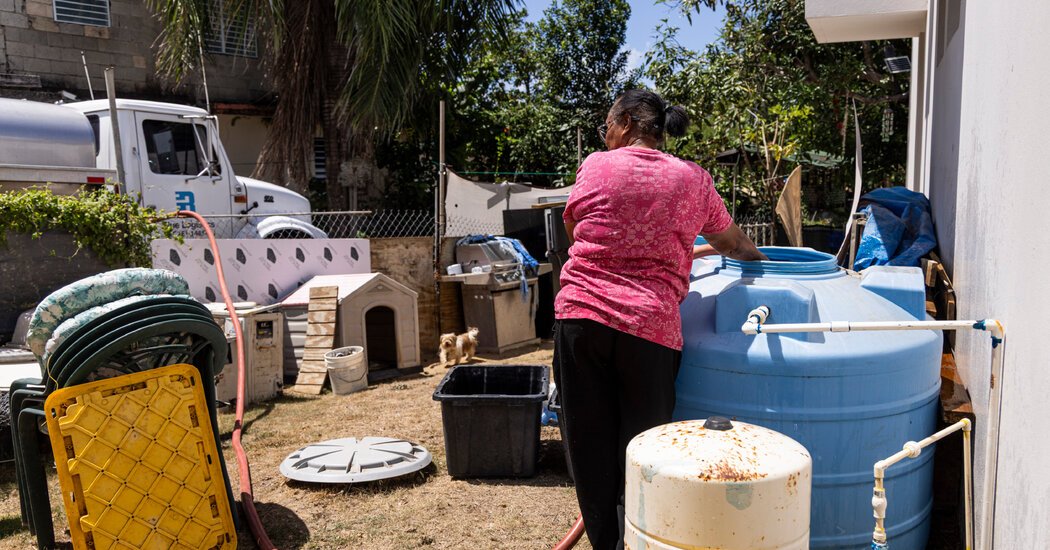
Across Puerto Rico, residents are being forced to forgo showers and housecleaning.
A restaurant owner in San Juan collects condensation from an air-conditioning unit so customers can use the water to flush toilets.
Miles away in the town of Loíza, residents flock to Peter Pabón, who weaves his tanker truck through narrow streets to fill buckets, storage bins and plastic bottles. Bedridden and sick residents depend on him.
“Everyone knows me already, and I know where everyone is,” said Mr. Pabón, 34, who delivers about 10,000 gallons of water daily for a private water company dispatched by the island’s government.
Similar scenes are unfolding in other parts of Puerto Rico, as it plunges into yet another water crisis driven by notoriously fragile infrastructure, and that has been worsened by a recent drought.
In June, a major pipeline ruptured, affecting service for tens of thousands of customers in the San Juan area. The pipeline was later fixed, but the interruptions persisted.
At the same time, more than half of the archipelago is experiencing moderate to extreme drought conditions, according to the U.S. Drought Monitor. The San Juan area experienced the driest July in more than a century, said Emanuel Rodríguez, a hydrologist with the National Weather Service.
The compounding problems have put another spotlight on the Puerto Rican government’s inability to reliably provide basic services, deepening frustration among residents already plagued by regular power outages.
This week, Gov. Jenniffer González-Colón of Puerto Rico cited the drought in declaring an islandwide state of emergency. Starting on Friday, the island’s water authority is scheduled to put in place new rationing measures by shutting off water for rotating 48-hour periods in parts of San Juan and surrounding areas.
Ms. González-Colón urged conservation, saying that washing cars, watering plants and hosing down driveways “limits our ability to maintain water availability in the metropolitan area.”
But residents have had little patience for the government’s response and what they say is a lack of communication. At a small protest in San Juan this week, Alfredo Cuyar, a 66-year-old retired aviation executive who lives in an upscale part of the Santurce neighborhood, said his water service had been terrible for more than a year — long before the drought.
“Not even after Hurricane Maria did we lose our water service,” Mr. Cuyar said of the 2017 storm that also devastated the island’s electricity grid.
Water woes are nothing new for the U.S. territory of more than three million residents who have long contended with low water pressure and spotty service. Droughts prompted strict water rationing in 2015 and 2020.
Government officials and experts blame a lack of investment and maintenance in the island’s aging water infrastructure. Félix Aponte Ortiz, a leading water management expert in Puerto Rico, says that up to 60 percent of the water in the island’s system never makes it to customers.
“There’s an emphasis in producing more water and in rehabbing the big infrastructure,” Mr. Aponte Ortiz said, “but not so much in updating pipes.”
This spring, the mayor of San Juan sued the Puerto Rico Aqueduct and Sewer Authority over its inability to deal with water outages.
The authority did not return requests for comment.
Mr. Rodríguez, the hydrologist with the Weather Service, said that this year’s El Niño weather pattern and a mild tropical storm season were making it difficult to predict when enough rain might replenish reservoirs.
“It could be five or six months of below-normal precipitation, not only us but all of the entire northeast Caribbean,” he said.
The Puerto Rico National Guard, mobilized by emergency declarations, has distributed nearly 600,000 gallons of water, mostly in the San Juan region. Officials are offering grants of up to $5,000 for small businesses to buy or rent water trucks or to buy bottled water, cisterns and tanks, among other equipment and services.
But relief efforts have done little to ease the misery of residents like Mindy Muñoz, 45, a hotel worker who says she has gone 80 consecutive days without running water in her Santurce apartment.
To save water, she cooks, cleans and flushes less often. Ms. Muñoz is lucky that her job sometimes allows her to bathe in vacant hotel rooms.
The anxiety of lacking has left her mentally wrecked, she said. “I feel like I need therapy,” Ms. Muñoz said.
The crisis is also hampering the island’s vital tourism and hospitality industry.
Tourists are now canceling trips, said Sami Rodríguez and Allen Wolford, who run an Airbnb in San Juan and are trying to open a boutique hotel. Construction on some rooms has been stalled, in part, because there isn’t enough water to mix concrete, Mr. Rodríguez said.
Every day, David Santini ferries 30 gallons of water in his Toyota Corolla to his restaurant in San Juan, Molinis Café, so that staff members can cook favorites like the mashed plantain dish mofongo.
“You start getting used to this misery, to this mediocre reality, but I’m still surprised that this is the reality in Puerto Rico,” Mr. Santini said. “You live in a daily state of stress and uncertainty as a business owner.”