dailynewsnblog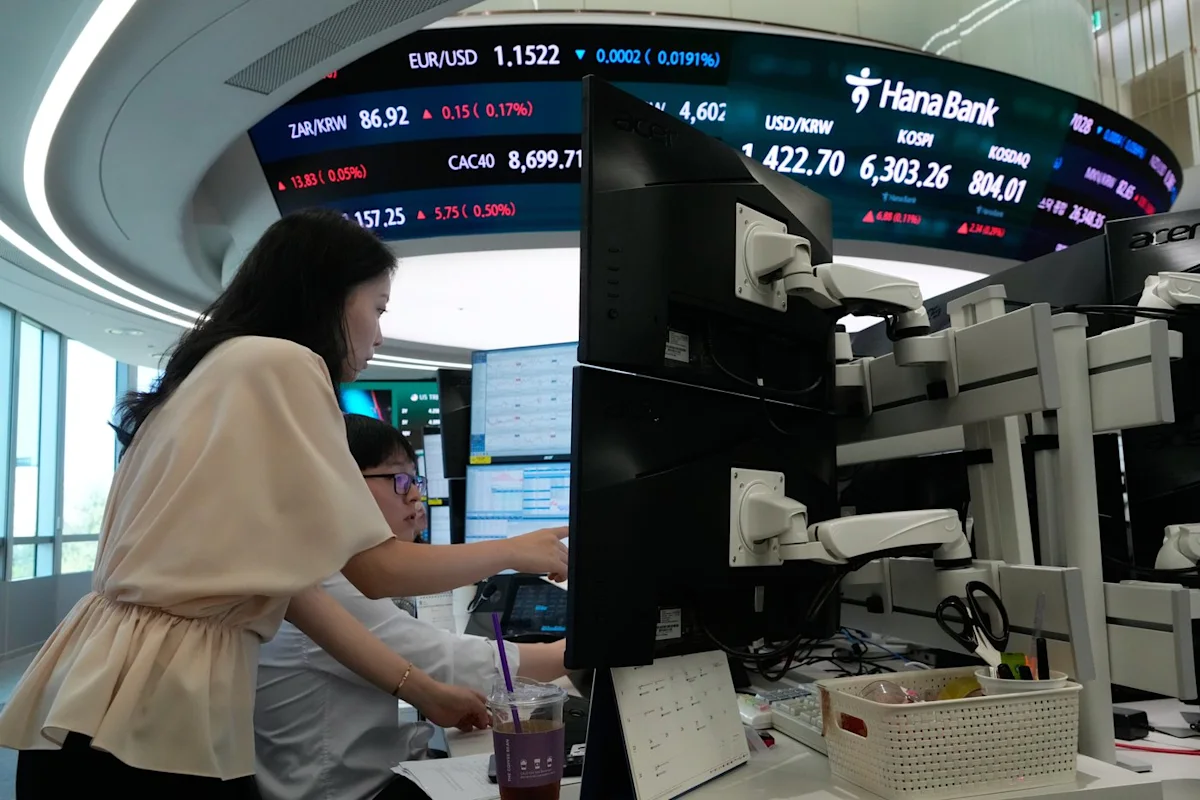
BANGKOK (AP) — World shares were mixed Friday after a modest retreat on Wall Street, while the price of Brent crude gained more than 1%.
In early European trading, Germany’s DAX rose 0.4% to 26,253.77, while the CAC 40 in Paris edged 0.2% higher to 8,715.47.
Britain’s FTSE 100 was up 0.1% at 10,879.57.
The future for the S&P 500 rose 0.1% while that for the Dow Jones Industrial Average slipped 0.1%.
Selling of computer chipmakers and other stocks linked to the boom in artificial intelligence appeared to taper off a bit as Tokyo’s Nikkei 225 lost 0.1% to 65,606.71.
The Kospi in South Korea dropped 0.6% to 6,258.77 and Taiwan’s Taiex fell 0.4%.
The Shanghai Composite index gained 1% to 3,940.04 after China reported its exports grew at a slightly slower but still robust pace of about 24% in July on strong demand for electronics and other high-tech products. China’s huge trade surplus narrowed last month and imports also slowed.
Hong Kong’s Hang Seng picked up 0.5% to 25,668.03.
In Australia, the S&P/ASX 200 slipped less than 0.1%, to 9,263.60.
On Thursday, stocks declined on Wall Street as oil prices rose and more company earnings reports rolled in.
The S&P 500 fell 0.2% and the Dow industrials fell 0.9%. The Nasdaq composite fell 0.1%.
The price of Brent crude rose nearly 4% on Thursday as progress toward reopening the Strait of Hormuz, vital to securing stable oil supplies, remained unclear.
Iran has said it is close to a deal with Oman for reopening the strait. U.S. President Donald Trump has also previously said a deal is close, but the conflict has had many starts and stops over the past five months.
Reopening the strait may require a compromise since the Trump administration has ruled out Iran charging fees to ships. But Iran has insisted on some measure of control, saying the strait will not go back to being an international waterway.
As of early Friday, a barrel of Brent, the international standard, was up 1% at $83.33. U.S. benchmark crude oil advanced 0.7% to $77.79 per barrel.
A fifth of the world’s traded oil and natural gas once passed through the Strait of Hormuz. Oil prices have surged as high as $113 due to the war and higher prices have added more heat to inflation by raising the price of gasoline and raising costs for shipping.
While markets are still weighed down by worries over the war and over a possible bubble in investments in artificial intelligence, strong overall corporate profits have helped allay concerns on Wall Street about shares being overpriced.