dailynewsnblog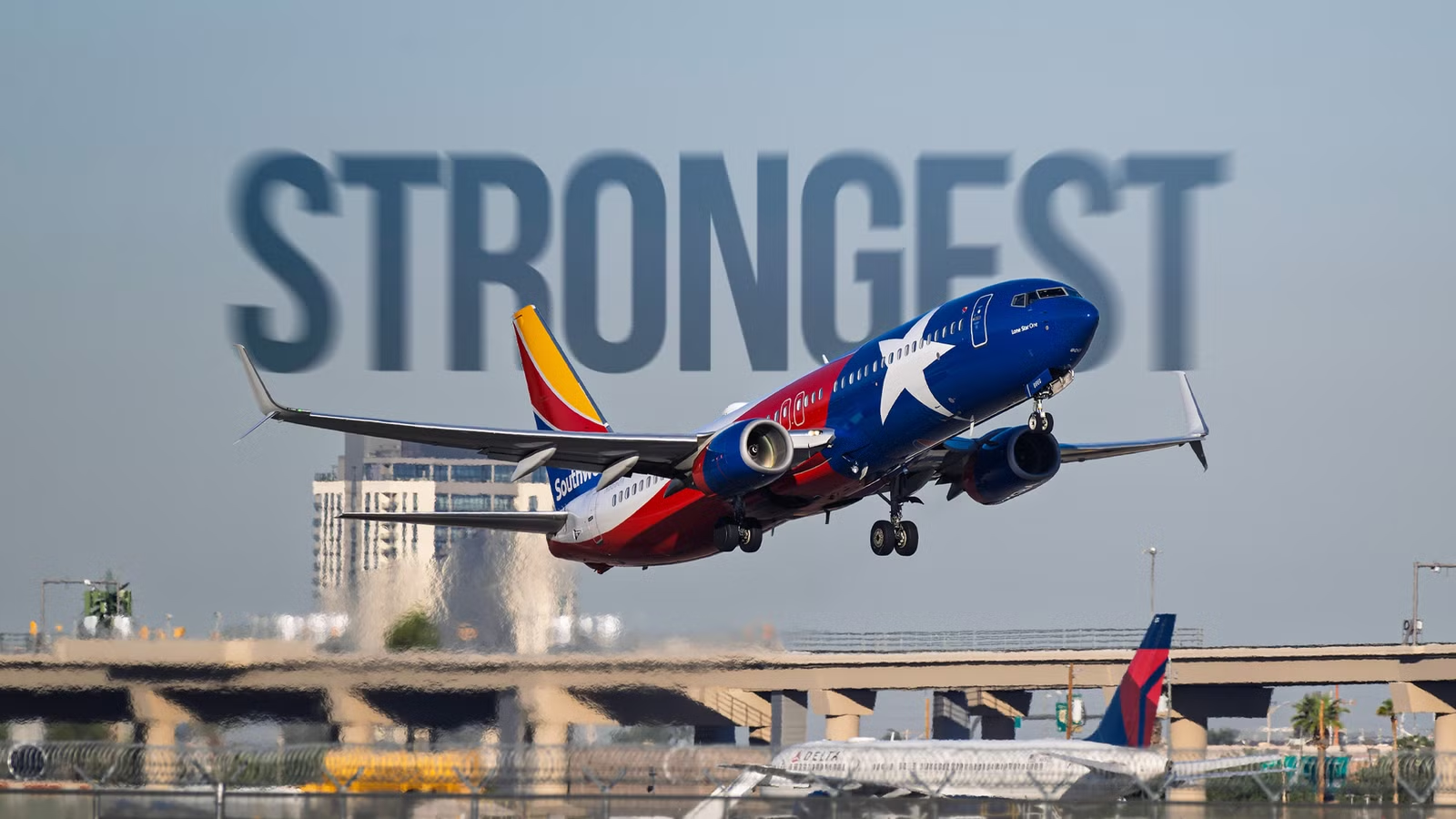
For the first time in several years,  Southwest Airlines is not the strongest airline brand in the world. Brand Finance’s Airlines 50 2026 report, published in April, placed All Nippon Airways at the top of the brand strength rankings with a BSI score of 90.2 out of 100 and a AAA+ rating. Southwest dropped to 89.1 and an AAA rating, tied with Japan Airlines for second place. Japanese carriers hold two of the top three positions for the first time in the history of the rankings.
Southwest’s decline traces directly to two policy changes the airline made in 2025 and 2026: ending its bags fly free policy and introducing basic economy fares with differentiated cabin options. Both were central to the brand identity that had kept Southwest at the top of the rankings for years. Here is how Brand Finance measures airline brand strength, what drove ANA and JAL to the top, and what the numbers say about whether Southwest’s transformation is costing the airline the brand it spent five decades building.
ANA Takes The Top Spot With A 90.2 Brand Strength Score

All Nippon Airways topped the Brand Finance 2026 airline brand strength rankings with a Brand Strength Index score of 90.2 out of 100 and a AAA+ rating, the highest tier in the consultancy’s grading system. The BSI measures a combination of factors including brand reputation, customer preference, recommendation likelihood, emotional connection, and operational performance. ANA scored at or near the top across all of those categories, producing a composite score that exceeded every other airline in the 2026 assessment.
ANA’s rise to the top position followed several years of consistent improvement in the rankings. The airline expanded its international network through the 2020s, adding long-haul routes from Tokyo Haneda and Narita to destinations across North America and Europe while maintaining the service standards and operational reliability metrics that Japanese carriers are known for. ANA’s onboard products, including The Room business class on the Boeing 777-300ER and the forthcoming Room FX on the 787-9, have consistently rated among the best in the industry in passenger surveys. The brand strength score reflects cumulative perception across all of those touchpoints rather than any single factor.
Brand Finance publishes the airline brand rankings annually as part of its broader cross-industry brand valuation research. The methodology combines publicly available financial data with proprietary consumer survey data covering more than 100,000 respondents across multiple markets. The BSI is distinct from brand value, which measures the financial worth of the brand as an intangible asset. An airline can have a high brand value driven by scale and revenue while scoring lower on brand strength, or vice versa. ANA’s 90.2 BSI represents the strongest brand perception of any airline globally, though it does not make ANA the most financially valuable airline brand in the world.
How Southwest Dropped From First To Tied For Second

Southwest Airlines held the top position in the Brand Finance airline brand strength rankings for multiple consecutive years before dropping to a BSI of 89.1 out of 100 in the 2026 report, a decline of more than a full point from its previous score. The airline received an AAA rating rather than the AAA+ it had held, placing it in a tie with Japan Airlines for second position globally. The 1.1-point gap between Southwest and ANA is modest in absolute terms, but represents a meaningful shift in a ranking system where the top positions are typically separated by fractions of a point.
Brand Finance attributed the decline directly to Southwest’s decision to end its Bags Fly Free policy and introduce basic economy fares, changes that took effect in 2025 and 2026. Those policies had been central to Southwest’s brand identity for decades. The airline marketed Bags Fly Free as a competitive differentiator against every other US carrier, and the single-class cabin with open seating was presented as a simpler, more transparent alternative to the tiered fare structures and ancillary fee models used by Delta, United, and American. Removing both in quick succession altered the brand’s positioning in a way that the BSI methodology captured through lower scores on preference and recommendation metrics.
The decline was not catastrophic. A BSI of 89.1 is still among the highest of any airline in the world, and the drop represents a loss of relative position rather than a collapse in brand perception. Southwest did not fall into the middle of the pack. It fell from first to tied for second, behind an airline that scored higher rather than ahead of competitors that caught up. The significance is less about where Southwest sits now and more about the direction of the trend.
What Bags Fly Free And Single-Class Simplicity Built

Southwest Airlines introduced its no-bag-fee policy in 2008, the same year that American Airlines became the first US legacy carrier to charge for checked bags and the rest of the industry followed within months. The decision not to match the industry’s move toward bag fees was a deliberate brand positioning choice. Southwest ran a national advertising campaign around the slogan “bags fly free,” turning a pricing policy into a marketing identity that distinguished the airline from every domestic competitor. The campaign worked. Consumer surveys consistently ranked the no-bag-fee policy as one of the top reasons passengers chose Southwest over other carriers on overlapping routes.
The single-class cabin reinforced the same identity. Southwest operated every flight with one fare class, one cabin, and open seating where passengers selected their own seats after boarding in a numbered queue. There was no basic economy, no premium economy, no first class, and no fare-based restrictions on seat selection, carry-on bags, or ticket changes. The model was simple enough that a passenger could understand the entire product in one sentence. That simplicity was the brand. Southwest did not compete on premium products, lie-flat seats, or lounge access. It competed on being easy to understand, consistent across every flight, and free of the fees and restrictions that other carriers used to segment their passengers.
The two policies together created a brand perception that was unusual in the US airline industry. Southwest was trusted in a category where trust is difficult to build. Passengers believed the fare they paid was the fare they owed, and that the experience would be the same on every flight regardless of what they paid. That perception showed up in the BSI through high scores on emotional connection and recommendation, the two categories where trust and simplicity translate most directly into measurable brand strength. Removing both policies in 2025 and 2026 did not erase the trust instantly, but it introduced a gap between what passengers associated with the brand and what the brand now delivers.
Japan Airlines Tied Southwest And What That Signals

Japan Airlines climbed six positions in the Brand Finance brand strength rankings to reach third place globally with a BSI of 89.1 out of 100 and an AAA rating, placing it in an exact tie with Southwest. With ANA at first and JAL at third, Japanese carriers hold two of the top three positions in the 2026 rankings. Japan’s airline sector saw its combined brand value grow 19% year-on-year to $5.7 billion, the largest regional increase in the report. No other country placed two carriers in the top three on brand strength.
Brand Finance attributed JAL’s rise to expanded international services, service innovation, and what it described as targeted market engagement. JAL’s MaaS initiative, which integrates air and rail booking into a single platform, was cited as an example of service innovation that strengthens brand perception by making the airline more useful to passengers beyond the flight itself. JAL’s investment in its onboard product, including new business class suites on the A350-1000 and consistently high cabin service ratings from passengers, contributed to the scores on preference and recommendation that drove the BSI upward.
The contrast with Southwest is the underlying story of the 2026 rankings. ANA and JAL gained brand strength by investing in product quality, service innovation, and premium experiences. Southwest lost brand strength by removing the specific policies that had defined its identity and differentiating its cabin in ways that make it more similar to the carriers it had historically positioned itself against. The two Japanese carriers built their brands by adding value. Southwest weakened its brand by removing simplicity.
Brand Strength vs Brand Value: Southwest Is Still Worth $6.7 Billion

Brand strength and brand value are different metrics, and the distinction matters for understanding what happened to Southwest. Brand strength, measured by the BSI, reflects how passengers perceive the brand across categories like reputation, preference, recommendation, and emotional connection. Brand value measures what the brand is worth as a financial asset, calculated using revenue forecasts, brand contribution to demand, and the strength score itself. A brand can lose strength while gaining value if the underlying business is generating more revenue even as customer perception shifts.
That is what happened to Southwest; despite dropping from first to tied for second on brand strength, Southwest’s brand value rose 5% to $6.7 billion in the 2026 report. The policy changes that weakened the BSI score are the same changes that are expected to generate additional revenue. Checked bag fees produce ancillary income that Southwest did not collect before. Basic economy fares create a price-segmented cabin that allows the airline to charge more for preferred seats and premium positioning. Assigned seating, which Southwest is introducing under its “Southwest. Even Better.” transformation program, enables the airline to sell specific seat locations as an upgrade product. Each of those changes generates revenue that flows into the brand value calculation even as it reduces the simplicity and trust metrics that drove the brand strength score.
The divergence raises a question that Brand Finance’s methodology does not answer: whether the revenue gains from the policy changes will eventually rebuild the brand strength score at a new baseline, or whether Southwest has permanently traded a portion of its brand perception for higher ancillary revenue. Delta, which charges for bags, sells basic economy, and assigns seats, holds the highest brand value of any airline in the world at $18.6 billion. Its brand strength score is lower than Southwest’s. The two metrics describe different things, and the airline Southwest is becoming may ultimately look more like Delta on both dimensions than like the airline Southwest used to be.
Catch what other trackers miss
Emergency squawks, holds, NOTAMs — live signals, no signup.
Open tracker
Catch what other trackers miss
Emergency squawks, holds, NOTAMs — live signals, no signup.
Open tracker