dailynewsnblog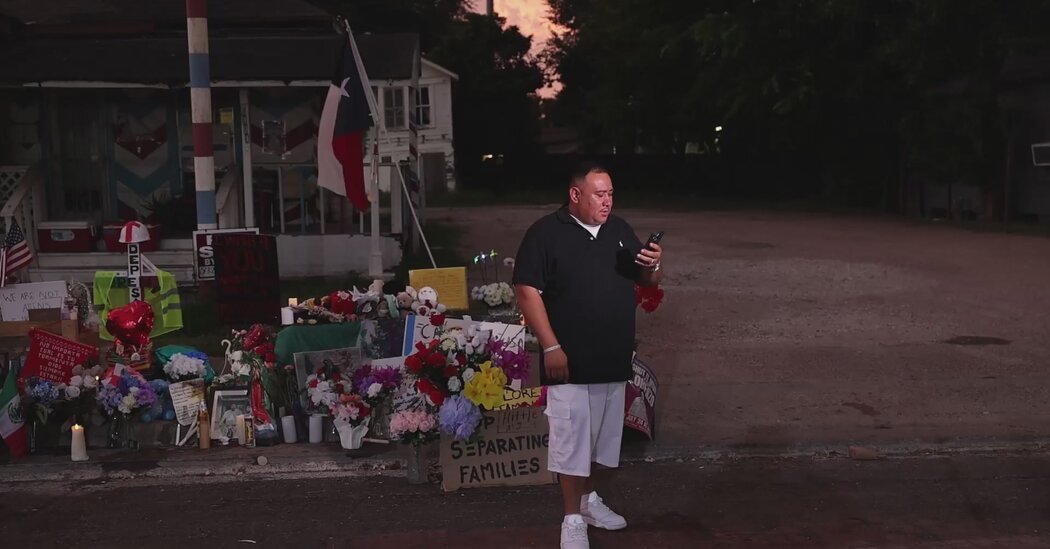
The melancholic songs began to appear on social media just days after an immigration agent fatally shot Lorenzo Salgado Araujo while he was on his way to work in early July.
One such melody — or corrido, a traditional Mexican folk ballad — was made by Jaime Velasquez, with a little help from A.I.
Mr. Velasquez, 42, had grown up in Houston’s close-knit, heavily Latino, Magnolia Park neighborhood. Mr. Araujo was killed there during a traffic stop on July 7. That sense of solidarity made Mr. Araujo’s death especially painful.
“It’s like somebody took my uncle or my dad,” Mr. Velasquez said. “Even though I don’t know the family, it touched me. It touched my heart.”
He began jotting down the details of the shooting gathered from news broadcasts. Then he wrote a corrido, in Spanish, from Mr. Araujo’s perspective. The lyrics included:
It was early on the morning of July 7th,
roosters were crowing and the sun was rising,
when I left my home filled with love and hope …
Once he’d finished writing, he used an A.I. song generator called Zona to compose the tune.
“It lets you put instrumentals on it and choose a voice,” he said.
Within seconds, the software had produced a finished corrido that he shared on Facebook. Two days after Mr. Araujo was killed, the corrido was already echoing through the Magnolia Park neighborhood, blaring from car stereos.
For generations, corridos have helped Mexican and Mexican American communities make sense of violence, injustice and loss on their own terms. Now the centuries-old tradition is colliding with a modern reality: high-profile immigration arrests and shootings, A.I. that can create songs in seconds and social media that can spread them before the deaths have been investigated.
Since the mid-19th century, corridos have functioned as a form of news, preserving the version of events remembered by communities rather than authorities.
“It was news as the public experienced it — not the way that official channels were going to report about it in newspapers,” said Teresita Lozano, a ballad scholar at the University of Texas Rio Grande Valley, whose work explores the intersection of immigration politics and corridos.
The corrido tradition traces its roots to the Spanish romance ballad, which colonizers brought with them to Mexico. The music emerged as a distinctly Mexican form as tensions mounted along the Texas-Mexico border after the Mexican-American War in the mid-1800s.
The thousands of corridos written since then resemble an alternative history of the border, documenting moments of violence, injustice and loss.
When Texas Rangers descended upon the small border village of Porvenir in 1918, killing 15 unarmed Mexican American men and boys, members of the community memorialized the massacre in a corrido. They did the same after Esequiel Hernández, a high school sophomore, was shot and killed by U.S. Marines patrolling the Texas border in 1997.
Mr. Araujo’s death, scholars said, fits squarely within that tradition.
“This is a community reacting in the way it has been doing it for over a hundred years,” said Juan Carlos Ramírez-Pimienta, a leading corrido scholar at San Diego State University.
“The corrido tradition still serves that purpose,” he added. “To communicate indignation.”
What has changed, thanks to technology, is the speed at which these corridos are made.
Ms. Lozano noticed the proliferation of A.I.-assisted corridos on social media following Charlie Kirk’s death in September 2025.
“I remember them popping up really quickly,” she said, “and I was thinking, ‘Is it even possible for someone to write it this quickly?’”
In the past, a corrido’s reach was constrained by geography, radio DJs and the recording industry. Today, a new corrido can be recorded, uploaded and shared across platforms like TikTok and YouTube within hours.
Mr. Araujo’s death has left a scar across Houston’s East End. A father of three U.S.-born children who spent 35 years building homes around the city, he was killed by an Immigration and Customs Enforcement officer during an operation aimed at another man. His story has turned into something more than one family’s tragedy; it’s a communal loss that has long inspired people like Mr. Velasquez to write corridos.
“He was a hard-working man who went out every day for his family,” said Mr. Velasquez, who owns and operates a mobile collision repair business in Houston. “That’s what I do every day.”
Norma Galo Medina, who lives in North Carolina, was similarly moved to create a corrido following Mr. Araujo’s death.
“I felt a great deal of sadness and shock,” she said. “What we immigrants are living through in this country made me think about the importance of honoring his memory.”
She spent two sleepless nights writing the lyrics, then used an app called BandLab to create a musical arrangement.
“I told it I wanted regional Mexican music — a sad, mournful norteño corrido,” Ms. Medina said.
She adjusted the instrumentation and chord progressions. Then she recorded herself singing, using A.I. to alter her range.
“I used a male voice so it would sound stronger,” she said.
She shared the corrido in a TikTok post that has since been viewed more than 40,000 times. Ms. Medina said she was overwhelmed by the response.
The corrido genre has seen its share of reinvention. Contemporary artists like Peso Pluma and Junior H have popularized “corridos tumbados,” or trap corridos, which fuse the traditional narrative ballad with hip-hop and trap influences. Traditionalists have questioned whether these trap corridos qualify as corridos at all.
Andrea Daniela, a mariachi alternative artist originally from Magnolia Park, whose own work blends corridos and spirituality — a style she calls “corridos metafísicos,” — believes that A.I. crosses a line.
“A.I. can’t replicate presence,” she said. “A.I. can’t replicate my passion, my heart.”
Mr. Ramírez-Pimienta, the corrido scholar, is not convinced this new technology poses an existential threat to the art form. When commercial records and radio became dominant, he said, corridos that once stretched seven or eight minutes long were truncated to fit the constraints of a three-minute recording.
“Despite all the technological advances, the genre is still here,” Mr. Ramírez-Pimienta said. “It still serves a purpose.”
Ainara Tiefenthaler contributed reporting.