dailynewsnblog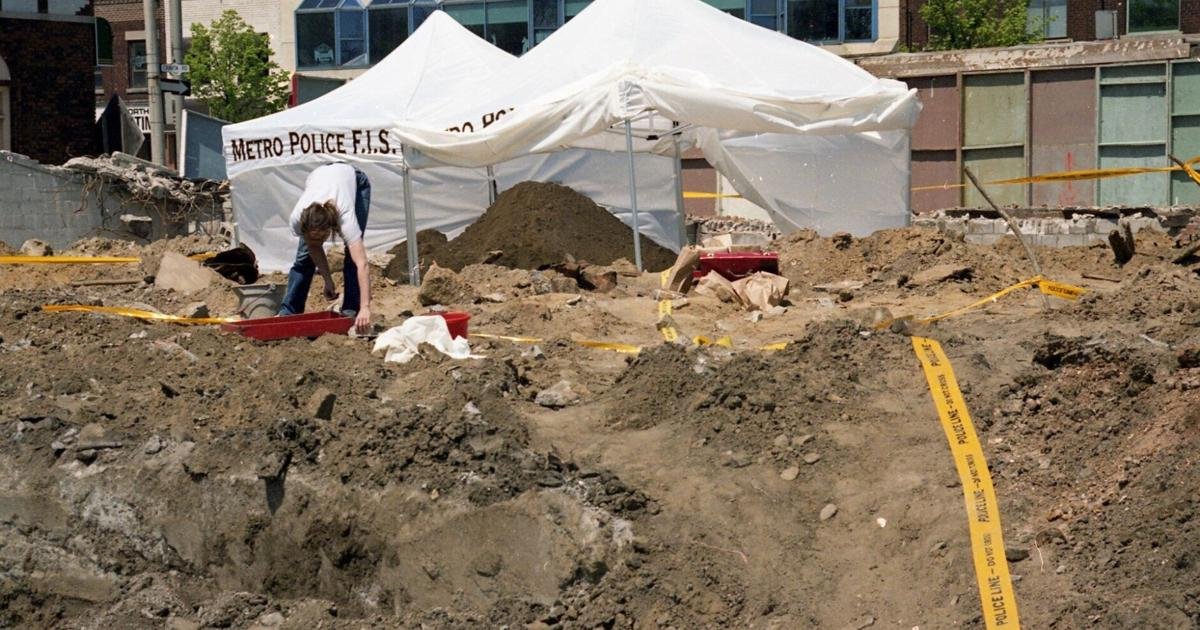
“Did Dad ever tell you what happened to my mother?” he wrote a relative, when he was old enough to write. “I’ve asked him and he never told me.”
Not long after his mother suddenly disappeared, his father went away too. Before he left, he told his son, “Don’t talk to the cops.”
The little boy was moved to Saskatchewan to live with family members.
He kept asking questions as he grew older.
“Do you have any knowledge why Dad changed his name in the mid-1930s?” the little boy wrote in a letter to a relative.
Decades later, the little boy’s correspondence was studied by Det. Const. Mike Kelly of the Toronto Police Service, homicide and missing persons unit, cold case section.
Kelly was then investigating Case No: 1995-80618, also known as “The Danforth Lady” homicide.
Her name was Mary McLeod Moffat.
How the ‘Danforth Lady’ was found
The investigation began on May 18, 1995, when the skeletal remains of a smallish woman were discovered by demolition workers beneath the concrete floor of an automotive garage at 1515 Danforth Avenue.
The woman’s autopsy found she had suffered at least a half dozen blunt force injuries to the head from a hammer-like weapon.
Det.-Sgt. Jim Crowley of Toronto police was originally tasked with “The Danforth Lady” homicide investigation. He was initially hopeful there was enough physical evidence for her to be identified and the crime to be solved.
“She actually has been kind of mummified,” Crowley told The Star at the time. “The air would never have gotten to her.”
Soon, Crowley found himself oddly bonded to the woman.
“Obviously, she deserves a proper burial,” Crowley told The Star shortly after her remains were found.
Computer searches weren’t so easy in 1995 and so Crowley pored over old police files, newspaper articles and city directories. He also spoke with family members of missing women across the GTA.
He concluded that she was likely dead for at least 46 years, as concrete for the floor of the auto dealership was poured in 1949.
Her autopsy also determined that she was between 20 and 30 years old when she was buried there.
She was white, of medium build with strawberry blond or auburn-coloured hair and she had likely given birth.
Her upper dental plate meant she could afford expensive dental work, suggesting she “was at least middle-class,” Crowley said.
As he struggled to learn her full story, Crowley pored through stories of domestic turmoil in the Toronto area in following the Second World War, as veterans struggled to reintegrate into their families after years overseas, surrounded by death and loss.
“This case has opened a lot of old wounds,” Crowley told the Star in 1995. “What is amazing to me is the number of ladies that went missing in the 1940s. I’m just fascinated by it. I had no idea.”
Crowley spent years working these cases, but never found Mary McLeod Moffat among them.
“He literally did everything that he could,” Kelly said. “They did a terrific job.”
Crowley died in 2010 at the age of 62 in a farming accident, after he retired from the force.
New DNA methods lead to breakthrough
It took more dogged police work, and rapidly advancing DNA investigation methods, to answer to questions that had haunted the little boy and Crowley.
Toronto police worked with forensic science innovator Othram Inc., a Texas-based leader in a technique known as investigative genetic genealogy, which draws on information shared on public databases like 23andme and Ancestry.com.
“Othram has a long-standing relationship with the Toronto Police Service, and we are grateful for the opportunity to assist with their unsolved sexual assaults, homicides and unidentified-human-remains cases,” Othram CEO David Mittelman wrote in an email. “It is deeply gratifying when our work can help solve a case and provide long-awaited answers to a victim’s family.”
Othram’s advanced DNA testing helped police solve the case of the Golden State Killer, Joseph James DeAngelo Jr., 72, of California. DeAngelo eventually pleaded guilty to 13 murders and 13 kidnappings in 2020.

Demolition workers discovered skeletal remains of an unidentified woman at a construction site near Danforth and Coxwell Avenues in 1995.
Toronto police
Othram earlier helped solve the murder of nine-year-old Christine Jessop, who went missing in Queensville, on Oct. 3, 1984.
Her body was found three months later.
Calvin Hoover, a friend and neighbour of the Jessop family, was identified by Toronto Police in 2020 as the likely killer. He had already died by suicide in 2015.
Jessop’s neighbour, Guy Paul Morin, served significant time in custody before he was exonerated due to advances in DNA testing in 1995.
“We try to assist in exonerations too,” Mittelman said. “In the Christine Jessop case, they initially accused and prosecuted the wrong person. He (Morin) didn’t feel exonerated until we later caught the real killer.”
“The justice system failed me, but science saved me,” Morin later said.
The ‘eureka’ moment
Despite the advances in DNA, there was bacterial contamination in the evidence for The Danforth Lady.
“We had two complete failures,” Kelly said.
Finally, the murdered woman was identified as Mary McLeod Moffat (nee Davidson).
Kelly’s team learned that Mary was born in Aberdeenshire, Scotland, in 1905 and immigrated to Canada with her family in 1913.
She was likely murdered around April 1936.
Police found that her husband, Andrew Lloyd Moffat, operated a tire business at 1509 Danforth Ave., adjacent to the former auto dealership where Mary’s remains were eventually discovered.
“That was the Eureka moment,” Kelly said.
Moffat emerged as the primary suspect in Mary’s homicide.
Kelly learned that Moffat had abandoned Mary and remarried three times.
Wife No. 3 left him in 1941.
At one point, he was married to two women at the same time.
Along the way, he changed his name to Drake Lloyd Cummings and lived in Nebraska and then Vancouver, before his death in B.C. in 1985 at the age of 77.
When police felt they had finally solved the case, a living relative of Mary’s with significant health issues firmly told police she wanted to be left alone by the press.

A file photo of laboratories run by Othram, the the DNA lab and forensic genetic genealogy company that helps Toronto police crack cold cases.
Daniel Adaclog/Othram
“She’s had a very distinguished career in her field,” Kelly said.
In the end, the little boy who sought his mother and Crowley died not knowing answers to the grim discovery under Danforth Avenue.
“Mary’s family never knew,” Kelly said.
Mittelman said he expects artificial intelligence to accelerate forensic DNA investigations.
“Its greatest near-term value is as an enabling layer that helps experts organize complex genetic and genealogical information, prioritize investigative paths, apply analytical methods more consistently and preserve a transparent record of how conclusions were reached,” Mittelman said. “For example, we have built AI systems to automate many time-consuming aspects of forensic genetic genealogy. We use this routinely in our work.”
Kelly said he thinks rapid advances in DNA technology means there will be plenty more cold cases like Mary’s murder solved in the near future.
“This makes the otherwise impossible, possible.”