dailynewsnblog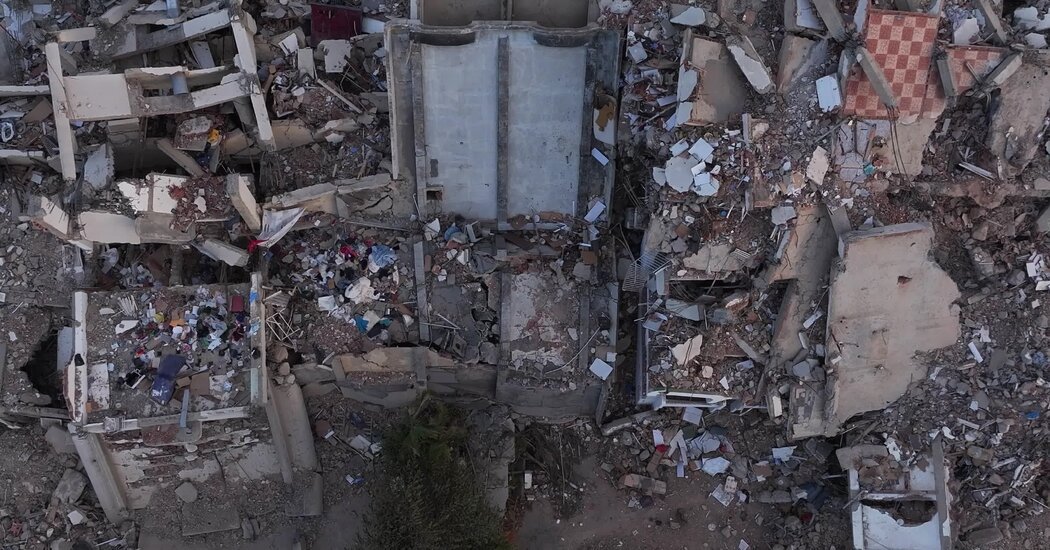
There was a billboard on the seaside road along Venezuela’s northern coast with a gigantic photo of a smiling Nicolás Maduro, the country’s former leader, and the words “a land flowing with milk and honey,” a biblical phrase that describes a blessed land.
But there was no Mr. Maduro, no milk and no honey behind the sign. Just mountains of rubble, body bags and makeshift encampments for thousands of Venezuelans left homeless by June’s devastating, back-to-back earthquakes.
La Guaira, once a lively beachside escape, and the state hardest hit by the disaster, is completely disfigured. Tall residential towers overlooking the Caribbean are dusty piles of contorted debris. With about 24,000 people left homeless and hundreds of buildings damaged or destroyed, according to the government, the coastal strip has become an immense humanitarian camp, with many living in tents by the debris.
The inescapable presence of the sea and its salty summer breeze clashed with a near-constant presence of death — in the corpses that kept emerging from the rubble, in the body bags on pickup trucks, in the boxes of ashes carried from the morgue to cars, homes, shelters or church altars.
Spaces designed for leisure or business or commerce now serve only two essential functions: survival or burial.
The McDonald’s, a popular stop for residents and tourists on the way to the beach, functions as a field hospital. The port has been turned into a crowded morgue. The golf course and a surfing resort are homeless camps.
The muddy, fly-infested encampments in La Guaira raise urgent questions about where the huge numbers of displaced will eventually live and what a future for the region, once a main gateway into Venezuela, could look like.
The challenges are magnified because it is the second time in less than three decades that the area has faced a colossal reconstruction task following a natural disaster.
After mudslides killed at least 15,000 people along the coast in 1999, and floods forced thousands of people out of their homes in 2010, the government built a forest of high-rise apartment buildings meant to fulfill a pledge by Venezuela’s socialist president, Hugo Chávez, to provide the poor proper homes.
This year, many of those buildings collapsed, trapping and killing large numbers of residents. Some critics have said that builders did not account for the loose soil that made them vulnerable in a quakes. (The official death toll stands at more than 5,500, but that is most likely an undercount.)
Many Venezuelans see the sprawling ruins, months after U.S. forces captured Mr. Maduro, as the culmination of a failed political and economic project overseen by a corrupt and incompetent authoritarian government.
Just as major questions loom over what lies ahead for Venezuela, the fate of La Guaira is also deeply uncertain.
Venezuelan authorities have promised to build housing that can better withstand earthquakes.
But many Venezuelans question whether their government has the capacity or resources for such a colossal endeavor. The country’s finances have been cratered by mismanagement and U.S. sanctions and the regime struggled to handle even immediate disaster response.
Others wonder whether quake survivors would be willing to stay in the area at all.
“I don’t know what will happen with us,” said Iraida Rivas, a nursery school director, as she stood at the gate of her school. Three toddlers who had attended the school died in the quakes. “We have lived through too much.”
For now, the region is trapped in a painful limbo between tragedy and the future.
Woven through debris, where hands of the dead were still visible for weeks after the quakes from beneath the crushing weight of massive columns, were people sleeping, eating and waiting.
A Seaside Town Turned Grim
The basketball court at the Juan José Mendoza school, which had over 1,400 students, became a camp for foreign volunteers supporting rescue and recovery efforts. The court’s walls still showed students’ writing — initials encircled by hearts, declarations of love — near mattresses where volunteers slept.
The quakes killed 110 students and left 50 more missing, said the school’s director, Diana Ferrer.
At the Republic of Panama high school, bunk beds replaced desks to house hundreds of refugees. Inside the “Hugo Chávez’’ classroom slept people injured in the collapse of public housing constructed by and named for Mr. Chávez. Amputees lay next to colorful school banners depicting the muscular system, while teenagers sat below a whiteboard titled “My Future Project.”
It was unclear what future they will have in La Guaira. Taxi drivers, commercial painters, hairdressers, builders, beach sellers and many others lost their jobs.
On a recent morning, a now unemployed port worker waited in line at a soup kitchen near a makeshift morgue. He had bought bus tickets to leave for Colombia with his wife.
“There is nothing here,” said his wife, Zenaida Pacheco Mata, 64.
Around La Guaira, cheerful signs that read “Coconut Beach,” and “Children’s Bay,” are now juxtaposed with the names of missing people, spray-painted on the walls of houses where they are assumed to be entombed. Photos of the disappeared hung from the trunks of palm trees and lampposts.
Coated in a pale layer of dust inside the wreckage of higher-end condos, broken fish tiles looked like they were abandoned lifetimes ago.
Colorful, ripped beach umbrellas stood on the empty shore. The few beach clubs still open distributed medicines and supplies, or housed survivors. Some families were living in Los Caracas, a tourist resort and popular surf destination nestled between the Caribbean and tropical mountains. Among postcard-perfect patios guests talked of orphaned children and funerals.
And unlike the resort’s usual clientele, “We have no place to go back to,” said Raid Lara, 40, one of the refugees.
Even those whose homes still stood had their normalcy completely shattered.
Celia Figueira’s small seaside cottage was relatively undamaged, but her part of her daughter’s house next door had toppled directly into a swimming pool. It listed there now, tilted atop the water like a sinking ship.
Still, Ms. Figueira, 66, wanted to leave La Guaira, and not simply because her garden now looked like a surrealist painting.
“There were two buildings where my friends lived there,” she said, pointing at an empty space outside. “Now I stand here and I don’t see them. And my friends are below.”
The Sprawling Encampments
Outside her window, camping tents and shelters fashioned out of trash bags, towels and blankets filled every corner of La Guaira.
Venezuelan authorities, foreign governments and nongovernmental organizations have set up multiple camps and shelters around the region and in the capital — in parks, squares, schools, basketball courts, baseball stadiums and parking lots.
But many people preferred to put up tents beside the rubble where they were still digging to find loved ones’ bodies.
“I’m not leaving until I get him,” said Dayana Delgado, whose 8-year-old son, Braine was buried under debris on a basketball court. “They are not going to build apartments and put people to live on top of my son’s body.”
Zoe Santander, 38, whose 9-year-old son, Xavier, was underneath the collapsed tower where they lived, was also staying near the ruins. “Leaving would mean abandoning him,” she said. The tent where she was sheltering is not waterproof and her boyfriend, Carlos López, 33, said he had a bad cough from the constant, soaking rain.
“It’s not life to live like this,” he said, between coughs. “We need to figure out what we are doing next.”
Jorge Rodríguez, the leader of Venezuela’s Congress and whose sister Delcy is the country’s interim leader, said the government had identified potential plots of land in La Guaira to build new homes.
“We are sure that La Guaira will be reborn with great strength,” said José Alejandro Terán, the region’s governor.
The Trump administration, which effectively controls the country’s finances, government and natural resources, has said it had been working with Venezuelan authorities and the private sector to open more housing options, and was working to prepare areas for demolition and reconstruction.
Beyond doubts about whether their government’s pledges can be trusted, many in this quake-ravaged region are traumatized.
“La Guaira scares me,” Ms. Santander said. “I don’t want to live here.”
Many residents are terrified of ever living in a high-rise again. They spend their days tracing the vast geometry of these buildings — mapping every square inch of pancaked floors to find their relatives.
“I am not going back to a tall tower,” said Dionisia Rangell, 70, who lost a daughter and a granddaughter and broke an arm when the Hugo Chávez housing projects collapsed. “This land was left hurting.”
More than a month after the earthquake, cranes have completely swept up the rubble from some of the buildings. The Maduro billboard that once stood on the La Guaira highway had been torn down. It was replaced by a new sign advertising the government’s campaign to rebuild, under the slogan “Venezuela is reborn.”
Isayen Herrera and Adriana Loureiro Fernandez contributed reporting from La Guaira, and Sheyla Urdaneta from Buenos Aires.
Drone piloting by Camille Rodríguez Montilla.