dailynewsnblog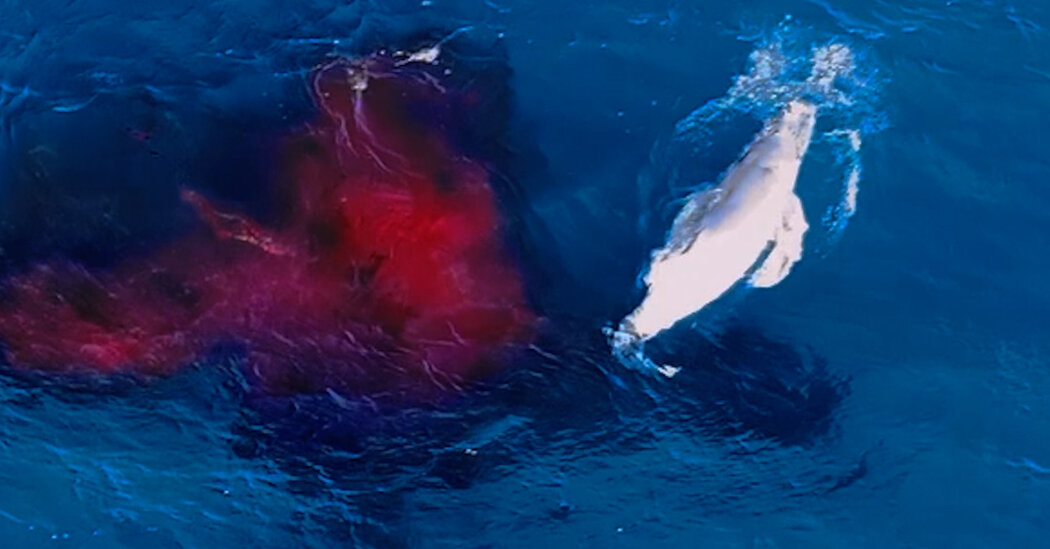
A drone has captured a humpback whale giving birth to a calf in waters off Australia’s east coast, in what may be a world first.
Alexander Forrest, 20, a wildlife photographer, was standing on a coastal point in northern New South Wales to capture the annual whale migration along a stretch of ocean known as the “humpback highway.”
Mr. Forrest said he noticed one “unusually slow” whale swimming along. Sensing something was happening, he flew his drone toward the whale and hit record.
The footage he captured shows a vivid red plume of blood in the water above the adult whale, before a pale gray calf emerges with a flick of its tail. The calf pokes its head above the water as if to take its first breath. The pair are then seen swimming together in the clear waters.
Initially, Mr. Forrest thought the blood indicated that a predator had attacked the whale. But soon he realized what he was seeing.
“It was just amazing. I didn’t know what to think. I was just putting all the pieces together in my mind like, ‘What have I just witnessed?’” he said. “I knew it was rare.”
Mr. Forrest said he called the Organisation for the Rescue and Research of Cetaceans (ORRCA) to let them know what he had seen and ask them to help monitor the newborn and its mother.
The video is thought to show the fourth complete humpback whale birth ever recorded on film, and the first ever captured by drone, ORRCA said later in a post on social media.
While previous footage has captured humpback whale births, none has captured an entire birth, and the moments afterward, from a drone, according to Vanessa Pirotta, a whale scientist at Macquarie University.
The video will add vital information to the small trove of what scientists know about how the animals give birth, she added.
“This is a secret moment of a whale that’s never been seen like this from the drone,” she said.
Each year during the southern hemisphere’s winter months, about 50,000 humpback whales migrate along Australia’s east coast from their southern feeding ground to the warmer northern waters off Queensland — where they breed and give birth, and then swim back in spring. This 9,941-mile journey is one of the longest migrations of any animal.
Beachgoers can often spot the whales as they make their journeys up and down the coast.
The animals are considered one of Australia’s great conservation success stories, said Ms. Pirotta. Humpback whales were hunted almost to the point of extinction 60 years ago.
But in recent decades, and thanks to the efforts of conservationists, their numbers have bounced back.