dailynewsnblog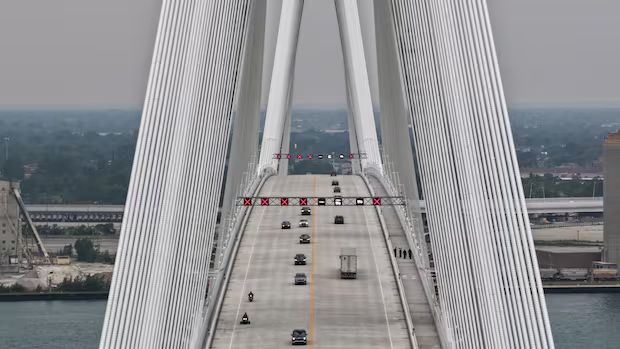

Listen to this article
Estimated 4 minutes
The audio version of this article is generated by AI-based technology. Mispronunciations can occur. We are working with our partners to continually review and improve the results.
Opposition members of the House of Commons used a meeting of the Standing Committee on Government Operations and Estimates Wednesday to call for more transparency on the deal to open the Gordie Howe International Bridge.
But a Liberal majority voted to adjourn the meeting without voting on a motion calling for a study of the deal.
Conservative MP Dan Albas’ motion called for a study lasting at least five meetings, with testimony from Infrastructure Minister Gregor Robertson, Canada-U.S. Trade Minister Dominic LeBlanc and Finance Minister Francois Philippe Champagne.
It would’ve also ordered the department of housing, communities and infrastructure to produce all drafts of the proposed agreement in principle within two weeks of the adoption of the motion.
Windsor West Conservative MP Harb Gill told the committee the deal appears to be part of a series of concessions made by the Canadian government to the U.S., including the dropping of the digital services tax and the so-called Netflix tax and the withdrawal of retaliatory tariffs.
“So tell us, what did Trump originally want?” Gill asked.
‘We will give credit where it’s due’
“We know he talked about half ownership. Canada didn’t give him that. That is great. We will give credit where it’s due. So what else did he want? How much revenue? For how long? What kind of control was he looking for over the bridge?”
The meeting occurred as the Liberal government continues to face questions about its revenue-sharing agreement with the U.S.
The proposed agreement in principle to open the bridge, which opened to motorists on Monday, says Canada will share half of net revenues with the U.S. for the next 15 years.
Prime Minister Mark Carney said on previous occasions that the tolls would not be split with the United States until after Canada’s debt to build the bridge is paid back.

The first vehicles crossed the Gordie Howe International Bridge between Windsor, Ont., and Detroit on Monday, more than 20 years after the planning started and following delays and uncertainty caused by a frayed Canada-U.S. relationship.
Speaking to reporters in Charlottetown last week, Carney acknowledged he was not as clear as he could have been when explaining the nature of the deal in recent weeks.
Conservative MP Kelly McCauley said on social media last week that he would convene a committee meeting to allow MPs “to get to the bottom of the matter.”
Some Liberal members of the committee said they opposed Albas’ motion because it did not address the bridge’s positive impacts.
And many spoke at length about the benefits of the bridge to the Canadian economy and to international trade – prompting multiple point of order calls from opposition members complaining that the members weren’t addressing the motion.
Conservative MP Melissa Lantsman subsequently tabled an amendment to the motion calling for the proposed study to also include testimony relating to the bridge’s benefits.
“I’m going to amend the motion to give the Liberals everything that they wanted and that they’ve asked for here in this committee,” she said.
MP ‘never negotiated publicly’
Liberal members of the committee also insisted that the deals related to the bridge opening were already public, but Lantsman asked a detailed series of questions that she said remain unanswered.
“What’s included in the agreement refers to, quote, ‘all incurred operating costs of the bridge,’ she said, when providing examples.
“The problem is, the agreement never defines this, whether it’s public or not. … Reporters pushed officials on this. And the closest thing to a definition we got was the prime minister’s office describing things like toll booths or maintenance or snow removal. But we don’t actually know. And that’s exactly why we’ve brought this committee forward.”
Liberal MP Marie-France Lalonde said, as a businesswoman, she never negotiated publicly.
“I would negotiate, and then the agreement would become public,” she said in French.