dailynewsnblog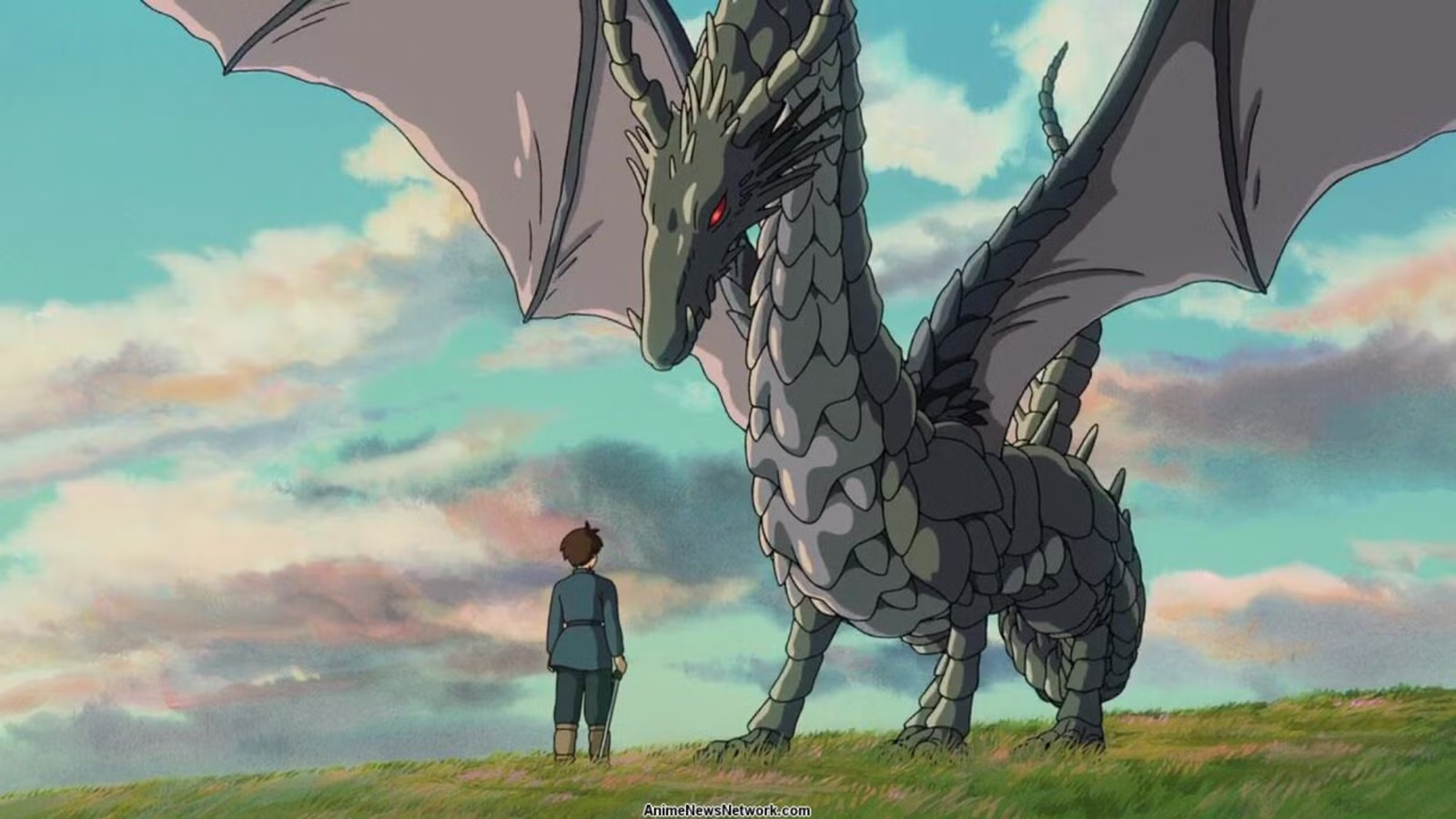
Studio Ghibli has weathered surprisingly few genuine critical disappointments across its four-decade history. It’s a studio best known for anime masterpieces, which is why calling a Studio Ghibli movie “bad” almost feels like a contradiction. While it does have a few “lesser” films in its catalog, from Earwig and the Witch to Ocean Waves (a sleeper hit if you ask me), no Ghibli film has been more persistently labeled the studio’s weakest than Tales from Earthsea, which celebrates its 20th anniversary next month with a North American theatrical release.
The film marks the feature directorial debut of Goro Miyazaki, son of Studio Ghibli co-founder Hayao Miyazaki, and adapts Ursula K. Le Guin’s beloved Earthsea novels into a sprawling fantasy adventure, drawing from multiple books in the acclaimed series rather than adapting a single novel. It was an ambitious assignment for any filmmaker, but especially for someone making his first feature — a role he was thrust into after serving as a consultant.
Next month’s re-release arrives as part of a celebration of the film’s original 2006 debut, giving audiences another chance to revisit one of the most divisive films Studio Ghibli has ever produced. While Tales from Earthsea has never enjoyed the same reputation as classics like Spirited Away, Princess Mononoke, or Howl’s Moving Castle, its return offers an opportunity to reassess a movie whose legacy has only become more complicated with time.
20 years ago, critics pointed to the film’s uneven pacing, fragmented storytelling, and difficulty balancing ideas pulled from multiple Earthsea novels into a single narrative. Fans expecting another instant Ghibli classic instead found a story that felt caught between honoring Le Guin’s rich fantasy world and carving out its own identity. For example, the film borrows the central journey of The Farthest Shore while weaving in major characters and themes from Tehanu, compressing stories that were never meant to unfold together. The result is a narrative that often rushes through character development while struggling to give its philosophical ideas room to breathe.
Hayao Miyazaki had reportedly expressed reservations about his son directing the project before ultimately stepping away to allow him to make the film on his own. That father-son dynamic inevitably became part of the conversation surrounding Tales from Earthsea, sometimes overshadowing the work itself.

On rankings of Studio Ghibli’s catalog, Tales from Earthsea almost always lands at or near the bottom of the list. For a studio with one of the strongest filmographies in animation history, “worst Ghibli movie” is hardly the harshest label imaginable, but it’s a label the film has struggled to shake for two decades, even in the wake of middling releases like From Up on Poppy Hill and the aforementioned Earwig — both also directed by Goro.
Yet time has also been kinder to Earthsea than its initial reception suggested. Even many viewers who still consider it one of Ghibli’s lesser efforts acknowledge the remarkable craftsmanship on display. The painted backgrounds remain breathtaking, reflecting the strong visual sensibilities that first earned Goro Miyazaki the directing job through his storyboards in the first place. Joe Hisaishi’s score lends emotional weight throughout the film, uplifting scenes with sweeping orchestral strings, gentle piano melodies, and warm brass fanfares. Several sequences capture the quiet melancholy that has long defined the studio’s best fantasy films. Its themes of mortality, identity, and humanity’s relationship with nature fit comfortably alongside the ideas explored throughout Ghibli’s broader body of work, even if the story itself never fully comes together.

A younger generation of anime fans has also discovered the film through streaming on HBO Max, where expectations are often different than they were in 2006. Removed from the impossible burden of following Howl’s Moving Castle and living up to the Ghibli name in real time, Tales from Earthsea is increasingly viewed less as a disaster and more as an ambitious, if deeply flawed, fantasy from one of — if not the — greatest animation studios on the planet.
That doesn’t make it a hidden masterpiece. The criticisms that greeted it two decades ago remain valid, and it still stands as one of Studio Ghibli’s least successful features. But anniversaries aren’t just for celebrating perfection — they’re also a chance to revisit the works that reveal a studio’s growing pains and creative risks, which Goro Miyazaki knows all too well. Goro’s later film, Earwig and the Witch, ambitiously used leveraged 3D animation for the first time in Ghibli’s four decades of production, but the film is often lauded as worse even than Tales from Earthsea.
Despite its limited mass appeal, Hayao Miyazaki himself still considers it worthy of praise. In Goro’s blog dated July 3, 2006, he relays a heartfelt message from his father during the launch party, saying, “It was made honestly, so it was good.” Goro admits his father’s words brought him to tears. For all its inefficiencies, Tales from Earthsea still offers that spark of honesty, an ambitious experience that’s just as wondrously fantastical as Ghibli’s other projects.
For longtime Ghibli fans, the theatrical return is an opportunity to see one of the studio’s most debated films on the big screen. And for newcomers, it’s a reminder that even animation’s most celebrated filmmakers occasionally stumble. 20 years later, Tales from Earthsea reminds us that when a studio’s weakest film is still this visually enchanting and passionately debated, then you’ve built one of the greatest legacies in animation.
Tales from Earthsea will be re-released in theaters on August 8 and 10 and is available to stream on HBO Max.