dailynewsnblog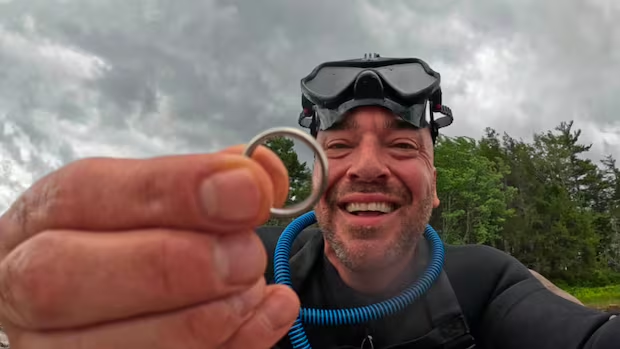

Listen to this article
Estimated 4 minutes
The audio version of this article is generated by AI-based technology. Mispronunciations can occur. We are working with our partners to continually review and improve the results.
When Louisiana’s Jeff Daglaris lost his wedding ring at the bottom of a Nova Scotia lake, he turned to the internet for advice and the answer was simple: call Nate McLagan.
McLagan, a weapons tech with the Royal Canadian Navy, has been metal detecting for about two decades. This year he’s set a goal to find missing items for 25 people and word is getting out.
He says he’s received a lot of requests about lost wedding rings and enjoys being able to complete those types of assignments.
“As soon as I give the ring back, they actually fall down on the ground. Like, so many tears and tears of joy … it’s overwhelming,” he said in an interview.
Daglaris lost his ring while on a course in Nova Scotia in June. He and his friends were kayaking around an island in Kejimkujik National Park, about 130 kilometres west of McLagan’s home in Eastern Passage.
As they were climbing rocks and jumping into the water, Daglaris’ 14-karat gold wedding band slipped off his finger and into the lake.
“I was a little, honestly, disappointed in myself because right before I got in the water, I was like, ‘Maybe I should take this off and put it in our dry bag,'” Daglaris said in an interview.

The ring had barely left his finger since he married his wife, Taylor, three-and-a-half years ago.
He and his friends tried diving for it, but the water was too dark and they had no equipment. Daglaris tagged the location on his phone, took pictures and searched the internet for answers. That’s when he found McLagan and sent him a message.
The next weekend, armed with his metal detector, dive gear and some photos from the lake, McLagan made the two-hour drive and kayaked out to the island.
“And right as I was at the Halifax airport about to get on the plane, he sent me a picture with my ring,” Daglaris said.
McLagan said it took only a few minutes to find the band, which was shining exactly where Daglaris said it would be.
He said he was all smiles when he brought it to the surface and let Daglaris know he had found it.
“He was like, ‘Oh my God.’ He can’t believe that he got his ring back and just the timing of it too, like for him to find me and then him leaving. I found it the same day. Everybody was in awe, almost,” McLagan said.
McLagan says he got into the diving aspect of metal detecting about three years ago. He had never gone out looking for a specific object until last year when he saw a Facebook post that somebody had lost a wedding band in Porters Lake, N.S., which he recovered.
McLagan said he treats his recovery missions as a hobby and volunteers his time to help people who contact him. If he has to go out of his way, he said he will accept some money, mostly to cover expenses like gas.

McLagan found 13 lost objects last year, and wants to hit 25 this season.
“If people reach out to me and say they lost a ring somewhere on some beach that’s like two-and-a-half-hours away, well at some point I’m going to make my way to that beach,” he said. “If I find it … I’ll get back to them.”
McLagan usually looks for personal items like cellphones, keys and rings, but has amassed a collection of other items and he tries to find their owners online.
He’s discovered everything from artillery fuse primers to a silver pin given to Canadian veterans following the First World War.
The pin had a number on the back, and McLagan contacted the Royal Canadian Legion about it, but it couldn’t be traced.
MORE TOP STORIES