dailynewsnblog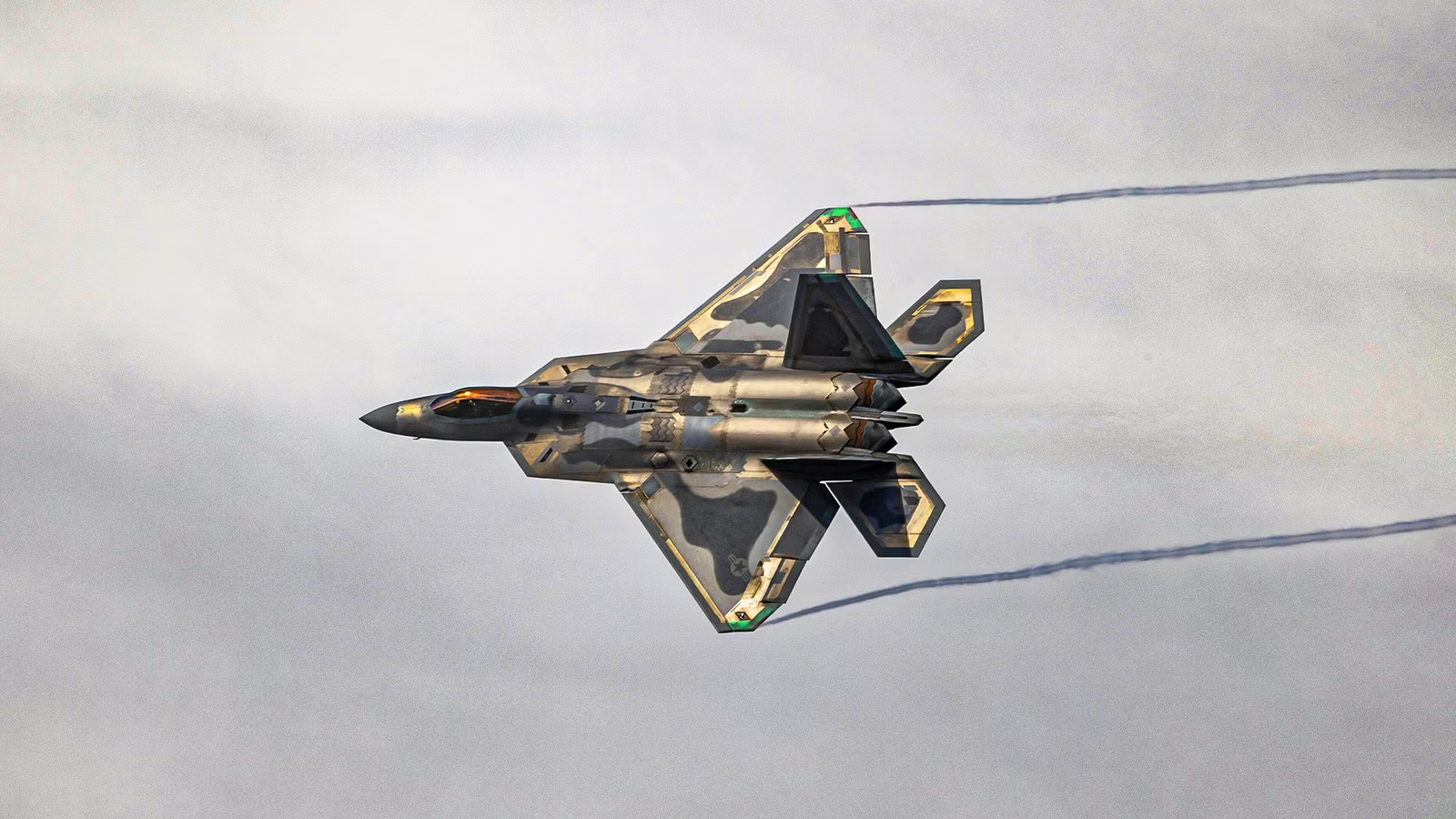
While most older fourth-generation fighter jets are able to fly at supersonic speeds, they have to engage their afterburners, which reduces their range. Not only do afterburners use an incredible amount of limited fuel, but they also place enormous thermal stress on the engines, accelerating wear and increasing maintenance requirements.
Before the F-22 Raptor, fighter jets could mostly go supersonic using the afterburners for a ‘kick’ during take-off, during certain maneuvers, interceptions, prolonged supersonic dashes, and other somewhat limited use cases. The F-22 did not set out to be the world’s fastest fighter jet.
Rather, it was designed to be the first fighter jet capable of sustaining high Mach numbers economically without engaging afterburners. That is, the F-22 was designed to be the first high-performance supercruiser, being designed around its supercruise and stealth. The fighter jet first entered service around 20 years ago, and, powered by its pair of powerful F119 engines, it is believed to remain the world’s most efficient supercruiser.
The Dual-Engine Competition

While the Air Force competition for the aircraft is well remembered, pitching the Northrop YF-23 against the Lockheed Martin YF-22, less is remembered that it was a dual competition for both the engine and the aircraft. In most competitions, the bidding aerospace aircraft manufacturer submits its proposed aircraft powered by its engine of choice, but not this program.
Both the YF-23 and YF-22 were required to have one demonstrator powered by the Pratt & Whitney YF119 and the General Electric YF120, so that the Air Force could independently assess the performance of each engine. The GE YF120 was considered more advanced and futuristic, being an early attempt to make an adaptive cycle engine.
However, the YF119 also provided next-generation performance while relying on more established technologies and supply chains, and was considered less risky. The Air Force selected the YF119 as the safer option, and one that was still far ahead of any other engine of its time. Pratt & Whitney’s parent company, RTX, says of the engines it provides for the Raptor that:
“Two Pratt & Whitney F119 engines power the U.S Air Force’s F-22 Raptor. Supercruise, the ability to operate supersonically without afterburning, gives the F-22 exceptional combat performance without compromising mission range.”
The F-119’s Performance

The Pratt & Whitney F119 is widely considered the most important Western fighter engine developed since the F100 in the 1970s. Much of the stealth, thermal management, and supercruise capabilities of the Raptor are attributable in part to the engine. It was the world’s first operational engine that truly made sustained supercruise practical while also providing exceptional thrust, low observability, and reliability.
It had been considered that these factors were mutually exclusive, but the F119 managed to chart a balanced way through them. The advancements were possible due to improvements in computational fluid dynamics, blade aerodynamics, blisk construction, and more durable materials. The engine had fewer stages compared with previous engines, and its new nozzles allowed for two-dimensional thrust vectoring with the nozzles moving by around 20 degrees.
Besides the sidelined GE YF120, its closest peers were probably the General Electric F110 and the Eurofighter’s EJ200, for which Rolls-Royce was the lead contractor. The Eurofighter Typhoon, powered by two EJ200 engines, is widely considered the world’s second best supercruiser, being able to maintain speeds of Mach 1.3 on dry thrust. The newer Su-57 and J-20 remain somewhat unknown quantities.
How Much Fuel Does An F-22 Carry?

One of the key design differences between Western and Russian/Chinese fighter jets is that Western jets are built around the assumption of in-air refueling. Russian and Chinese in-air refuel assets and capabilities are comparatively meager, especially when it comes to fighter jets. This means the Russian Flanker series and Chinese J-20s are designed with large internal fuel volumes. The F-22 was designed with aerial refueling in mind, but it also comes with a snag.
The older F-15 could not only count on refueling, but also carry drop tanks to extend its range. Conventional drop tanks compromise stealth, and so the F-22 has flown without them (except for flights like ferry missions). The Air Force is working to develop stealthy drop tanks to boost its combat range, but this comes two decades after it entered service.
The Raptor was built to carry around 18,000 lbs (8,200 kg) of fuel, which is one of the largest internal fuel loads ever developed for a fighter aircraft. This is similar to the F-35A, but more than the larger F-15EX (13,455 lbs or 6,100 kg) and far more than the F-16 Block 50 (7,000 lbs or 3,175 kg)
Adding the two new drop tanks (estimated at 600 gallons or 3,600 liters each) is estimated to boost a capacity of around 26,000 lbs (11,800 kg) or a 44% increase in fuel carried. With that being said, there will be a weight and drag penalty, so it doesn’t neatly correspond to a 44% increase in combat radius.
The F-22’s Supercruise

Afterburners are an additional combustion stage located behind the engine’s turbine where fuel is “dumped” into the hot exhaust. This adds around 30–70% more thrust, depending on the engine, but it also typically consumes fuel around three to five times faster than using dry thrust. It produces a huge infrared signature, dramatically compromising an aircraft’s stealth profile while punishingly reducing its combat range.
Supercruise is when a fighter jet can fly faster than the speed of sound without the afterburners. This is challenging and requires very powerful engines with a high thrust-to-weight ratio, low aerodynamic drag, an efficient supersonic airframe design, and more. The Raptor’s stealthy shape and carrying munitions internally greatly assist here.
US Air Force fighter jet combat ranges (per USAF) | Nautical miles |
|---|---|
F-16 Fighting Falcon | 400 |
F-22 Raptor | 590 |
F-35A Lightning II | 670 |
F-15E/EX | 690 |
Collaborative Combat Aircraft | 700+ (planned) |
F-47 | 1,000+ (planned) |
As an approximate illustration, compared with a Raptor flying with no afterburner, a Raptor at supercruise (around Mach 1.3) may burn around 1.2 to 1.5 times the amount of fuel. With afterburners, it may burn three to five times more fuel. Interestingly, the F-35 follows a different design philosophy and mostly lacks the ability to supercruise, although it may be able to achieve it for limited periods at around Mach 1.2 under certain conditions.
Altitude Matters At Supercruise

As a rough guide, a Raptor may consume around 3,000 to 5,000 lbs of fuel per hour while cruising at Mach 0.8-0.9. Entering low supercruise of around Mach 1.2, it may use 5,000 to 7,000 lbs (1,360 to 2,270 kg) of fuel per hour. At Mach 1.5, the fuel consumption may be around 7,000 to 10,000 lbs (2,270 to 4,540 kg) per hour, and at its up-end supercruise (Mach 1.7+), it may be around 10,000 to 14,000 lbs (4,540 to 6,350 kg).
It should be noted that the exact fuel consumption rates of the F-22 at supercruise (and other phases of flight) are classified. They are also highly contingent on a range of factors like altitude, maneuvering, engine temperature, and payload/fuel remaining on board. The optimal altitudes for supercruising are around 35,000 to 50,000+ feet (10,700 to 15,000+ meters).
At lower altitudes, the aircraft experiences denser air and increased drag, requiring higher thrust and higher fuel burn to reach the same Mach number. Supercruise may be possible at 20,000 feet (6,000 meters), but it is less efficient and less common operationally.
At very high altitudes (over 50,000 feet), the aircraft enjoys further reductions in drag, but the thinner air also means engine thrust decreases. Here the aircraft also need less thrust to maintain speed. The difference is so significant that a Raptor may consume less fuel per mile traveled while flying at Mach 1.5 at an altitude of 50,000 feet (15,000 meters) compared with Mach 1.2 at 20,000 feet (6,000 meters).
Enter The Sixth-Generation F-47

From what is publicly known about the next-generation F-47 currently being developed by Boeing to replace the F-22, it will take supercruising to the next level. Like the F-22, the F-47 has a separate engine competition with the GE Aerospace (XA102) and Pratt & Whitney (XA103) adaptive cycle engines as part of the Next Generation Adaptive Propulsion program.
These will not only increase the aircraft’s fuel efficiency, but also greatly aid in thermal management, which is one of the leading design priorities of next-generation fighter jets. The USAF has said the F-47 will have a combat radius of 1,000+ nautical miles and a top speed of Mach 2+. This is a similar speed to the Raptor, which the Air Force also lists on its infographic as Mach 2+.
However, the range is impressive and dramatically more than the F-22’s listed combat radius of 590 nautical miles. Little is known about the F-47’s intended performance, although it is widely accepted that improved supercruise performance is a given. The bigger question for analysts is how fast it will be able to sustain supercruise.
Analysts have speculated that the F-47 could achieve a higher sustained supercruise speed than the F-22, potentially approaching Mach 1.8 or beyond (up to or beyond Mach 2), although no official figure has been released. Overall, the F-47 may or may not have a greater max speed than the Raptor, but it will have greater propulsion efficiency, thermal management, and high-speed persistence, making those high Mach numbers more practical.