dailynewsnblog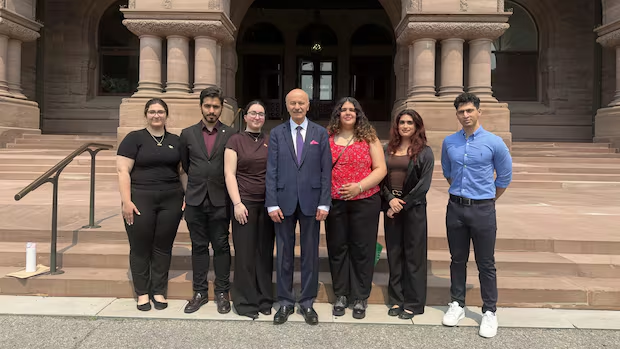
Iranian students across Ontario are calling on the province to provide international students with greater financial support as the ongoing U.S. and Israel-Iran conflict raises concerns about their academic future in Canada.
Speaking at Queen’s Park Monday, a coalition of Iranian student associations from Toronto Metropolitan University (TMU), University of Toronto, York University and Queen’s University said international students have been facing significant financial hardships since the outbreak of the war and its recent escalation, which saw a precarious ceasefire break between the U.S. and Iran this month.
Fata Niaizi, an international fourth-year student studying computer science at the University of Toronto, said the threat of another internet blackout — like the one earlier this year that lasted months — risks his ability to keep studying in Canada.
“When the internet goes down, so does any way for our families to send us money,” he said.
Iran’s tanking currency, the rial, also means his family is facing immense financial hardship in supporting his education abroad.
“When I arrived in Canada in 2022, one Canadian dollar was worth 22,000 tomans. Today it’s worth over 135,000 tomans,” Niaizi said.
Toman is a superunit of the rial and the informal currency Iranians often use in daily life.
Niaizi is part of the student coalition asking the province to expand emergency financial assistance programs for Iranian students, implement temporary flexibility measures such as reduced tuition, and work with the federal government to help students meet living costs, such as through expanded work permits.
The students, who were joined on stage by former MPP for Richmond Hill, Reza Moridi, said they plan to present their petition to the Ontario Legislative Assembly in the fall.

The U.S. military carried out another round of strikes on Iran, hours after U.S. President Donald Trump said that recent Iranian attacks on ships in the Strait of Hormuz signalled the end of the fragile ceasefire.
Institutions ‘disconnected’ from realities students face, expert says
Niazi said that if he can’t get enough money from his family to pay a registration deposit, he risks getting de-enrolled from his courses in the coming school year. That could place his study permit at risk because it is tied to enrolment conditions, as outlined on the Government of Canada website.
Sara Hormozinejad, a researcher at TMU’s Global Migration Institute who studies Iranian migration, said the circumstances students face are “not just ordinary financial hardship.”
On top of the difficult situation students are facing back home, they have to also figure out the pathways to find out what services they can or can’t get to help fund their studies, Hormozinejad said.
“Education is very important for Iranian families. They actually save to send their children to Canada to follow that dream,” she said.
“Families, parents back home were saving, were planning for the education of their children. It’s not like their children came here without that support … but the money that they saved lost value, drastically.”

In an emailed statement, Dayna Smockum, spokesperson for Ontario’s Ministry of Colleges and Universities, said students should reach out to their “respective institutions for accommodations and further support,” and the ministry encourages institutions to be flexible with “students impacted by global conflict.”
“Our government commends the students’ dedication to continuing their studies during these difficult times,” she said.
‘I had to go to food banks to just cover my groceries’: student
When the U.S. and Israel-Iran war broke out, Amirrezza Foroughifar, a fourth-year student at TMU, couldn’t reach his family for almost 90 days.
Not being able to reach them also meant he couldn’t receive the financial assistance he needed for his studies.
“I was just left in the dark. I was trying to apply for financial aid, emergency scholarships, things like that,” said Foroughifar, who is also the vice-president of TMU’s Iranian Student Association.
“I had to go to food banks to just cover my groceries and my basic food needs,” he said.
When asked whether the Canadian government is monitoring the situation Iranian international students face, Briannah Dale, spokesperson for Immigration, Refugees and Citizenship Canada, said education is the responsibility of provincial and territorial governments.
Hormozinejad said all levels of government are responsible.
“The federal government is involved because they are issuing visas. Institutions [and] universities are involved because they are the ones that are giving acceptance letters for students to come over to Canada to study. They’re saying that they want you, we want you to come and study in our universities,” she said.
CBC News reached out to the universities the students in the coalition are from for comment. All of their respective statements said they are committed to supporting Iranian students and encouraged individual students to reach out to the university to get connected with appropriate financial support.